
Livraison le jour même ou le lendemain

Qualité garantie

Débloquez vos offres de bienvenue: Livraison GRATUITE | Jusqu'à -80 % | 30 jours d'essai gratuits à JoyPlus
Téléchargez l'application
Carrying bags of compost, camping gear, the weekly shop or your pet’s belongings quickly becomes a chore without the right equipment. Yet not all models sold as foldable all-terrain transport trolleys are created equal. Stated capacity, wheel quality and folding mechanism can vary enormously.
Before you opt for a foldable wagon or a collapsible trolley on wheels, here are the pitfalls to avoid and the criteria to scrutinise.
A large bag may boast a capacity of 300 litres while only supporting a limited weight. Conversely, a more compact model can often carry more weight. Volume refers to the space available, whereas the maximum load indicates the weight the trolley can actually transport.
For tools, bottles or logs, always check the load capacity, not just the litre capacity. Poorly distributed weight can also affect stability, especially on a slope or uneven ground.
A garden or camping trolley needs to roll over grass, gravel, loose soil and slightly bumpy paths. The mere mention of “all-terrain” guarantees nothing on its own.
Look in particular at:
Narrow wheels are likely to sink into sand or waterlogged lawn. Wider tyres make movement easier, but sometimes take up more space once the trolley is stored away.
A trolley can be foldable without being easy to store. Measure the space available in your boot, garage, cellar or garden shed. Also check the handling of the frame, handle and wheels.
A trolley with a telescopic handle, or one with a quick-release handle, can greatly simplify use, provided the mechanism locks properly. The weight of the trolley itself also deserves your attention if you have to lift it out of a car or carry it a short distance.
For occasional use, a capacity of 100 to 150 litres is generally sufficient for shopping, beach accessories or leisure gear. Those who regularly transport tools, bags of pellets or group equipment would be better off looking at a large-capacity trolley.
The load should be spread across the base, without concentrating heavy items on one side. Always respect the limit stated on the product page. When several figures appear in a commercial listing, take the lowest safety value and consult the technical specification before ordering.
An alloy steel or carbon steel frame provides the rigidity needed to carry heavy loads. Oxford 600D fabric is commonly used for its good mechanical strength and relatively simple maintenance. A PE coating can offer extra protection against splashes, without making the fabric completely waterproof.
After a trip in the rain, let the fabric dry completely before folding the trolley. This habit helps prevent unpleasant odours, damp marks and premature wear on the stitching.
A trolley with brakes proves especially useful on a sloping driveway, on a campsite or on uneven ground. Brakes are used to immobilise the trolley when stationary; they do not replace the need for careful handling on a slope.
To transport a pet, use suitable, secure equipment. A foldable wagon is not automatically designed to serve as a pet carrier. The animal must be properly secured or supervised, and the load must remain perfectly stable.
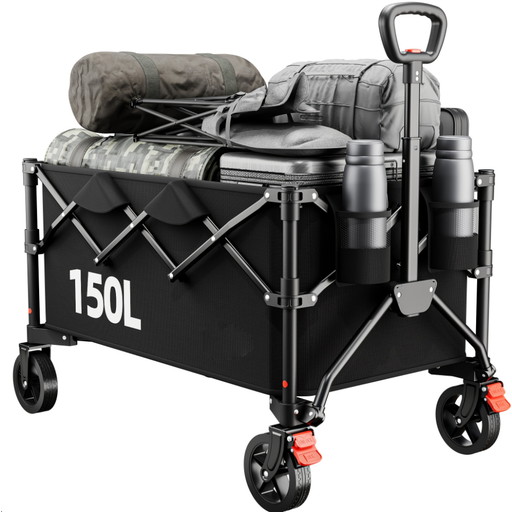
Why this choice suits this profile: Its 150-litre format is ideal for shopping, occasional gardening and outdoor trips. Its four-sided folding makes storage easy, even in a small space.
The 120 kg load capacity, alloy steel frame and all-terrain wheels with brakes are clearly stated. The removable wheels and bag also make cleaning easier.
Quick-release handle, 150-litre capacity, braked wheels and easy maintenance thanks to removable components.
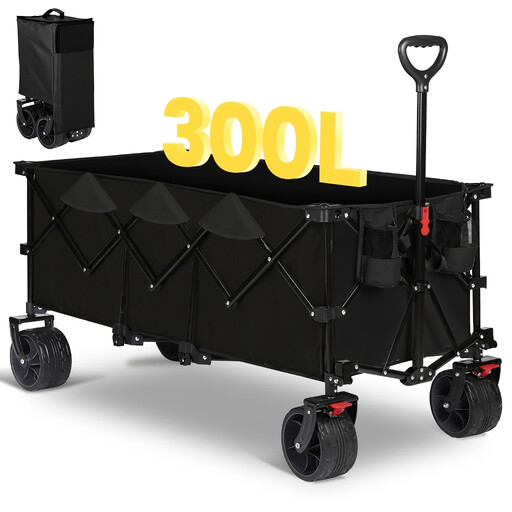
Why this choice suits this profile: This robust transport trolley is aimed at those who prioritise a large volume for camping, gardening or carrying bulky equipment.
The product page states a certified maximum load of 200 kg and a volume of 300 litres. The wide 17.8 cm tyres and brakes compensate for the limitations of narrow wheels on uneven ground.
Stated volume of 300 litres, four-way folding mechanism, no assembly required and two cup holders.
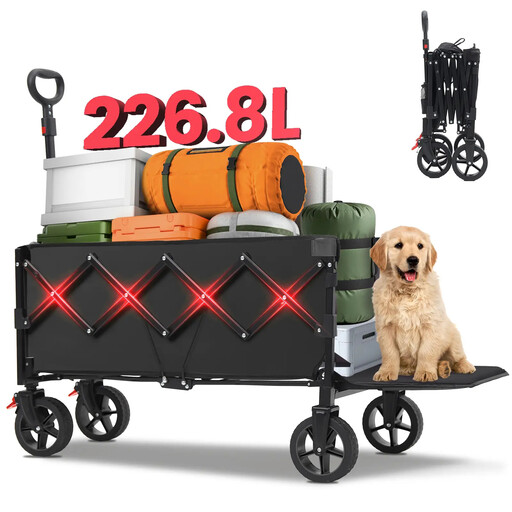
Why this choice suits this profile: Its handle that doesn’t touch the ground can prove handy for regularly transporting sports gear, shopping, garden equipment or a supervised pet.
The detailed product page mentions a safety limit of 100 kg, despite different capacity figures in the commercial title. So it’s this 100 kg value you should keep in mind before use.
Carbon steel frame, Oxford fabric, braked wheels and folded dimensions of 50.8 × 45 × 19.6 cm, according to the supplied product sheet.
We have put together a comprehensive, real-time updated selection of products that meet these strict criteria, as well as European safety regulations.
To keep a foldable 4-wheel trolley in good condition, a few simple habits are enough:
A trolley used near the sea should be rinsed and then dried to limit salt deposits on the metal parts and wheels.
It all depends on the model. The products featured here state 200 kg, 120 kg and a safety limit of 100 kg for the third model, according to its detailed product sheet. Always respect the value given in the usage instructions and distribute the load evenly.
It can serve as a beach trolley if its wheels are wide enough and the weight carried remains reasonable. Loose sand requires more effort than a firm path. After each use, rinse the wheels and let the fabric dry before storing the trolley.
The lifespan depends on the load carried, frequency of use, humidity and the quality of maintenance. Respecting the maximum load, drying the fabric and cleaning the wheels all help to prevent premature wear. The folding mechanisms and brakes should be checked regularly, especially with heavy use.