
Livraison le jour même ou le lendemain

Qualité garantie

Débloquez vos offres de bienvenue: Livraison GRATUITE | Jusqu'à -80 % | 30 jours d'essai gratuits à JoyPlus
Téléchargez l'application
At home, in a nursery or at preschool, foam motor skills blocks for children let you create an evolving play course without installing a permanent structure. However, some purchases can quickly disappoint: tricky-to-clean covers, blocks that slide on the floor, or dimensions that don't suit the room.
Before choosing colours and shapes, it's worth checking a few practical features. Here are the main pitfalls to avoid, along with a selection of products suited to different needs.
A block designed for climbing, crawling or stepping over obstacles needs to hold its shape well. Very lightweight foam may feel comfortable when you first unpack it, but can become unstable when a child puts weight on it. The product description should specify the type of foam and, if possible, its density or ability to regain its shape.
XXL foam building blocks are handy for creating visible structures that are easy to step over, but they also need plenty of clear space. Check their dimensions once unfolded, not just the size of the packaging.
A baby motor skills course behaves differently on tiles, wooden flooring or laminate. A non-slip base on the main pieces, sturdy fastenings and a sufficiently wide structure all help limit movement during play. These features obviously don't replace adult supervision, especially with younger children.
Children play on the floor, and the modules quickly get exposed to crumbs, spills or dust. Washable foam blocks with removable covers make daily cleaning much easier. Also check for concealed zips, how easy the cover is to remove, and the manufacturer's washing instructions.
For an indoor climbing toy intended for children, choose high-density, resilient foam covered with a soft but sturdy fabric. Surfaces should feel pleasant to the touch and have no accessible sharp edges.
Velcro-style fastenings can hold several modules together. They're particularly useful for forming a tunnel, a small ramp or a foam play area. However, you should check their condition regularly and set the whole thing up on a flat surface.
The markings EN71-1, EN71-2 and EN71-3 refer respectively to European requirements for certain mechanical and physical properties, flammability, and the migration of certain elements. The product description may also refer to the European Toy Safety Directive.
A claim like "EN71-certified blocks" should be verified in the description, any available documents and the information provided by the seller. It doesn't replace the need to follow the recommended age, any maximum weight limit and usage instructions. For a nursery or classroom, also ask for the compliance documents required by your setting.
A set delivered vacuum-packed may need 24 to 48 hours to regain its full volume. Avoid using it straight away if the foam hasn't yet returned to shape. In a small home, compare the dimensions once the modules are assembled and check whether you can store them against a wall or in a cupboard.
A climbing toy for toddlers should be chosen based on the child's abilities, not just their age. The first few uses should take place on a clear floor, with no furniture nearby or hard objects in the fall zone.
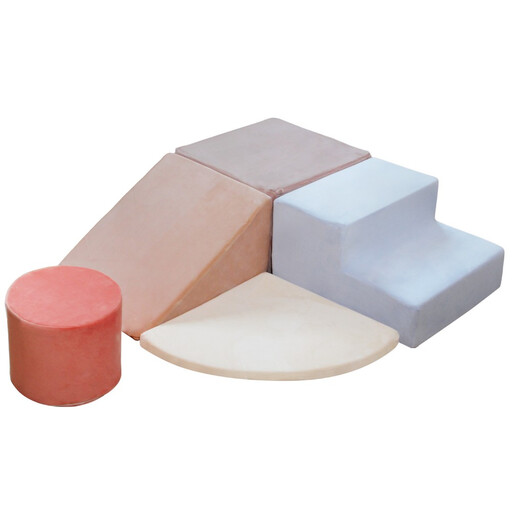
Why this choice suits this profile: This five-piece set is a great entry point for creating a soft play course at home, with different configurations for climbing, crawling, sliding and building.
The description mentions a textured non-slip base on certain pieces, Velcro-style fastenings and a removable, machine-washable cover.
High-density foam and a soft fabric cover, with stated compliance to EN71-1, EN71-2 and EN71-3 standards, as well as Directive 2009/48/EC.
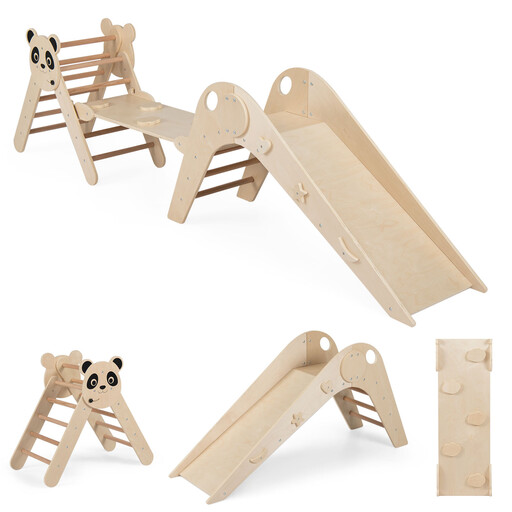
Why this choice suits this profile: This wooden model is aimed at families looking for a more complete structure, with a climbing triangle, a sliding board and a balance bridge.
The foldable design reduces its footprint when stored. The description also mentions non-slip handles, smooth edges and side rails.
Beech wood and plywood, a foldable structure, a stated load capacity of up to 50 kg per component and suitable from age 3.
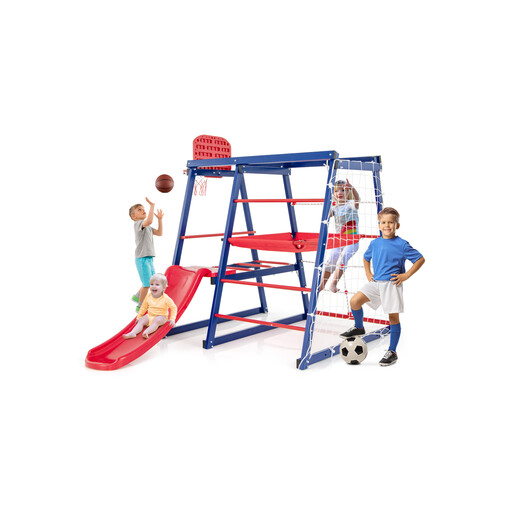
Why this choice suits this profile: In a spacious playroom or for regular family use, this structure offers several activities for children aged 3 to 7.
Its rust-resistant metal frame and reinforced connections meet the needs of a fixed piece of equipment, provided the assembly instructions are followed carefully.
Seven stated functions, including a slide, a net, a ladder, a rope and a basketball hoop. Dimensions given: 150 × 142 × 146 cm.
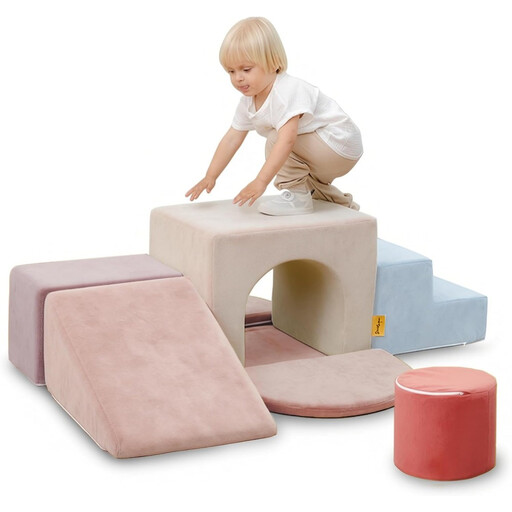
Why this choice suits this profile: The seven modules offer more possibilities for creating obstacles, tunnels and small structures in a dedicated room.
The removable, machine-washable covers make rotation and cleaning simple. Concealed zips limit access to the fastenings during play.
A seven-piece set in high-density polyurethane foam, with a non-slip base, Velcro-style fastenings and stated compliance with EN71 requirements.
We've selected a full, real-time updated list of products that meet these selection criteria and European safety requirements.
It depends on the height of the modules, the stability of the whole set and the manufacturer's recommendations. For a baby who is just starting to move around, choose low shapes and floor-based activities. Taller structures or those with a ladder are generally intended for older children.
The lifespan varies depending on how often it's used, the weight it supports, the quality of the foam and how well the cover is maintained. Regular inspection helps you spot permanent deformation, a seam coming undone or a base that no longer grips the floor properly.
They can be suitable if their recommended age, dimensions, materials and compliance documents meet the requirements of the setting. For motor skills modules in a nursery, also plan a cleaning routine, storage space and frequent checks on the condition of the pieces.