
Livraison le jour même ou le lendemain

Qualité garantie

Débloquez vos offres de bienvenue: Livraison GRATUITE | Jusqu'à -80 % | 30 jours d'essai gratuits à JoyPlus
Téléchargez l'application
A baby activity course can transform a living room, nursery or reception classroom into a real exploration zone. But not all foam climbing blocks for children are created equal, and they are not all suited to the same uses. The number of pieces, the presence of a cover or an EN71 label alone are not enough to help you make the right choice.
Here are the main pitfalls to avoid and the criteria to consider before buying a climbing and crawling play set.
A five-block set can be perfectly suitable for a smaller space, while a seven-piece model offers more possible configurations. However, quantity does not guarantee a more engaging course. You should also consider the variety of shapes, the stability of the base and whether the modules can be connected to one another.
When setting up an indoor play area, choose a set that offers several activities: climbing, descending, crawling through a tunnel, using a ramp or building.
Young children often play on the floor, handle the blocks with their hands and can easily spill a drink or drop food. A fixed or difficult-to-remove cover can therefore turn cleaning into a real chore.
Washable foam blocks with removable covers make it easier to keep laundry in rotation. However, check the washing instructions supplied with the product and make sure the zips are properly concealed.
Soft foam never removes the need to make the surrounding environment safe. The floor should be flat, clear and spacious enough for the child to move around without hitting furniture. Hook-and-loop fasteners and non-slip bases can improve stability, but they do not replace adult supervision.
The product description should also specify the recommended age, materials used, warnings and applicable standards. The EN71 toy designation refers to a series of European standards covering, among other things, mechanical properties, flammability and the migration of certain substances. Check that the stated compliance applies to the model you have chosen, rather than only to a wider product range.
For foam climbing modules, look for high-density or high-resilience foam, with clear information provided in the product description. Foam that is too soft may sag under the child’s weight. Conversely, a block that is too firm will offer less comfort during crawling and after minor falls.
The cover should feel pleasant to the touch, withstand repeated handling and have no accessible elements that could inconvenience the child. Concealed zips are a useful detail to check.
Blocks designed for climbing or crawling should stay in place when the child pushes or climbs on them. Textured, non-slip undersides are particularly useful on pieces used as a base. Hook-and-loop fasteners allow several modules to be joined together to create a more cohesive structure.
Before ordering, check the contents carefully: number of blocks, shapes included, available dimensions and maximum weight where stated.
A motor skills toy with a washable cover is easier to fit into a home, nursery or school. Sets delivered vacuum-packed generally need time to regain their original shape. For the models featured here, the product descriptions state that they fully expand within 24 to 48 hours of unpacking.
Do not place a child on a piece that is still compressed. Allow the blocks to regain their full volume, inspect the stitching and check that the covers are properly closed before first use.
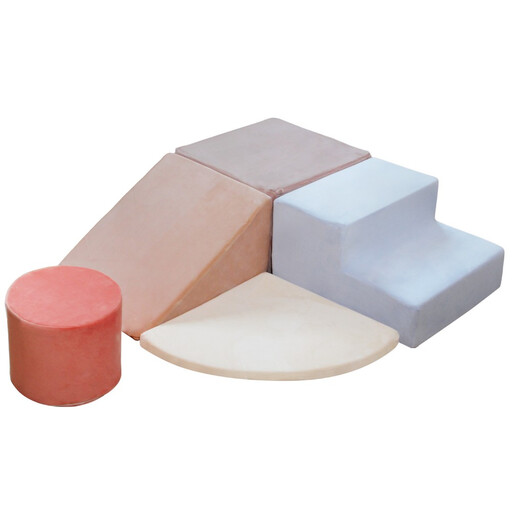
Why this choice suits this profile : Its compact size makes it easy to introduce motor-skill play at home without setting aside an entire room for storage. The five blocks can be used for climbing, crawling, sliding or building.
The product description mentions a non-slip base on certain pieces, hook-and-loop connections and removable, machine-washable covers. The fastenings are stated to be concealed.
A five-piece set, stated to use high-density foam, with machine-washable covers and delivery in compressed packaging.
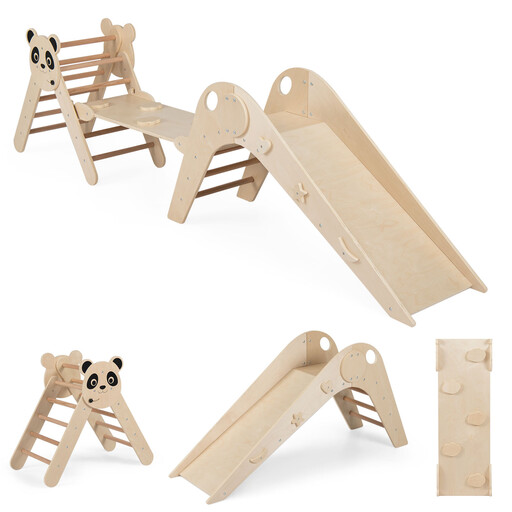
Why this choice suits this profile : Families looking for a durable structure that is easy to store upright can consider this wooden set, which the product description recommends from the age of 3.
Its foldable design addresses the problem of limited space. The wooden surfaces, handles and edges are described as smooth, but careful assembly and adult supervision remain essential.
A triangle, balance board and ramp-tunnel, all foldable for easy storage. The product description states a capacity of 50 kg per component.

Why this choice suits this profile : Nurseries, playrooms and families with a dedicated room can enjoy a set combining climbing, crawling and a sensory play area.
The product description clearly states that the balls are not included, avoiding an unwelcome surprise on delivery. The block covers and ball-pit lining are described as removable and washable.
A ball pit combined with climbing modules, non-slip undersides stated to be included on the pieces, and easier cleaning thanks to the removable components.
We have put together a complete, real-time-updated selection of products that meet these demanding criteria, as well as European safety regulations.
Before each play session, move furniture with hard corners out of the way and check that the modules do not slide on the floor. With younger children, start with a low configuration made up of blocks placed close together. Taller structures should always be used under the direct supervision of an adult.
To keep the blocks in good condition:
The course can evolve with your child simply by changing the order of the pieces. This modularity encourages free play, building and exploration, without presenting the product as a medical device or a guarantee of development.
It depends entirely on the height of the modules, the chosen configuration and the manufacturer’s recommendations. For a baby, choose a low structure and stay nearby. The wooden sets featured here are recommended from the age of 3, while foam blocks should be used in accordance with the labelling and warnings shown in their product description.
Compressed models generally need 24 to 48 hours to regain their full volume. Place them in a sufficiently well-ventilated room, then check their shape, firmness and that the covers fit properly before use.
Not always. For the BanaSuper set with ball pit, the product description states that the balls are sold separately. Remember to factor this purchase into your budget and check the ball diameter recommended for the child’s age.