
Livraison le jour même ou le lendemain

Qualité garantie

Débloquez vos offres de bienvenue: Livraison GRATUITE | Jusqu'à -80 % | 30 jours d'essai gratuits à JoyPlus
Téléchargez l'application
Foam climbing blocks for children can transform a living room, bedroom or nursery into a proper play zone. But not all sets are created equal. A colourful appearance or the words “XXL” aren’t enough to judge their safety, how easy they are to clean, or how long they’ll last.
Before you buy a baby activity course or a soft climbing toy, there are three pitfalls that deserve your attention.
Big blocks aren’t necessarily stable. A base that’s too light, foam that quickly loses its shape, or elements that are simply stacked can cause the structure to shift during play. Go for non-slip foam, a textured base and, where the model has them, hook-and-loop fastenings.
A foam climbing course often ends up on the floor, sometimes with sticky hands, a snack nearby or several children playing at once. A fixed cover makes cleaning difficult and can make the set less pleasant to use over time. A removable, washable cover – ideally machine-washable according to the manufacturer’s instructions – is a real bonus at home and in group settings.
The EN71 certified label needs careful scrutiny. The standards EN71-1, EN71-2 and EN71-3 cover mechanical and physical properties, flammability and the migration of certain elements. They don’t replace age recommendations, warnings or adult supervision. Also check for concealed zips and the absence of small accessible parts.
The product pages for BanaSuper sets mention high-density polyurethane foam, sometimes described as high-resilience foam. This means a structure designed to maintain good support during climbing, crawling and building activities. However, it doesn’t allow you to predict an exact lifespan – that depends on how often it’s used, the weight it bears and storage conditions.
For a construction toy for toddlers, look at how easily the shapes can be stacked and rearranged without creating a structure that’s too tall. The blocks should remain easy for an adult to move and be wide enough to reduce the risk of tipping over.
A non-slip base is useful on wooden floors, laminate or tiles, but it doesn’t replace the need to set the blocks on a flat, clear surface. Hook-and-loop fastenings can hold several pieces together during a course, while concealed zips limit direct access to the cover’s contents.
Before each play session, check the seams, the joining strips and the condition of the foam. Put aside any piece that has a tear, a damaged zip or has lost its stability.
A five-piece set can work well in a small flat or a child’s bedroom. Six or seven blocks offer more possibilities for creating a tunnel, a step, a slope or a small obstacle course. You’ll still need a clear area around the setup and should keep it away from furniture corners.
Products delivered vacuum-packed usually need 24 to 48 hours to regain their full shape. Don’t use them straight after opening if the pieces haven’t yet returned to their original form.
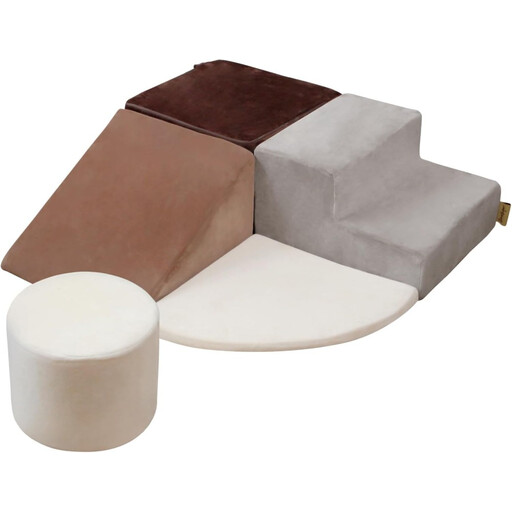
Why this choice suits this profile: Its five-piece format lets you start with a baby activity course without taking up as much room as a larger set.
The product page mentions a non-slip base on certain pieces, hook-and-loop fastenings and concealed zips.
Removable, machine-washable cover; high-density foam stated; compliance with EN71-1, EN71-2 and EN71-3 indicated on the product page.
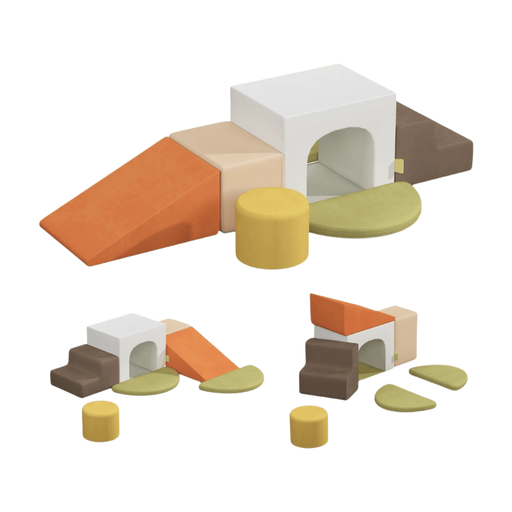
Why this choice suits this profile: The seven shapes let you change the layout of an indoor children’s play area more often.
The hook-and-loop fastenings, non-slip base and concealed zips address the main concerns for a modular course.
Seven blocks in high-density polyurethane foam, removable washable covers and stated compliance with the European Toy Safety Directive.

Why this choice suits this profile: This configuration combines a foam climbing course with a sensory zone. It could work well in a family room, nursery or preschool with a dedicated space.
The product page states that the ball pit is supplied without balls – this detail prevents an unpleasant surprise at installation.
Removable, washable cover and pit liner, non-slip pieces, concealed zips and stated compliance with EN71-1, EN71-2 and EN71-3.
We’ve put together a full, real-time updated list of products that meet these demanding selection criteria and European safety regulations.
The recommended age depends on the design of the course, the height of the blocks and the manufacturer’s instructions. Gradual use on the floor can be considered once your child moves confidently, but adult supervision is still essential. Always check the labelling and warnings for the model you choose.
Vacuum-compressed sets usually need 24 to 48 hours to regain their full volume and firmness. Place the pieces in a well-ventilated area without covering them, then check they’ve returned to their original shape before first use.
Not always. For the BanaSuper model with a ball pit, the product page states that balls are sold separately. You’ll need to factor them into your budget, allowing a quantity that suits the volume of the pit and the space available.