
Livraison le jour même ou le lendemain

Qualité garantie

Débloquez vos offres de bienvenue: Livraison GRATUITE | Jusqu'à -80 % | 30 jours d'essai gratuits à JoyPlus
Téléchargez l'application
Crafting enthusiasts know it well: a successful card making or scrapbooking project starts with the right tools. A flower cutting die can transform a simple sheet of paper into a decoration of incredible delicacy. The problem is, the market is flooded with models making tempting promises, and it's easy to end up with a tool that just doesn't hold up. A die that tears the paper, details that refuse to cut through, metal that bends after just two passes through the machine… these are frustrations every crafter has faced.
This guide is here to help you see things more clearly. We'll break down the pitfalls to avoid and the criteria you absolutely must check to ensure your next scrapbooking cutting die purchase is a lasting investment, not a disappointment.
Before you commit, watch out for these two common issues that can quickly ruin your creative session:
To make the right choice, focus on these three key points. They are your guarantee of a reliable and versatile tool for your card making projects and other creations.
This is the starting point, and it's non-negotiable. Not all dies are universal. Most thin dies (the most common type) are compatible with popular manual die-cutting machines (like the Sizzix Big Shot, Spellbinders Platinum, etc.). However, you should still check the die's thickness and the manufacturer's recommendations. A die that's too thick could damage your machine, while one that's too thin might not apply enough pressure for a clean cut.
The lifespan of your metal flower die depends primarily on the quality of its material. High-quality dies are typically made of carbon steel. This material allows for the creation of fine, precise cutting edges that stay sharp use after use. Conversely, a low-quality die will warp or dull quickly, turning every cut into an ordeal. Some dies also allow for embossing, a technique that creates a raised relief on the paper without cutting it. This dual function is a real bonus.
Think about how you'll primarily use it. A die for creative card making needs to be the right scale.
To help you see how these criteria apply in practice, here are a few models perfect for different types of crafters and crafting projects.
Why it's perfect for beginners: Perfect for getting started, this die offers a simple and timeless flower shape. Its versatile size is suitable for decorating a card as well as adding a small detail to an album page. It's an excellent starting point for getting familiar with the technique.
Its clean design, with bold lines and few tiny details, minimizes the risk of tearing the paper. It ensures a clean cut even for less experienced users.
Its simplicity makes it very easy to use and to release from the paper after cutting. Ideal for quick and satisfying results.

Why it's perfect for details: Designed for crafters who want to add a touch of sophistication, this die creates a floral **lace border**, perfect for enhancing wedding invitations, birthday cards, or the edges of an album page.
Although the design is detailed, its long shape provides a solid structure. The machine's pressure is distributed along a clear axis, which facilitates a clean cut of fine details without tearing the paper.
It allows you to create professional-looking finishes that bring an immediate touch of class to any paper project.
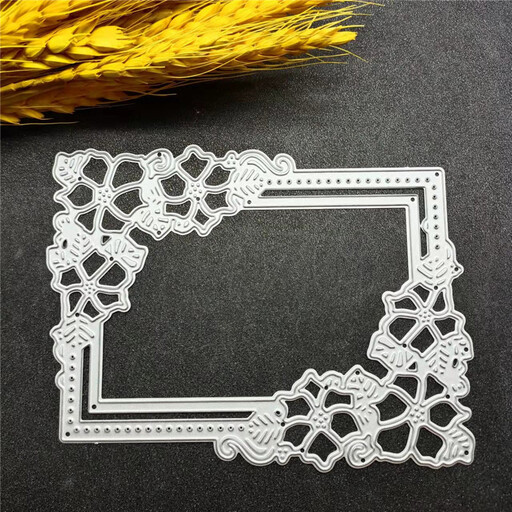
Why it's perfect for scrapbooking: This die is made for scrapbooking. It cuts an elegant floral frame, ideal for showcasing a photo or serving as a centerpiece on a 12x12-inch page. Its visual impact is immediate.
By definition, it's a large-format die, so it avoids the trap of details that are too small and impossible to cut. Its function as a frame ensures a result that is both beautiful and practical.
It offers an all-in-one solution for quickly creating structured and elegant scrapbook layouts.
Explore our full selection of products that meet our strictest quality criteria.
Most thin dies can cut standard cardstock, with a weight ranging from 80 gsm to about 250 gsm. For thicker papers, multiple passes through the machine may be necessary. It's always a good idea to do a test cut on a scrap piece of paper before you start.
After each use, use a small brush or a pointed tool to gently remove any paper bits stuck in the die. Store them flat, ideally on magnetic sheets, to prevent them from bending or bumping into each other, which could damage their cutting edges.
While most thin dies are designed to be universal, there are exceptions. Always check the width of the die to ensure it will fit through your machine's opening. The stack of cutting plates (the "sandwich") can also vary from one machine to another. Refer to your device's user manual for the recommended stack.