
Livraison le jour même ou le lendemain

Qualité garantie

Débloquez vos offres de bienvenue: Livraison GRATUITE | Jusqu'à -80 % | 30 jours d'essai gratuits à JoyPlus
Téléchargez l'application
A floor fan can cool a room, improve air circulation or speed up the drying of a surface. Yet some purchases prove disappointing after just a few weeks. Advertised power without an airflow rating, limited battery life or an overly restricted oscillation range can quickly make the appliance impractical for everyday use.
Before comparing models, it is therefore worth separating marketing claims from the criteria that really matter in France.
A high wattage does not necessarily guarantee a more pleasant airflow. Power mainly indicates how much electricity the motor consumes. When comparing two appliances, also check the airflow rate, number of speeds and the ways in which the airflow can be directed.
A high-speed fan may be perfectly suited to a workshop, gym or basement, but prove too noisy in a bedroom. Conversely, a direct-current motor often focuses on quieter operation and offers more speed settings.
The term “quiet” should be treated with caution. Noise levels can vary considerably depending on the selected speed. When a decibel rating is provided, check the conditions under which it was measured. For a bedroom or office, it is better to choose a quiet fan with a night mode, timer and genuinely usable low-speed setting.
A rechargeable floor fan gives you more freedom when the socket is out of reach, on a covered terrace or during a brief power cut. However, the stated battery life generally depends on the speed used. Also remember to check the charging time, the type of charger supplied and the instructions relating to the lithium battery.
In a living room, oscillation and adjustable height are often just as important as power. An oscillating fan distributes air over a wider area, while a fixed model focuses the airflow on a specific spot.
For a workshop or drying tasks, prioritise concrete specifications such as airflow in litres per second, tilt angle and number of speeds. A compact floor fan may be more suitable than a tower model when air needs to circulate close to the floor.
Check the dimensions, base weight and range of adjustments. A wide horizontal rotation is useful in a living room, while vertical tilt allows you to direct air towards a wall, ceiling or damp area that needs ventilating.
The appliance should stand on a flat, stable surface. The cable must not create a trip hazard, particularly in a workshop or a busy room.
A remote control lets you change the settings from the sofa or bed. A connected fan may also offer scheduling, app control or remote adjustments, but it will then depend on a compatible Wi-Fi connection.
Also inspect the grille, check whether there is a filter and consider how easy the appliance is to clean. Always unplug the appliance before cleaning or maintaining it, and do not place it near a bath, sink or area exposed to splashes. For a fan heater, check the overheat protection, stability and the required distance from flammable materials. A certification such as IPX1 corresponds to a specific level of protection, but does not make the appliance waterproof.
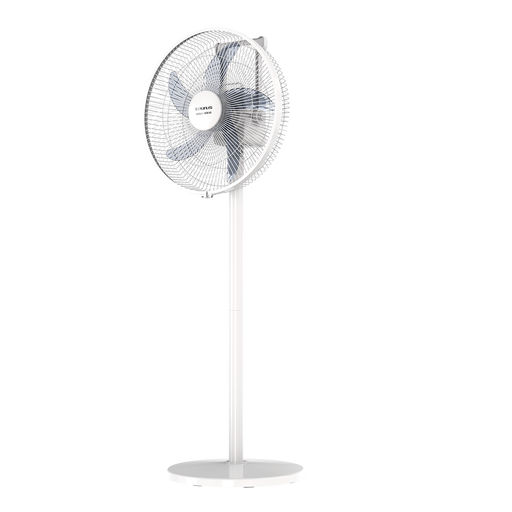
Why this choice suits this profile : This versatile model can be used on a stand, on a desk, as a tower fan or wall-mounted, without you needing to stay close to a power socket.
Its five speeds, three modes and timer programmable for up to 8 hours let you adapt operation to your needs, rather than leaving the appliance running continuously at full power.
11.1 V, 3.6 Ah lithium battery, advertised battery life of up to 8 hours, remote control and automatic oscillation.
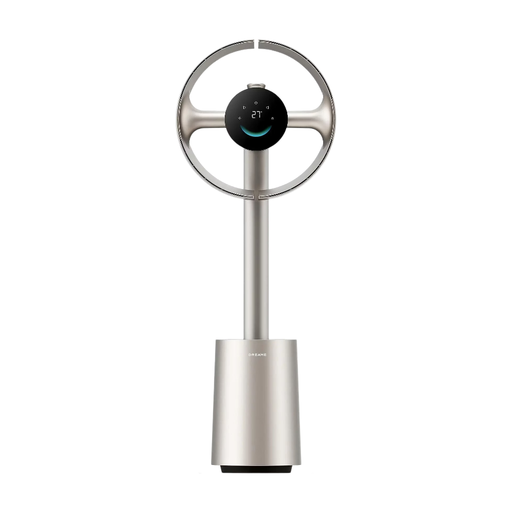
Why this choice suits this profile : This bladeless fan will appeal to users looking for a sleek design, wide airflow distribution and digital or remote controls.
The product details state that it offers horizontal oscillation of up to 180° and vertical oscillation of up to 90°, with two independently adjustable wings. This provides concrete reference points rather than a vague promise of wide coverage.
55 W power, removable and washable main filter, Wi-Fi app, voice control and magnetic remote control.
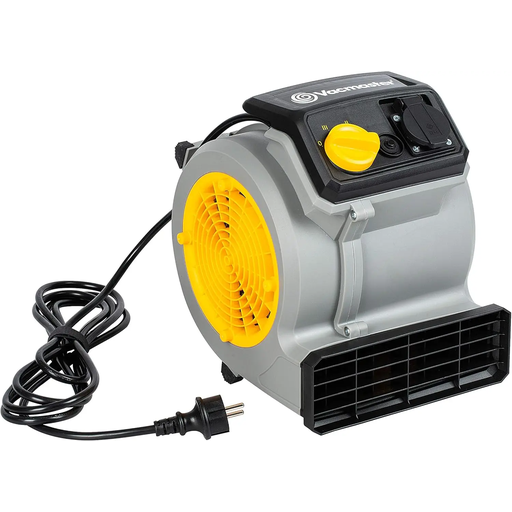
Why this choice suits this profile : This floor fan is designed for workshops, gyms, cellars and spaces where cooling, ventilation or rapid drying take priority over a domestic design.
Its stated airflow of 245 l/s, three speeds and tilt of up to 45° make it easier to direct the airflow according to the task.
124 W motor, stated noise level of 75 dB and an integrated socket allowing up to 12 appliances to be connected, depending on the electrical setup.
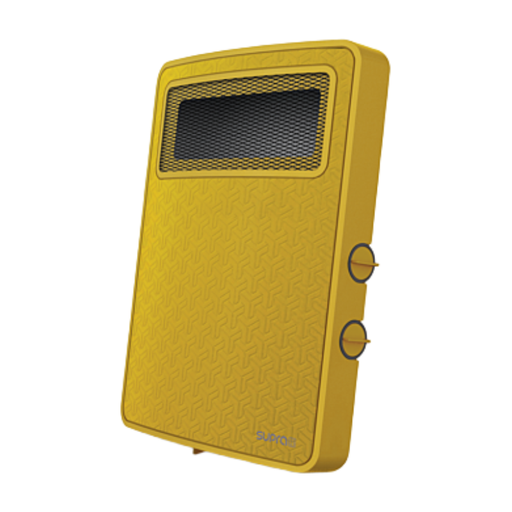
Why this choice suits this profile : This appliance is ideal for those looking for both a ventilation function and supplementary fan heating in a portable format.
The power is clearly divided between two settings, 1,000 W and 2,000 W, with a mechanical thermostat and cool-air function. However, it should not automatically be regarded as a replacement for your main heating system.
Two heat settings, overheat protection, tip-over protection, frost protection mode and washable filter.
We have put together a complete, real-time updated list of products that meet these demanding selection criteria, as well as European safety standards.
Place it on a stable surface, away from curtains and lightweight objects. To circulate the air, point it slightly towards a wall or switch on oscillation. Avoid directing it continuously at someone who is sitting still, and do not use it in a damp environment unless the product is designed for this purpose.
The cost depends on the power, selected speed and tariff set out in your electricity contract. To estimate it, multiply the power in kilowatts by the usage time, then by the price per kilowatt-hour. A 55 W appliance will use far less electricity at full power than a 2,000 W fan heater, but the comfort provided and the intended use are not the same.
No exact lifespan can be guaranteed for every model. Longevity depends on how often it is used, the quality of the electricity supply, maintenance and storage conditions. Clean the grilles and filters regularly, never block the air inlets and unplug the appliance before carrying out any work. For rechargeable models, follow the charging instructions and avoid exposing them to excessive heat.