
Livraison le jour même ou le lendemain

Qualité garantie

Débloquez vos offres de bienvenue: Livraison GRATUITE | Jusqu'à -80 % | 30 jours d'essai gratuits à JoyPlus
Téléchargez l'application
A floor fan can cool a room, speed up floor drying or improve air circulation in a garage. However, the differences between models go far beyond the power rating shown on the box. A very fast appliance may prove noisy, while a quieter fan may not deliver enough airflow for a workshop or cellar.
Here are the key points to review to avoid unpleasant surprises and choose an appliance that genuinely suits your needs.
Power, expressed in watts, indicates how much electricity the motor uses, but it is not enough on its own to assess air-circulation performance. Two 100 W fans can move very different volumes of air depending on the design of the blades, grille and rotation speed.
When choosing a powerful fan, focus instead on the airflow rate, given in m³/h or litres per second, as well as the number of speed settings available.
Noise levels vary depending on the setting used. A figure advertised in night mode or at minimum speed does not necessarily reflect the noise produced at full power. For a bedroom, office or living space, look for a decibel rating clearly linked to a specific operating mode.
A high-speed fan designed for a garage or workshop will naturally be more audible than a model intended to run overnight. The key is to find the right balance for your surroundings.
Without an adjustable tilt, the appliance may blow too high or too low. A lightweight base can also vibrate when the motor is running quickly. An oscillating fan, adjustable tilt and non-slip feet help distribute the air more effectively while limiting unwanted movement.
For a bedroom or small lounge, several speed settings and a night mode may be more than sufficient. In a workshop, cellar or gym, it is better to prioritise an air circulator that clearly states its airflow rate and offers precise directional adjustment.
Compact floor models are generally placed close to the floor to move air through a targeted area. They are particularly useful for speeding up drying after cleaning, ventilating a basement or providing occasional cooling at a workstation.
A quiet fan should state its noise level in decibels, preferably alongside the corresponding operating mode. A remote control is convenient from a sofa or bed, while a timer prevents the appliance from running for longer than necessary.
Remote control and automatic oscillation are especially useful for a bedroom fan. In a workshop, however, simple, easily accessible buttons may be more practical, particularly when the appliance is being used while wearing gloves.
A rechargeable fan offers greater freedom in a room without a power socket, on a covered terrace or during occasional jobs. Compare the stated battery life, charging time and the manufacturer’s recommendations for the lithium battery.
For extended professional use, a mains-powered model is generally more suitable. Also remember to check compatibility with the French mains voltage, the cable length and the conditions of use recommended by the manufacturer.
A fan fitted with an air purifier does more than simply move air. It incorporates a filtration system whose performance should be supported by precise data, such as CADR, expressed in m³/h. This figure indicates the volume of air filtered under certain conditions, but it is not a medical guarantee.
The recommended filter replacement frequency, availability and cost should also be taken into account. A clogged filter can reduce airflow and place additional strain on the motor.
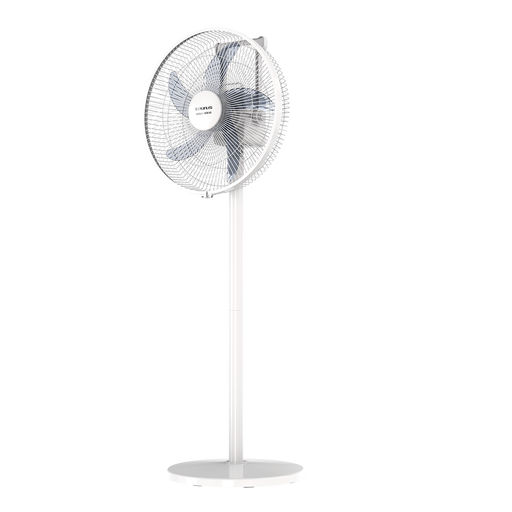
Why this choice suits this profile : This versatile model can be moved from the floor to a desk or mounted on a wall as required. It runs on battery power and offers five speeds along with three modes.
The product details mention a DC motor described as quiet, a timer of up to 8 hours and a remote control. This allows you to adjust the operating time without leaving the appliance running continuously.
Stated battery life of up to 8 hours, 40 cm diameter, automatic oscillation and five speed levels.
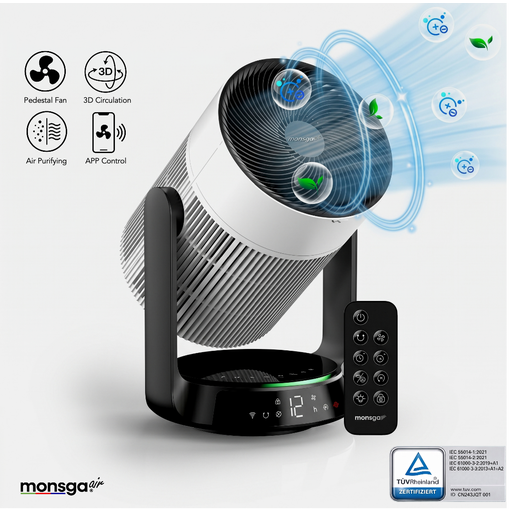
Why this choice suits this profile : It is aimed at those who want to combine air circulation and filtration in a single appliance, particularly in a lounge, bedroom or air-conditioned office.
The advertised functions are supported by separate technical data : airflow of up to 14,8 m³/min, a CADR of 280 m³/h and a stated noise level of 25 dB in sleep mode. However, check the availability and price of replacement filters before buying.
90° automatic horizontal oscillation, stated 360° rotation, manual vertical adjustment of up to 120° and control via the app, remote control or touch panel.
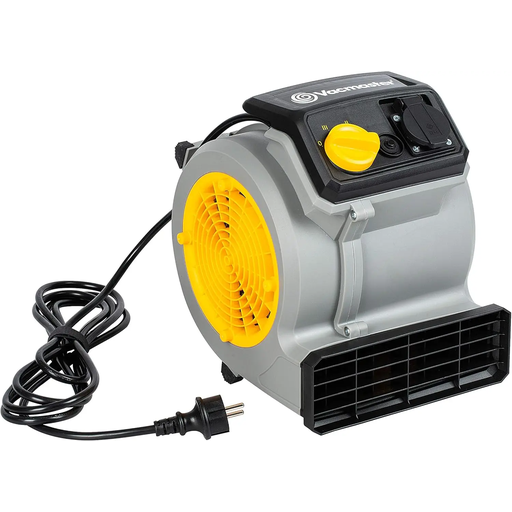
Why this choice suits this profile : Designed for workshops, garages, basements and gyms, this fan focuses on targeted airflow, drying and sustained ventilation.
Its adjustable tilt of up to 45° lets you direct the airflow towards a precise area, rather than relying solely on general oscillation. It must be placed on a stable, dry surface.
124 W motor, stated airflow of 245 l/s, three speeds and an integrated socket allowing up to 12 appliances to be connected, according to the product details.
We have brought together a complete, real-time updated selection of products that meet these demanding criteria as well as European safety standards.
Place it on a stable surface and direct the airflow towards the occupied area or an opening to encourage air renewal. Used alongside air conditioning, an air circulator can help distribute cool air more quickly, but it does not replace proper air-conditioner maintenance or settings.
It depends on its power, how long it is used and the electricity tariff. A 35 W model uses less electricity per hour than a 124 W appliance, but their airflow rates and intended uses are not comparable. To estimate consumption, multiply the power in kilowatts by the number of hours of operation, then by the price per kilowatt-hour.
It depends on the quality of the motor, how often it is used and how well it is maintained. Dust the grille regularly, make sure the air inlets are not blocked and always unplug the appliance before cleaning it. With a rechargeable fan, follow the charging instructions and keep the battery away from excessive heat and naked flames.