
Livraison le jour même ou le lendemain

Qualité garantie

Débloquez vos offres de bienvenue: Livraison GRATUITE | Jusqu'à -80 % | 30 jours d'essai gratuits à JoyPlus
Téléchargez l'application
As a product expert at Joybuy, I see every day how choosing a flex-head ratcheting wrench set can become a real headache. Between the marketing jargon and indecipherable spec sheets, it's easy to end up with a tool that fails you mid-repair. This guide is here to break down the essential criteria and help you make the right choice, whether you're a weekend mechanic or a seasoned DIYer.
Before diving into the technical specifications, it's crucial to sidestep the most common traps that lead to a poor investment.
Beware of entry-level sets that boast about their "?robust steel?" or "?treated metal?". Without an explicit mention of Chrome Vanadium (Cr-V) steel, you risk investing in wrenches made from a poor-quality alloy. The result? Tools that bend under the first sign of stress, wear out visibly, and, even worse, damage your bolt heads, turning a routine repair into a complete nightmare.
The appeal of a ratcheting wrench? To tighten and loosen continuously without ever removing the tool from the nut. It's a small revolution... provided the mechanism can keep up. Its effectiveness depends on the tooth count. A low-end 48-tooth ratchet, for example, requires a 7.5° swing arc to engage. In the maze of an engine bay or wedged behind furniture, that much space is a luxury you rarely have, rendering the wrench simply unusable.
To ensure the versatility and durability of your future ratcheting combination wrench set, focus on these three non-negotiable parameters.
This is the gold standard for professional and automotive mechanical tools. Chrome Vanadium steel is an alloy renowned for its excellent resistance to torsion, wear, and corrosion. In practical terms, a Cr-V wrench set guarantees rock-solid durability and perfect torque transmission, with no risk of the tool deforming.
Aim for a ratchet with at least 72 teeth. It offers a swing arc of just 5°, a non-negotiable feature for working in the most inaccessible corners where every degree of movement counts. For purists or for precision work, 90 or 144-tooth mechanisms exist, offering even more formidable accuracy. This guarantees faster and less frustrating work.
The 180° flex-head is the other secret weapon of these wrenches. It allows you to navigate and reach nuts at awkward angles where a classic wrench would give up. Also, look for a 12-point polygonal box end. It provides a better grip, distributes tightening force more evenly, and drastically reduces the risk of stripping the nut.
To move from theory to practice, here is our selection for every budget and need.
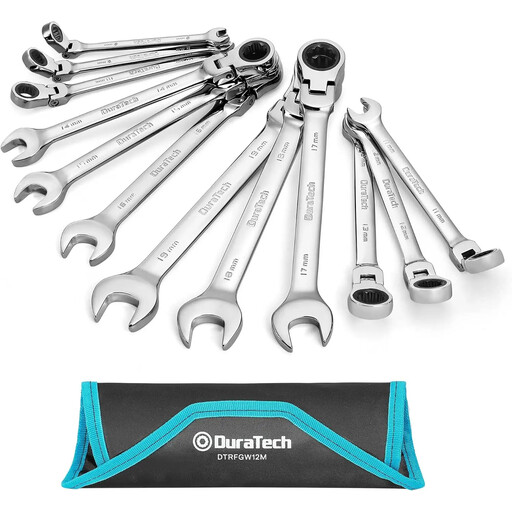
Perfect for: routine car maintenance, furniture assembly, or small everyday repairs. This set covers the most common metric sizes from 8 to 19 mm, and its roll-up pouch is a real bonus for storage and transport.
With its Chrome Vanadium steel construction and 72-tooth ratchet, it checks all the boxes: durability and efficiency in tight spaces. Say goodbye to the disappointments of low-end tools.
The perfect balance between build quality, essential features (180° flex-head), and a comprehensive set of sizes for maximum versatility.
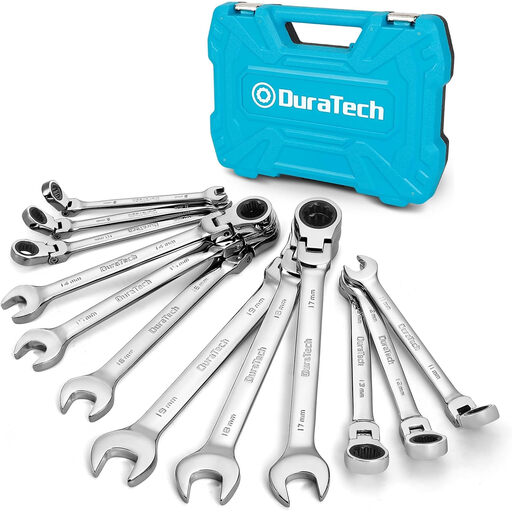
Perfect for: those who regularly get their hands dirty. The hard case is not a gimmick: it protects the tools and simplifies organisation and transport. A must-have for keeping a workshop or garage tidy.
This set exceeds ANSI standards, a true mark of quality and reliability. The Cr-V steel and 72-tooth ratchet guarantee pro-level performance and unfailing longevity.
Its robust storage case, which secures your investment and keeps every wrench in its place, combined with impeccable build quality.
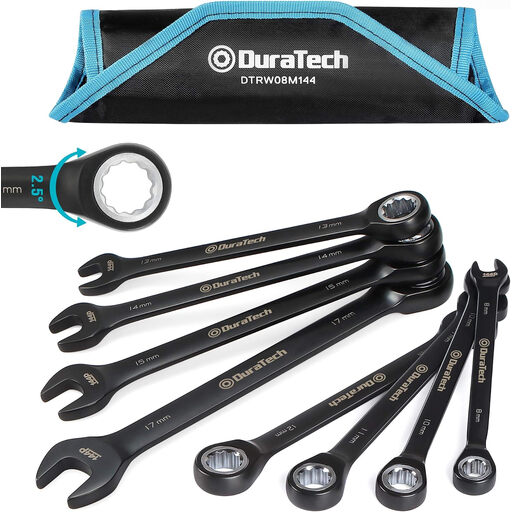
Perfect for: pros or enthusiasts tackling complex mechanics where every millimetre is a battle. Ideal for crowded engine bays, HVAC systems, or industrial maintenance.
It shatters the market standard with its 144-tooth mechanism, which needs only a 2.5° swing arc. This is the definitive answer to the problem of unusable ratchets in confined areas.
The surgical precision of its ratchet, allowing you to work where all other wrenches would throw in the towel. All this with a Cr-V steel construction and a sleek black chrome finish.
We have selected other products for you that meet these same quality and safety standards.
After each use, especially if you've worked in a greasy or dusty environment, a quick wipe with a clean, dry cloth is essential. To prevent corrosion, store the roll-up pouch or case away from moisture. And a golden rule: never strike a wrench with a hammer to force a nut. You risk destroying the ratchet mechanism.
For an amateur or for basic maintenance (oil changes, brake pad replacements, etc.), a set covering metric sizes from 8 to 19?mm is perfect. This is the range of sizes you'll find on almost all bolts and nuts on European or Asian vehicles. For more heavy-duty jobs (suspensions, gearboxes), you will indeed need to supplement it with larger sizes or specific sockets.
A ratcheting combination wrench is a 2-in-1 tool: an open end to quickly approach the bolt, and a box end (polygonal) with a ratchet to tighten or loosen effortlessly without removing the wrench. A standard box-end wrench, on the other hand, has no ratchet; you have to reposition it after each turn. In return, it is often sturdier for breaking loose a stubborn nut. The flex-head ratcheting wrench is therefore the ideal compromise between access, speed, and versatility.