
Livraison le jour même ou le lendemain

Qualité garantie

Débloquez vos offres de bienvenue: Livraison GRATUITE | Jusqu'à -80 % | 30 jours d'essai gratuits à JoyPlus
Téléchargez l'application
My role at Joybuy? To find the tools that truly stand up to the test by poring over spec sheets and customer reviews. A good flex-head ratchet wrench set can turn a mechanical nightmare into a simple task, especially when you need to squeeze into the tight corners of an engine or behind an appliance. The problem is, the market is flooded with models that look identical, but their quality varies wildly. Knowing how to sort the good from the bad is crucial to avoid throwing your money away.
This guide is here to help you see things more clearly, identify the criteria that really matter, and avoid the common pitfalls before choosing your next ratchet wrench set.
Don't be fooled by shiny packaging and slick marketing. Too many buyers end up with tools that give out after just a few uses or prove to be ineffective. Here are the most common traps to watch out for.
To make the right choice, rely on facts and objective technical specifications rather than empty promises. Here are the three points to examine closely.
This isn't just a nitpicky detail. Chrome Vanadium steel is an alloy renowned for its perfect balance of hardness, durability, and corrosion resistance. A tool forged from this material and given proper heat treatment will maintain its shape and strength even after years of heavy use. A chrome, polished, or matte finish is also a good indicator of quality: it makes cleaning easier and adds an extra protective barrier.
The number of teeth in the ratchet is crucial: it determines the swing arc, which is the minimum movement needed to turn the nut or bolt.
For a flex-head combination ratchet wrench, two aspects of the head need close attention. First, the joint must be able to pivot 180 degrees while firmly holding the selected angle. This ensures that force is applied correctly to the fastener. Second, the box end (the closed part of the wrench) should be a 12-point design. This provides a better grip on 6-point bolt heads, distributes torque more evenly, and drastically reduces the risk of stripping the fastener.
Taking these criteria into account, we've identified a few options that meet the needs of different user profiles.
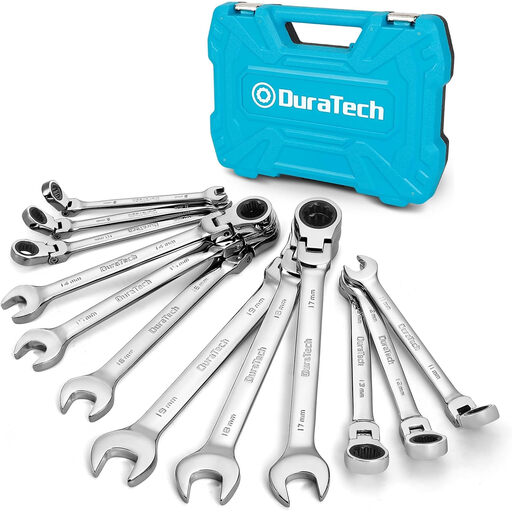
Why we chose it: Ideal for the DIY mechanic who maintains their own car or motorcycle. This set covers all the useful sizes, and the hard case keeps the tools well-organised and protected in the garage.
Made from Chrome Vanadium steel, it eliminates the risk of a poor-quality alloy. The 72-tooth mechanism and 180° flex head are built for performance. The set includes all essential sizes from 8 to 19 mm.
The combination of a flex head, a precision ratchet, and a complete range of sizes makes it an ultra-versatile set for automotive work.
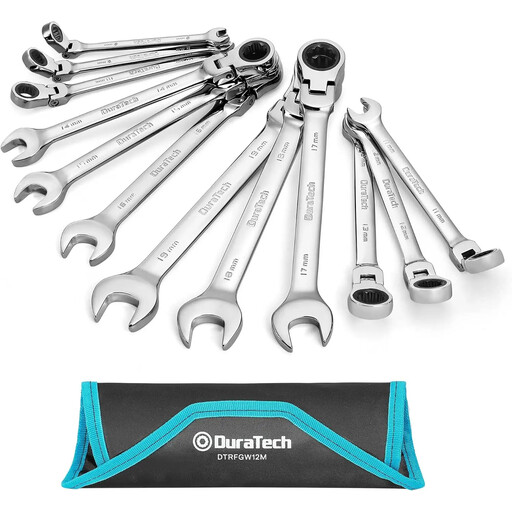
Why we chose it: For those who move from one job site to another or simply want ultra-compact storage. The roll-up pouch slips in anywhere: in a toolbox, under a seat, or in the car's trunk.
It shares the same excellent technical features as the cased model (Cr-V, 72 teeth, complete sizes), ensuring identical performance with a more portable storage solution.
Portability. The roll-up pouch is practical, lightweight, and effectively protects the wrenches while taking up minimal space.
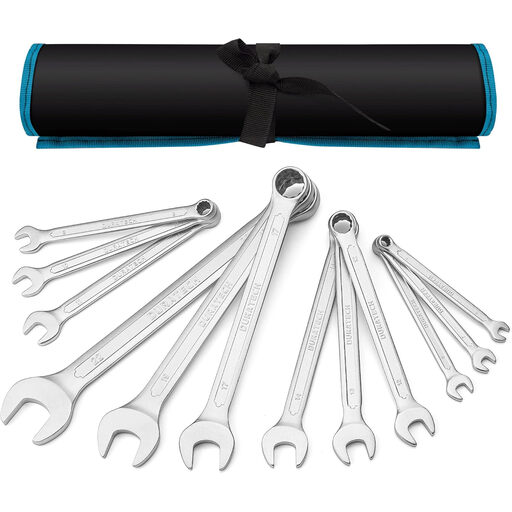
Why we chose it: For everyday DIY tasks or simple repairs where a flex head isn't essential. This combination wrench set provides a solid and reliable foundation, without the extra cost of a ratchet mechanism.
It's made from Chrome Vanadium steel, and its compliance with the DIN 3113 standard is a true mark of quality. The wide range of sizes (6 to 22 mm) protects you from the incomplete-set trap.
Excellent value for a durable and versatile wrench set, covering a very wide range of sizes for all common needs.
We have put together a complete selection of products that meet our quality criteria and current safety standards.
What is the lifespan of a flex-head ratchet wrench set? It all depends on the manufacturing quality and maintenance. A set made of Chrome Vanadium steel, cleaned well after each use to remove grease and dust, can last for years, even with regular DIY or mechanical use. The weak points remain the ratchet mechanism and the joint. A word of advice: never use a cheater bar to "force" the handle, as you risk permanently damaging the mechanism.
Is a 72-tooth mechanism really necessary? For working in a wide-open space, a standard ratchet might suffice. But as soon as you need to work in a modern engine bay, under a dashboard, or in any other tight spot, the 5° swing arc of a 72-tooth wrench is a game-changer. It allows you to manoeuvre where a standard tool would be blocked, saving you a ton of time and frustration.
Hard case or roll-up pouch: which to choose? It all depends on your habits. A rigid ratchet wrench case offers maximum protection and impeccable organisation, perfect for a workbench in a garage or workshop. The roll-up pouch, on the other hand, is lighter, more compact, and easier to transport. It fits easily into a tool bag or the trunk of a car. If portability is your number one criterion, the pouch is undoubtedly the best choice.