Anyone concerned about spin noise
If the machine will be near a bedroom or a neighbouring home, compare the spin noise level shown for each model. You’ll also need a space where it can be installed level, on a hard, flat floor.


For a washing machine in a flat, first compare the spin noise levels on the energy label and choose a capacity that suits your laundry loads; according to ADEME, 7 kg is enough for most households. A front-loading machine may suit you if you need more capacity, a top-loader if width is limited, and a washer-dryer if you need integrated drying – provided you check the specifications of the exact model. Make sure the machine can be installed securely and check its durability rating, too.
If the machine will be near a bedroom or a neighbouring home, compare the spin noise level shown for each model. You’ll also need a space where it can be installed level, on a hard, flat floor.
If you rarely wash bulky items, choose based on your usual loads rather than opting for the largest drum. ADEME says that 7 kg is enough for most households.
If width is limited, a top-loader could be a good option. If drying clothes is the challenge, consider a washer-dryer instead, checking its washing and drying capacities separately.
Consider this if: you have enough room in front of the machine and want to explore capacities suited to different-sized loads.
Bear in mind: Electrolux France says front-loaders generally offer greater capacity than top-loaders, but a larger capacity is only useful if your laundry loads call for it.
Consider this if: width is your main constraint or you prefer to load laundry from the top.
Bear in mind: Electrolux France describes top-loaders as compact, with generally lower capacities; their design alone doesn’t tell you how noisy they’ll be on a spin cycle.
Consider this if: you need integrated drying but don’t have space for a second appliance.
Bear in mind: you can’t always dry a full wash load in one go. For example, Whirlpool France lists an 8 kg washing capacity and a 6 kg drying capacity for its FFWDB864369BVFR model.
| Factor | What to check | What I need |
|---|---|---|
| Noise and vibrations | Compare the noise level in dB and the spin noise class on the model’s label. Check that the space allows for a stable, level installation on a hard, flat floor. | I want to minimise disruption during the spin cycle, both for other people in the building and for my neighbours. |
| Capacity | Compare the stated capacity in kg with the usual weight of your dry laundry loads. UFC-Que Choisir notes that the maximum load may be lower than the stated capacity for some programmes. | My regular laundry loads may not call for a large drum; I’d rather choose a capacity I’ll use regularly. |
| Energy, water and spin performance | Check the label for kWh per 100 cycles, litres per cycle, the Eco 40-60 programme duration and the spin-drying efficiency class. Compare figures based on the same reference programme. | If I dry my laundry indoors, spin performance matters too; the time I do my washing makes cycle length important. |
| Durability and aftercare | For a model sold in France, check its durability rating and look for parts that match its full model number. ADEME says that washing machines have been required to display this rating since April 2025. | I want to be able to distinguish between the durability rating, parts for my model and the written commitments made by the retailer or manufacturer. |
A capacity that’s too large for your usual loads may mean the drum is often only partly full. ADEME recommends matching capacity to your needs and says that 7 kg is enough for most households.
Estimate the weight of your usual dry laundry loads, then check the limits for the programmes you use, particularly for delicate fabrics.
The spin speed and the terms used by a brand are no substitute for checking the noise level listed for the exact model.
Compare the dB level and spin noise class on the labels, then check the spin-drying efficiency class separately.
UFC-Que Choisir and Electrolux France point out that the machine’s stability and how the laundry is distributed can affect vibrations, so choosing the right model alone won’t solve the problem.
Follow the instructions to remove the transit bolts, level the machine on a hard, flat floor and stick to the recommended load sizes.
The rating gives you information about the reliability and repairability of the model in question, but it doesn’t promise that every part will remain available for your model.
Compare the ratings of the models you’re considering, then check that any parts on offer are compatible and read the terms of any commercial guarantees.
A brand to consider if the claims made about vibration are among your priorities.
Its top-loading and front-loading ranges let you compare the space available with the capacity you need.
Its washer-dryers are worth considering when integrated drying could help with limited space.
A brand to consider if being able to identify parts for a specific model matters to you.
These top-loading and front-loading models offer two styles to consider for a flat. Compare their dimensions and capacities with your available space and laundry loads, then check the energy label for the spin noise level of the exact model.
 Image unavailable
A top-loader is worth considering if there’s limited space in front of the machine. The model name indicates a 7 kg capacity, 1,200 rpm and an A energy class. Compare its spin noise level with other machines before choosing it for a flat with shared walls.
 Image unavailable
This top-loader is worth considering if width is a constraint and your usual loads are fairly small. The model name indicates a 6 kg capacity, 1,400 rpm, a B energy class and 17 programmes; spin speed alone isn’t enough to tell you how noisy a machine will be.
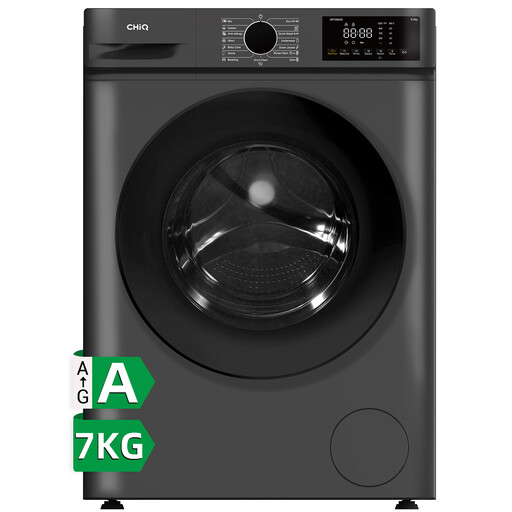 Image unavailable
This front-loader is worth considering if its door and dimensions suit the space you have in mind. The model name indicates a 7 kg capacity, 1,200 rpm, an A energy class and 16 programmes; check its label for the spin noise level before choosing it for a flat.
Compare the noise level in dB and the spin noise class on each model’s energy label. A ‘quiet’ claim or a technology promoted by the manufacturer is no substitute for checking these details.
Not necessarily. The label helps you compare models, but installation stability and how the laundry is distributed can also affect vibrations. UFC-Que Choisir and Electrolux France recommend, among other things, removing the transit bolts, levelling the machine and placing it on a hard, flat floor.
Start with your usual laundry loads: ADEME says that 7 kg is enough for most households. Also check the load limits for your chosen programmes, as UFC-Que Choisir notes that these may be lower than the stated capacity.
The rating gives you information about the reliability and repairability of the model in question. According to ADEME, washing machines have been required to display it since April 2025; check separately that parts are compatible with the model you’re considering.
Not necessarily: washing and drying capacities can differ. For example, Whirlpool France lists an 8 kg washing capacity and a 6 kg drying capacity for the FFWDB864369BVFR. Check both figures for the model you choose to see whether you’ll need to split the load.