Who are these solutions suitable for?
The space you have available and the amount of laundry you need to dry are the first things to consider when choosing an appliance.
No utility room
If your airer takes up space in a living room, bedroom or bathroom, compare the space an appliance would need with how you already ventilate the room. For air-drying laundry, ADEME recommends a large, well-ventilated room or one fitted with an extractor.
Frequent laundry loads
If you regularly need to dry several loads, check the drying capacity, programme times, stated energy consumption and noise level before setting aside space for a tumble dryer.
Space for just one appliance
A washer-dryer lets you consider washing and drying in a single appliance, provided the space has the necessary connections. Compare its two capacities separately: the drying capacity may be lower than the washing capacity.
What should you compare before choosing?
Start with the room and the loads you usually wash, then compare energy consumption using equivalent programmes and labels.
| Priority |
What to check |
What I need |
| Humidity and ventilation |
If you use an airer, check that the room can be ventilated or has an extractor. A dehumidifier works in the room it is used in, but does not replace air circulation. ADEME highlights the moisture released by laundry dried indoors. |
I’ll keep using my airer, but want to choose a suitable room and work out whether a dehumidifier could complement the existing ventilation. |
| Type of tumble dryer |
Compare capacity, the current energy label and consumption for the same reference programme. The European Commission says heat pump models are more energy-efficient than other tumble dryer technologies available in the EU. However, check the figures for each condenser or heat pump appliance. |
If I regularly dry loads in a drum, I want to compare both technologies without assuming a model’s energy use from its name alone. |
| Capacity and cycle time |
Check the weight of laundry the appliance can dry and the time needed for the stated load and programme. For a washer-dryer, check the washing and drying capacities separately: for example, LG lists 9 kg and 6 kg respectively for the F964V50WRS. |
Washed laundry needs to fit into my drying routine. With a washer-dryer, I may need to remove some of the laundry before drying. |
| Electricity and water |
Compare kWh figures on the same cycle basis. For a washer-dryer, also check water use for washing and drying: LG lists 359 kWh per 100 cycles and 90 L per cycle for the F964V50WRS. A dehumidifier’s energy use depends on its power rating and how many hours it runs. |
I want to understand the figures for the programme I’ll use, rather than compare numbers based on different types of use. |
| Space, noise and maintenance |
Measure the space available and the clearance needed, then compare the stated noise levels. Check the model’s manual for details of the tank, any water outlet, filters and maintenance tasks. |
The appliance will be near a living area or in a narrow passage, so it needs to be practical to install and maintain day to day. |
Which brands illustrate these solutions?
These manufacturer examples show what to look for when checking a specific model; they don’t cover every feature of each brand.
Bosch
The WQG24502FR is an example of the heat pump tumble dryers Bosch offers in France.
- Bosch lists a capacity of 8 kg, a noise level of 61 dB(A) and dimensions of 842 × 598 × 613 mm for this model.
- These dimensions and noise levels are specific to the WQG24502FR; check the details for any other model.
Beko
The DCB816W is an example of a condenser tumble dryer you can compare using its energy information.
- Beko lists a noise level of 66 dB(A), energy class G and condensation efficiency class D for the DCB816W.
- These figures don’t apply to other Beko tumble dryers; compare each model using the relevant energy label.
LG
The F964V50WRS washer-dryer shows why washing and drying capacities need to be checked separately.
- LG lists a washing capacity of 9 kg and a drying capacity of 6 kg, with 359 kWh per 100 cycles and 90 L per cycle for washing and drying on this model.
- These figures apply to the F964V50WRS, not to all LG washer-dryers.
Rowenta
Rowenta offers domestic dehumidifiers to consider as a way to complement an airer in a room.
- The Rowenta DH4236F0 manual lists three humidity settings: 40 %, 50 % and 60 %.
- A humidity setting doesn’t replace ventilation or checking that the appliance is suitable for the room.
Miele
Miele’s French tumble dryer range includes models with maximum capacities of 7, 8 and 9 kg.
- Miele recommends choosing a capacity similar to your washing machine’s, if possible.
- Capacity alone isn’t enough to choose a tumble dryer: compare the energy label, dimensions and noise level, as well as your usual loads.
Which appliances should you look at on Joybuy?
These options cover drum drying with a dedicated appliance and using a dehumidifier to complement an airer. To choose between them, check the details of the variant you’re interested in and the requirements of your room.
 Image unavailable
Hotpoint CHD84MWBSEE – heat pump, 8 kg
A dedicated tumble dryer to consider if you regularly dry loads in a drum. The title lists an 8 kg capacity and class C; check the applicable energy label, dimensions and installation requirements before choosing.
View on Joybuy
 Image unavailable
Comfee CD08EHP05W-HR – heat pump, 8 kg
Another drum-drying option for regular loads. The title lists an 8 kg capacity and class D; compare energy consumption on an equivalent label basis and check the dimensions, noise level and water management.
View on Joybuy
 Image unavailable
Electrolux EDH1018CD GentleCare – condenser, 8 kg
This model lets you explore a condenser tumble dryer option for a stated load of 8 kg. Before comparing it with a heat pump appliance, check its applicable energy label and how the water is collected or drained.
View on Joybuy
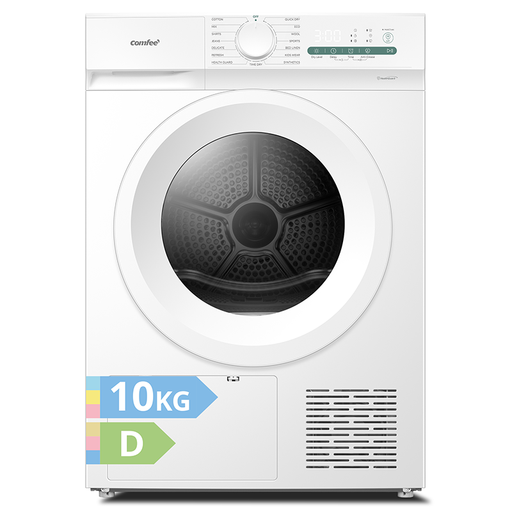 Image unavailable
Comfee CD10EHP05W-HR – heat pump
This model is designed for drum drying where you have a dedicated space. Its product information lists both 10 kg and 8 kg in different places, so confirm the capacity of this variant before planning your loads. Also check its energy consumption, dimensions and noise level.
View on Joybuy
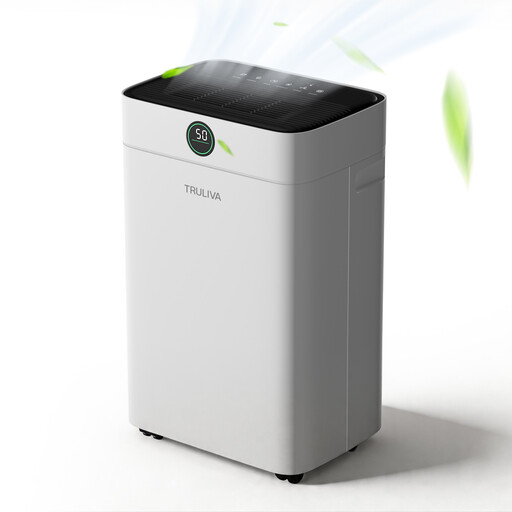 Image unavailable
TRULIVA – dehumidifier, 25 L/day, 2,8 L tank
Its laundry mode is designed to complement an airer in a room, not replace ventilation. The stated 25 L/day is based on conditions of 90 % relative humidity and 95 °F, rather than a guaranteed rate in your home. The title lists a 2,8 L tank and a continuous drainage hose.
View on Joybuy
Frequently asked questions
Can a dehumidifier replace ventilation when drying laundry indoors?
No. ADEME recommends air-drying laundry in a large, well-ventilated room or one fitted with an extractor, and notes that air circulation helps limit excess humidity. A dehumidifier can complement an airer in a room, but it won’t tell you whether your home’s ventilation is working properly.
Which figures should I compare between two tumble dryers?
Compare energy consumption using the same label and programme basis, then look at the capacity, cycle time, noise level and dimensions of the models. Also check how water is collected or drained. The European Commission says the energy scale for tumble dryers changed to a new A to G rating from 1 July 2025.
Can a washer-dryer dry a full washing load?
Check its two capacities, as they may differ. For example, LG lists a washing capacity of 9 kg and a drying capacity of 6 kg for the F964V50WRS. This means a 9 kg wash load can’t be dried in one go at the model’s stated capacity.
What maintenance does a tumble dryer need?
Follow the model’s manual for the filter, tank or condensate connection, and condenser maintenance. These tasks vary by appliance, so check what’s required even if an automatic cleaning function is listed.
How can I estimate a dehumidifier’s electricity use?
Multiply its power rating in kilowatts by the number of hours it runs to work out its consumption in kWh, as Rowenta explains. Use the power rating of the model you’re considering and a running time that reflects your use. You’ll also need to empty the tank or use drainage if the appliance supports it.


