
Livraison le jour même ou le lendemain

Qualité garantie

Débloquez vos offres de bienvenue: Livraison GRATUITE | Jusqu'à -80 % | 30 jours d'essai gratuits à JoyPlus
Téléchargez l'application
Starting first or second grade is a key milestone: it's the beginning of learning to write with a fountain pen. For many parents, choosing the first fountain pen quickly becomes a headache. Faced with shelves overloaded with marketing promises, it's hard to avoid the pitfalls that can turn this great adventure into a frustrating experience for your child.
Our mission, as experts, is to help you see things more clearly. Let's review the mistakes to avoid and the essential criteria for finding the tool that will smoothly guide your right-handed child in their fountain pen learning journey.
Marketing is often appealing, but a design flaw can quickly make a pen completely unsuitable for small hands. Here are the most common mistakes:
To make the right choice, you need to focus on objective features. A good ergonomic pen for a child must meet specific needs, especially for a right-hander.
This is the number one criterion: the shape of the area where the child places their fingers. Forget smooth, uniform surfaces. Look for ergonomic school supplies with:
This specific design helps to adopt the correct finger posture almost automatically, without effort, thus preventing fatigue and pain.
The nib is the heart of the pen. For a beginner's fountain pen, it must be:
For school, simplicity is key. Check that the pen is compatible with standard ink cartridges. Choosing erasable blue ink is practically a must-have for a fountain pen in first grade. It allows the child to correct their mistakes cleanly with an ink eraser, which builds their confidence and encourages them to practice without fear of crossing out their work.
Rather than an endless list, here is our targeted selection, based on the criteria we've just defined.
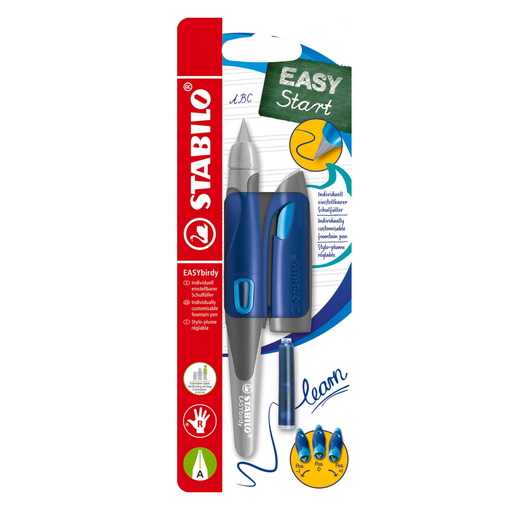
Its standout feature: This is the quintessential model for the learning phase. It checks all the boxes to ease a right-handed child's transition to a fountain pen.
Its non-slip grip section, with indentations specifically for right-handers, bypasses the "universal grip" problem. The adjustable nib and its covered base reduce the risk of leaks and inky fingers.
The nib can be adjusted to three different angles (with a small tool included) to perfectly match each child's unique hand position.
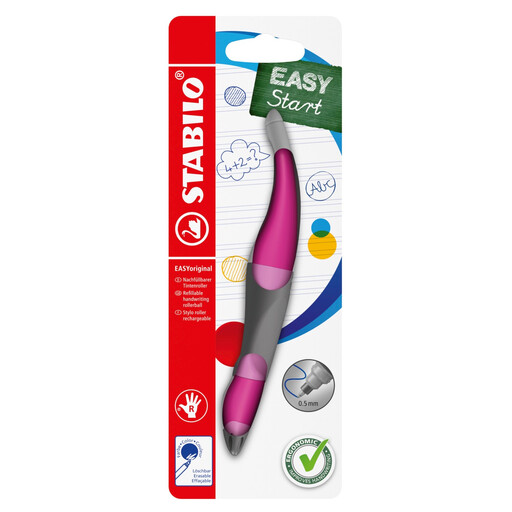
Its standout feature: For children (and parents) a little intimidated by a nib, this rollerball offers the same ergonomic benefits without the technical complexity of a fountain pen. An excellent, smooth transition.
It keeps the moulded grip section for right-handers but completely eliminates the risk of a scratchy or leaky nib. The result: a smooth, smudge-free glide from the very first use.
The best of both worlds! It teaches the correct pen grip with the simplicity of a rollerball. Bonus: the ink is also erasable.
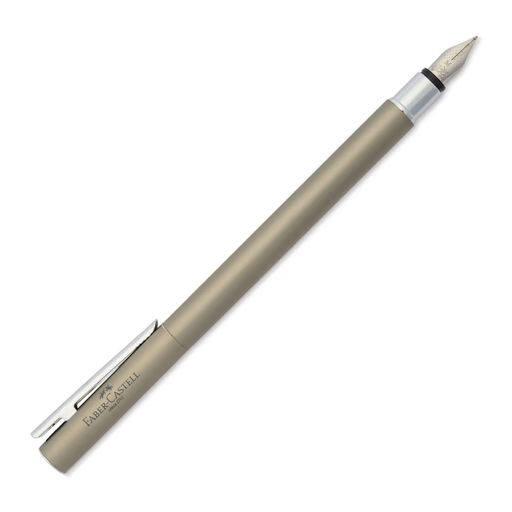
Its standout feature: Perfect for an older student (middle school, high school) or an adult looking for a pen that is elegant, slim, and comfortable. The logical next step after learning models.
Its slim, perfectly balanced body prevents hand fatigue, a classic flaw of low-end pens. The Faber-Castell stainless steel nib, renowned for its impeccable glide, avoids the "scratchy nib" syndrome.
A sleek, professional design in matte stainless steel, coupled with precise and reliable writing. A beautiful, durable, and rewarding object.
Our editorial team has selected a full range of products that meet our selection criteria and current standards.
There's no strict age limit, but the switch to a fountain pen usually happens in first grade (around 6-7 years old), once the child has a good grasp of writing with a pencil. The most important thing is that the child is ready and motivated. An ergonomic fountain pen for right-handers is specifically designed to make this transition as smooth as possible.
Maintenance is simple. The golden rule: always put the cap back on after use to prevent the ink from drying in the nib. If the pen hasn't been used for a long time and the ink won't flow, just unscrew the nib section and rinse it for a few seconds under lukewarm water. Dry it gently with a soft cloth before inserting a new cartridge.
Erasable blue ink is a standard in many schools. It allows a child to correct mistakes cleanly, without messy cross-outs, which is far less discouraging and encourages them to keep their notebook tidy. It's a way of giving them room for error—essential in any learning process—while getting them used to the presentation standards of writing with a pen.