Households where washing up by hand has become a daily chore
You mainly want to reduce a repetitive task and decide whether the practical benefits justify the purchase, without assuming that every household needs a dishwasher.


Choose a dishwasher if washing up every day is genuinely taking up your time and you can confirm that a suitable space is available. The right format then depends on your kitchen and the amount of washing: freestanding for greater flexibility, integrated when you have a suitable housing unit, or compact for a very small space. You should also compare the energy label, noise level and consumables.
You mainly want to reduce a repetitive task and decide whether the practical benefits justify the purchase, without assuming that every household needs a dishwasher.
You need to weigh up the flexibility of a freestanding model, the capacity of a slimline or compact appliance, and continuing to wash by hand if no suitable space is available.
You want to compare water and energy use, the duration of the eco cycle, noise levels, consumables and repairability, rather than focusing only on the most obvious specifications.
First confirm which format will fit your kitchen, then compare the capacity, consumption and noise levels of the appliances that genuinely suit the space available.
| Priority | What to check | Your needs |
|---|---|---|
| Everyday usefulness | Assess the amount of washing up you produce over several ordinary days and the cycle frequency you would find acceptable. Compare the place setting capacity with your actual routine. | I want to reduce a repetitive task without installing an oversized appliance if washing by hand is still quick and manageable. |
| Format and space | Measure the available space before choosing. Standard 60 cm models are advertised for 12 to 17 place settings, while 45 cm models take 9 to 10; an integrated dishwasher requires a suitable housing unit. | My kitchen must be able to accommodate the appliance without changing the layout at the last minute. A compact model could work if saving space matters more than capacity. |
| Consumption and maintenance | Compare the kWh per 100 cycles, litres per reference cycle and duration of the eco cycle on the energy label. Also allow for detergent, rinse aid, dishwasher salt and maintenance. | I want to compare usage on a like-for-like basis and plan for the products I will need to use regularly with the appliance. |
| Noise and repairability | Check the noise level in dB and its noise class, especially in an open-plan kitchen. Also look at the repairability index shown for the model you choose. | I want to run the appliance without disturbing the living area and include ease of repair in my decision. |
An integrated dishwasher must fit into a suitable housing unit and requires a compatible front panel, whereas a freestanding model has finished sides for a more independent installation.
Measure the space first and decide which solution suits it: freestanding, integrated, 45 or 60 cm wide, or compact.
For an integrated model, check the furniture door and its installation with the seller or kitchen installer.
A 45 cm slimline appliance can meet more needs than a compact countertop model, whose capacity remains limited. More frequent cycles can become inconvenient if the daily volume increases.
Look at your washing up over several typical days: choose a compact model for a small volume, but also compare a 45 cm appliance if you need more capacity.
The class does not tell you everything about water consumption, the duration of the eco cycle, noise or the consumables needed every day.
Read the full label: kWh per 100 cycles, litres per cycle, duration, capacity and dB. Also check the water softener settings according to your water hardness.
Detergent, rinse aid, dishwasher salt and maintenance are all part of everyday use.
In an open-plan kitchen, noise can affect everyday comfort. The repairability index helps you compare documentation, ease of dismantling and the availability of spare parts.
Compare the dB rating and noise class before buying, then check the repairability index for the model compatible with your kitchen.
These Joybuy options include freestanding, compact and fully integrated dishwashers, so you can compare the format with your kitchen space and household washing-up volume.
 Image unavailable
Worth considering for a kitchen that can accommodate a 60 cm freestanding dishwasher and a substantial daily load.
14 place settings, 11 programmes, half-load option, 75 kWh/100 cycles, 9,5 L per eco cycle and a declared noise level of 41 dB.
Check the installation dimensions, door clearance, connections and repairability index before buying.
 Image unavailable
A freestanding option for a household whose washing-up volume justifies 14 place settings.
Six programmes, adjustable upper basket, delay start, advertised water consumption of 9,5 L, 46 dB and energy class E.
Check the dimensions of 85 × 60 × 59 cm, the space beneath the worktop, connections, eco cycle duration and repairability index.
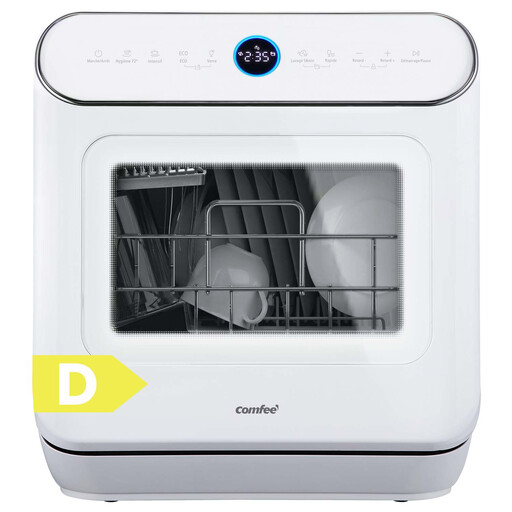 Image unavailable
This countertop format suits a very small space and a limited routine rather than large family loads.
Advertised capacity of 3 place settings, 7 programmes, dimensions of 420 × 436 × 465 mm, delay start, automatic opening and a tank that can be used without a permanent connection.
The capacity may mean running frequent cycles: check the actual load, door-opening space, noise level and consumption.
 Image unavailable
Consider this if your kitchen already has a suitable housing unit and you want the appliance concealed behind a furniture door.
13 place settings, energy class B, declared noise level of 44 dB, adjustable basket and AutoRelease door.
The stated minimum housing dimensions are 820–900 × 600 × 555 mm. Also check the front panel, hinges, plinth and connections.
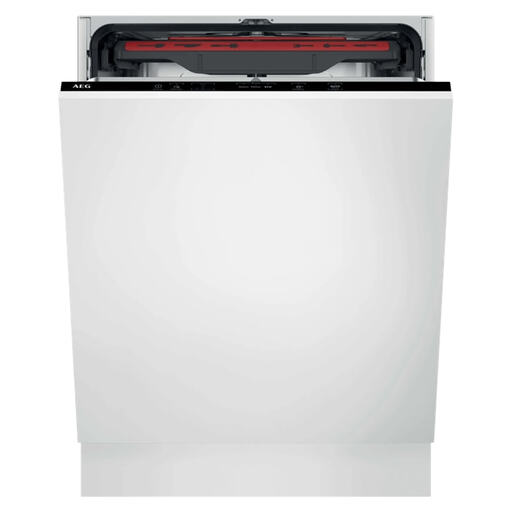 Image unavailable
This fully integrated option is designed for a household with a suitable housing unit that wants a capacity of 14 place settings.
14 place settings, 5 programmes, cutlery drawer, 10,5 L and 0,75 kWh per eco cycle, declared noise level of 44 dB and AirDry drying.
The advertised eco cycle lasts 240 minutes. Confirm the housing dimensions, front-panel and hinge compatibility, as well as the connections.
It is worthwhile when washing up by hand is repetitive or time-consuming and a suitable space is available. UFC-Que Choisir states that if cleaning and drying after meals takes less than 15 minutes, an appliance may not be essential; compare this indication with your actual volume and how you feel about the task every day.
Compare the energy class, kWh per 100 cycles, litres per reference cycle, capacity, eco cycle duration, noise level and noise class. ADEME reminds shoppers that the energy label must provide information both in shops and online.
No: an integrated model must be installed in a purpose-built housing unit and requires a compatible furniture door. A freestanding model has finished visible sides and offers greater flexibility when arranging the kitchen.
Allow for detergent and, depending on the product you choose, rinse aid and dishwasher salt. Follow the instructions when setting up the appliance, particularly when adjusting the water softener to suit your local water hardness.
Yes. The French Ministry for the Economy states that the repairability index is compulsory for dishwashers in France. This score out of 10 takes account of factors including documentation, ease of dismantling, spare-parts availability and their price.