What should you check before buying?
Freestanding
Consider this if: your kitchen has no dedicated recess and the connections are accessible.
Bear in mind: the appliance will remain visible. If you plan to install it under a worktop, check the model’s dimensions and installation requirements.
Fully integrated
Consider this if: you have a compatible recess and want a door panel to match your kitchen units.
Bear in mind: the door panel, its fixings and the plinth must be compatible with the appliance, so installation needs more preparation.
Semi-integrated
Consider this if: you want a door panel to match your kitchen while keeping the controls visible.
Bear in mind: you’ll still need a suitable recess and door panel, and the appliance won’t be as fully concealed as a fully integrated model.
Once you’ve chosen an installation type, consider whether the stated capacity suits your dishes and washing routine. A 45 cm width is an option for any compatible installation type, not a separate type of installation.
| Factor |
What to check |
Who is it for? |
| Installation and space |
Measure the width, height, depth and door clearance; check access to the water supply, drainage and electricity. For an integrated model, check the recess and door panel too. |
When my kitchen is already fitted, I want to install the appliance without finding out that it blocks a walkway or means changing the connections. Around 33% of consumers rank this as their most important requirement. |
| Capacity and loading |
Compare the stated place settings with the basket layout and space for your saucepans and large dishes. According to Que Choisir, 45 cm models generally hold 9 to 10 place settings, compared with 12 to 17 for 60 cm models. |
If my utensils quickly fill the baskets, I’d rather have a load size that suits my meals than have to run another cycle. Capacity and loading are the top priority for around 27% of consumers. |
| Running costs |
Check the kWh per 100 cycles, water per cycle and Eco programme duration on the label; also factor in anything needed for installation. |
For regular use, I want to compare water and electricity on a like-for-like basis, without overlooking what installation involves. Around 20% of consumers prioritise these costs. |
| Noise and everyday results |
Compare the decibels and noise class shown on the label. Check the programmes and, if possible, look for washing and drying tests on the exact model. |
In an open-plan kitchen, I want to minimise disruption during the cycle without having to rewash or dry the dishes by hand too often. This everyday convenience comes first for around 20% of consumers. |
Brands to compare
These ranges include examples of installation types and widths to consider; specifications vary by model.
Bosch
Bosch offers freestanding and integrated dishwashers in 45 and 60 cm widths. Its range lets you compare a slimline freestanding model with a standard-width option.
- Bosch’s specifications for the SPS4EMW17E describe a 45 cm freestanding model measuring 845 × 450 × 600 mm, with water consumption of 8,7 L per Eco cycle and a noise level of 44 dB.
- These figures apply to the SPS4EMW17E. Check the dimensions, consumption and features of each model separately.
Beko
Beko offers freestanding, semi-integrated and fully integrated models, making it useful for comparing different finishes in an existing kitchen.
- According to Beko’s specifications for the BDIN18451, this 60 cm fully integrated model is rated for 14 place settings and has a noise level of 42 dB.
- These figures apply to the BDIN18451 and don’t describe other models from the brand.
Whirlpool
The Whirlpool range includes 45 and 60 cm models, in freestanding, integrated and semi-integrated options.
- The Whirlpool catalogue includes the W3PFD636X, a 60 cm semi-integrated model.
- For each model you’re considering, check the recess, door panel and programme specifications rather than assuming they’re the same across the range.
Miele
Miele offers freestanding, integrated and fully integrated dishwashers in 45 and 60 cm widths.
- The Miele catalogue lets you compare basket configurations, drying features and noise levels across different models.
- Check each model’s specifications and the brand’s claims about washing or drying individually; these don’t prove general superiority.
Dishwashers to suit your kitchen
This selection includes freestanding appliances for kitchens without a dedicated recess and fully integrated models for fitted kitchens. First choose an installation type that works in your home, then compare the capacity and specifications of the model you’re considering.
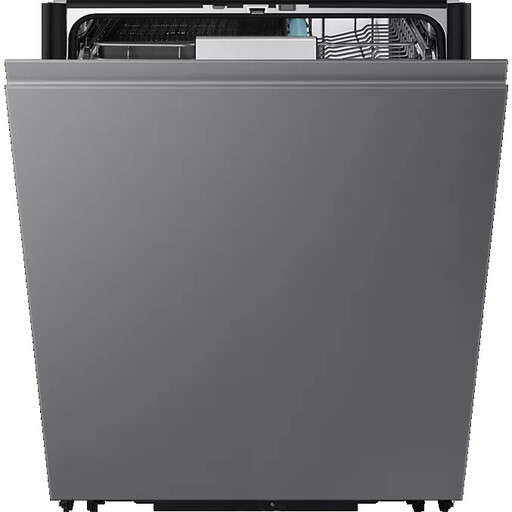 Image unavailable
Samsung DW90H79JAI0U1 Bespoke AI, fully integrated 60 cm
Worth considering for a fitted kitchen with a compatible recess and door panel.
Stated capacity of 14 place settings; energy class A. Check the installation measurements and exact Eco programme duration in the technical specifications before choosing.
View on Joybuy
 Image unavailable
Hotpoint H4FD641A, freestanding 60 cm, white
Worth considering if you have room for a 60 cm freestanding appliance without a kitchen-unit door panel.
Stated capacity of 14 place settings; 41 dB and energy class C. Check the full dimensions, connections and kWh per 100 Eco cycles on the label.
View on Joybuy
 Image unavailable
Samsung DW60M6050FS, freestanding, grey
Worth comparing if your kitchen can accommodate a freestanding model and you regularly have large loads of washing up.
Stated capacity of 14 place settings and seven programmes. Check the dimensions, door clearance and Eco programme water consumption on the model’s label.
View on Joybuy
 Image unavailable
Indesit D2F HK26 S, freestanding 60 cm, grey
Worth considering if you’re looking for a freestanding model for larger everyday loads.
Stated capacity of 14 place settings; energy class E. To compare running costs, check the kWh per 100 Eco cycles and which programme the stated water consumption figure applies to for this model.
View on Joybuy
 Image unavailable
AEG FSB34707Z, fully integrated 60 cm
Consider this only after confirming it’s suitable for your kitchen’s recess and door panel.
Stated capacity of 14 place settings; energy class C. Check the appliance’s actual dimensions and the compatible recess measurements before arranging installation.
View on Joybuy
Frequently asked questions
What connections do you need for a dishwasher?
You’ll need accessible water, waste water and electrical connections where you plan to install it. Que Choisir also recommends installing it on a stable, level surface. Check these points before choosing an appliance.
Can you alter a rented kitchen to install a dishwasher?
Under Article 7 of the French law of 6 July 1989, in the version in force since 15 June 2025 and published on Légifrance, changes that alter rented premises or equipment require the landlord’s written consent. Before drilling or making changes to fixed plumbing or kitchen units, explain the work you’re planning and check your tenancy agreement too. Whether a straightforward installation is permitted depends on the specific circumstances of the property.
What should you compare on the energy label?
Compare the energy class with the kWh per 100 cycles, water per cycle, capacity, Eco programme duration and noise level. ADEME and the European Commission explain that the consumption and duration figures shown relate to the Eco programme; they shouldn’t be applied as they are to other programmes.
Should a small household choose a 45 cm dishwasher?
No. A 45 cm width is mainly for homes with limited space, not a requirement based on household size. Que Choisir says this format generally holds 9 to 10 place settings, compared with 12 to 17 for a 60 cm model. Most importantly, check whether your dishes and saucepans fit in the baskets, and how often you want to run a cycle.


