Households still washing up by hand after most meals
Consider whether you have enough washing up to justify running regular cycles, and whether spending less time on this chore is worth the electricity and appliance maintenance.


If washing-up piles up after most meals and your kitchen can accommodate an installation, a dishwasher could make this daily chore easier. A freestanding model doesn’t need a matching cabinet door; an integrated model requires a suitable space, while a compact one offers less capacity in return for taking up less room. If you don’t have much washing up or installation would involve major alterations, sticking to washing up by hand may make more sense.
Consider whether you have enough washing up to justify running regular cycles, and whether spending less time on this chore is worth the electricity and appliance maintenance.
Measure the available space and check the connections before choosing between a 45 cm appliance, a compact model and washing up by hand. A worktop model also needs a suitable spot and a way to drain the water.
To fit the appliance in with your units, check the space, height, plinth and whether the cabinet door is compatible with the model you’re considering.
Start with how much washing up you have and the space available. Then compare the usage information for models that can actually be installed in your home.
Consider this if: you have a suitable space and don’t need to hide the appliance behind a matching cabinet door.
Bear in mind: its sides remain visible, and the connections must suit the space you choose.
Consider this if: you have a suitable space and want a cabinet door that matches your kitchen.
Bear in mind: the space, plinth and door-fitting system may need adjusting before installation.
Consider this if: you don’t have room for a standard appliance and are happy to wash smaller loads.
Bear in mind: its more limited capacity may mean running cycles more often.
Stick with this if: you don’t have much washing up, or there’s no suitable space and connections without major alterations.
The trade-off: washing up remains a chore after meals.
| Consideration | What to check | Think about your needs |
|---|---|---|
| Capacity | Compare the stated place settings with the amount of washing up you produce between washes. For freestanding models, Que Choisir associates 45 cm models with 9–10 place settings and 60 cm models with 12–17; always check the exact model number. | I want to avoid both running cycles too often and having an appliance that’s rarely full. |
| Water and energy | Compare labels on a like-for-like basis: kWh per 100 cycles and litres per Eco cycle, as well as its duration. ADEME and the European Commission present these figures as reference values, not as figures for every programme. | I want to compare how the models perform in everyday use, rather than comparing a quick cycle with an Eco cycle. |
| Noise | Check the noise level and noise class on the label for the exact model. Consider where the appliance will be used. | In an open-plan kitchen, noise during a cycle matters to me. |
| Installation | Measure the height, width and depth; check the water supply, drainage and electrical supply. For an integrated model, also check the space, plinth and cabinet door against the installation diagram. | My kitchen needs to be able to accommodate and connect the appliance without alterations I don’t want to take on. |
| Maintenance | Check the maintenance guidance, repairability index and information about spare parts for the model you’re considering. | I want to be able to maintain the appliance and consider how repairable it is, not just how much it holds. |
An appliance might fit the width available but still be too tall or deep. An integrated model also depends on the dimensions of its space and its installation diagram.
Measure all three dimensions, check the connections and consult the diagram for the exact model. In a fitted kitchen, check the cabinet door and plinth too.
Carpentry, plumbing or electrical work may be needed if the space isn’t ready for the appliance.
The water and energy figures on the label relate to the Eco reference cycle. They don’t necessarily describe a quick or intensive programme.
First compare kWh per 100 cycles, litres per cycle, duration and noise on the labels. Then look separately at any other programmes you plan to use.
A compact model takes up less space, but its size alone doesn’t tell you its energy consumption or energy class.
Compare its capacity and label figures with those of a 45 cm model, taking into account how many cycles you’d need for your washing up.
An appliance that meets your capacity needs should also be easy to maintain in a way that suits you.
Keep the full model number and check its repairability index, maintenance documentation and information about spare parts.
These range and model examples can help you identify features to check; they don’t represent every appliance from each brand.
The French range includes, among other options, 45 and 60 cm freestanding models and compact models, giving you a choice of sizes to compare.
The French range includes freestanding and integrated appliances, with noise levels listed for individual models.
The brand’s product information lets you compare capacity and programmes model by model.
These models show two options for your first dishwasher: freestanding appliances for larger loads and worktop models for smaller amounts. Check the dimensions and installation requirements for each model before choosing.
 Image unavailable
Worth considering if your household regularly has large loads. The product title lists 14 place settings, 60 cm, 41 dB and energy class C; check the full dimensions and connections for your space.
 Image unavailable
An option to consider for regular loads: the title lists 14 place settings and seven programmes. Compare the model’s label and confirm its dimensions and connection requirements.
 Image unavailable
For a household that regularly fills a full-size appliance, the title lists 14 place settings, 60 cm and energy class E. Check the height, depth and connections before considering installation.
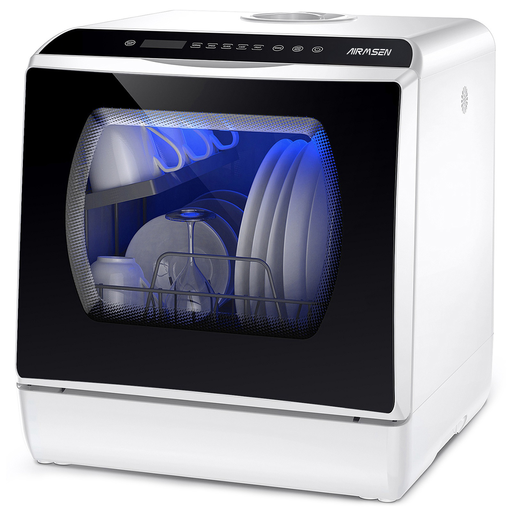 Image unavailable
The worktop design and built-in tank may suit a kitchen where space or a fixed water supply is an issue. The title lists 5+1 cycles; make sure you have a suitable surface and check how to drain the water from the hose.
 Image unavailable
This worktop model lists six place settings and seven programmes for smaller loads. Its title also lists 47 dB and energy class D; check its size and connections before choosing a spot for it.
Compare the labels for the Eco programme: kWh per 100 cycles, litres per cycle and duration, while also taking capacity into account. According to ADEME and the European Commission, these figures are based on a reference cycle; they don’t describe the consumption of a quick or intensive programme.
Measure the width, height and depth, then check the water supply, drainage and electrical supply. For an integrated model, also check the space, plinth, cabinet door and installation diagram for the model. Electrolux France says its installers don’t carry out carpentry, plumbing or electrical work.
Yes, if the space or cabinet door isn’t already suitable: an integrated model needs to fit into a space designed for it, as Que Choisir points out. Check the door-fitting system and any adjustments needed before arranging installation. A freestanding appliance also needs to fit in the space and be connected correctly.
No, not with every washing-up routine. Que Choisir gives at least 30 L for washing up by hand and less than 15 L per dishwasher cycle as useful points of reference. However, how meaningful this comparison is depends on how much you wash, how full the appliance is and your hand-washing habits.