
Livraison le jour même ou le lendemain

Qualité garantie

Débloquez vos offres de bienvenue: Livraison GRATUITE | Jusqu'à -80 % | 30 jours d'essai gratuits à JoyPlus
Téléchargez l'application
Protecting your most valuable possessions is a top priority. Property deeds, passports, family heirlooms, or business data: in the face of a fire or flood, the consequences can be irreversible. A fireproof and waterproof safe stands out as the most secure solution.
But be careful—the market is filled with models making tempting, and often misleading, claims. To help you navigate the options and make a truly informed decision, we've broken down the common pitfalls to avoid and the essential criteria to check.
Buying a safe is a long-term investment in your security. It's crucial not to be swayed by marketing claims that can hide critical weaknesses.
To ensure effective protection, three parameters must be examined closely. They are the true identity card of your future safe.
The terms "fireproof" and "waterproof" are meaningless without a standard to quantify them. The two most reliable international certifications are UL (Underwriters Laboratories) and ETL (Intertek).
The choice of locking mechanism depends on your habits and desired security level.
Before choosing, make a precise list of what you want to protect. Check the internal dimensions to ensure your binders, laptops, or valuables will fit without difficulty. A good home safe should offer removable shelves, door hooks, or a drawer to optimize the space.
To move from theory to practice, here are a few models that meet specific needs, all selected for their performance and reliability.
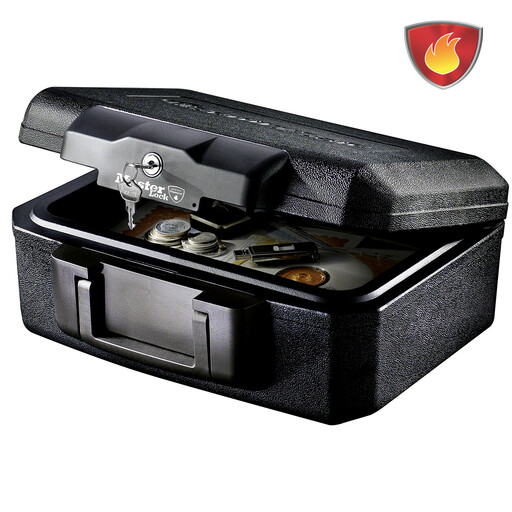
Why it stands out: Perfect for securing essential documents (passports, birth certificates) and some digital media. Its compact size and handle make it very practical for apartments, or even for taking with you if needed.
It doesn't just make a vague "fire-resistant" promise. It clearly displays its UL and ETL certifications, guaranteeing verified protection for documents and digital media for 30 minutes at 843°C (1550°F).
Dual certification (fire and digital media) in a compact, portable format, all secured with a simple and time-tested key lock.
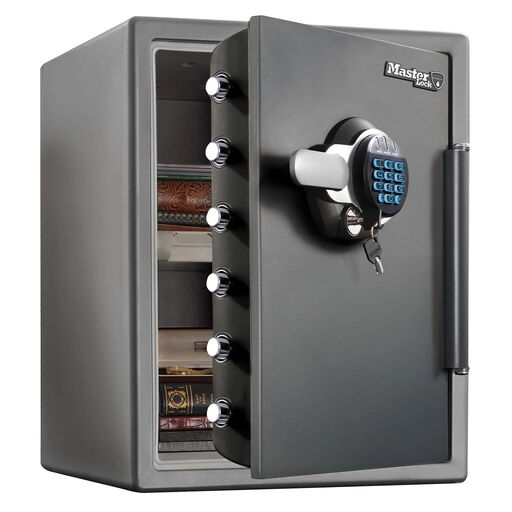
Why it stands out: This professional safe offers a large 56-liter capacity, perfect for small businesses or families with significant assets to protect. It combines advanced fire and water protection with a reinforced locking system.
It avoids the pitfall of a weak lock. In addition to its steel construction, it features six live-locking bolts and a pry-resistant hinge bar, all secured by a dual lock system (electronic combination and key).
Long-duration fire protection (UL 2 hours at 927°C / 1700°F) and water protection (ETL 24h), combined with top-tier anti-theft security.
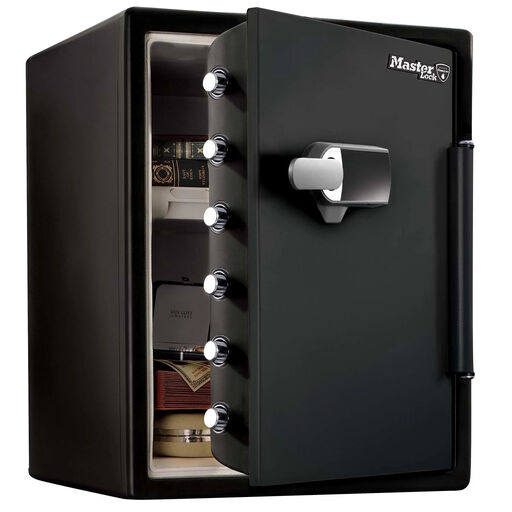
Why it stands out: For those who want no compromises. It offers complete protection against fire, water, and even impact (tested to withstand a 15 ft. / 4.5-meter drop during a fire). The integrated alarm and interior lighting make it a top-of-the-line choice.
It avoids the pitfall of poorly optimized space. Its large interior is intelligently designed with a deep tray, a drawer, and LED lighting, allowing you to easily store and find your most precious items.
Triple certification (fire, water, impact) and an integrated anti-theft alarm for total peace of mind.
We have selected a full range of products for you that meet our strict criteria for security and reliability.
Not always. Paper can withstand temperatures up to 177°C (350°F), but electronic media can be damaged at temperatures as low as 125°C (257°F). For adequate protection, you must choose a safe with a specific certification, such as the ETL Verified mark for digital media, which guarantees a lower internal temperature is maintained.
Bolting the safe to the floor is highly recommended to prevent the entire safe from being stolen. However, it is essential to follow the manufacturer's instructions carefully. On some models, drilling for installation can compromise the waterproof or fire-resistant properties. The manufacturer's data sheets, like those from Master Lock, will specify whether the certifications remain valid after the safe is bolted down.
The term "fire-resistant" is often a marketing claim with no technical value. In contrast, a product described as "fireproof" must be backed by a certification (UL or ETL) that specifies the duration and temperature level it was tested at (e.g., 1 hour at 927°C / 1700°F). Only this standard guarantees true document protection in a fire.