
Livraison le jour même ou le lendemain

Qualité garantie

Débloquez vos offres de bienvenue: Livraison GRATUITE | Jusqu'à -80 % | 30 jours d'essai gratuits à JoyPlus
Téléchargez l'application
The dread of losing irreplaceable documents—passports, property deeds, family photo backups—is universal. In the face of a fire or flood, a good safe promises restored peace of mind. The problem? The market is flooded with models making vague promises. To make the right choice, you need to learn how to decode the labels and sidestep marketing traps.
Before you decide, here are the three pitfalls to avoid at all costs:
For an informed choice, focus on objective data. Here are the three points to scrutinise.
These globally recognised labels are your best guarantee of performance for a fireproof safe. Be aware, they are not equivalent.
The choice mainly depends on your habits and the ease of use you're looking for.
Capacity, expressed in litres, is a decisive factor. Before buying, take inventory of what you want to protect: A4 documents, binders, a laptop, jewellery, etc. Above all, double-check the internal dimensions, as the thick layer of insulation often drastically reduces the usable space.
We have selected a few models that stand out for their reliability and meet a variety of needs, based on the objective criteria we've just covered.
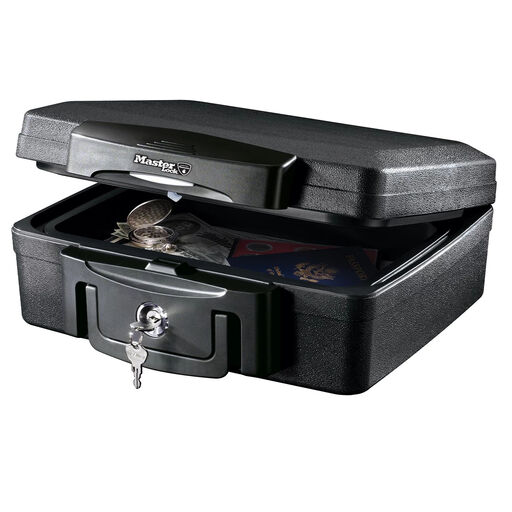
Who is it for? Perfect for securing the essentials (passports, ID documents, digital backups). Its carrying handle makes it very practical for those who are frequently on the move or live in a small space.
This model is fully transparent with clear certifications: UL for paper and ETL for digital media (30 min at 843°C / 1550°F), supplemented by an ETL certification for water immersion. Goodbye to empty promises.
Its strength: certified dual protection (fire and water) in a compact, portable format. The key lock ensures simple operation that never fails due to dead batteries.
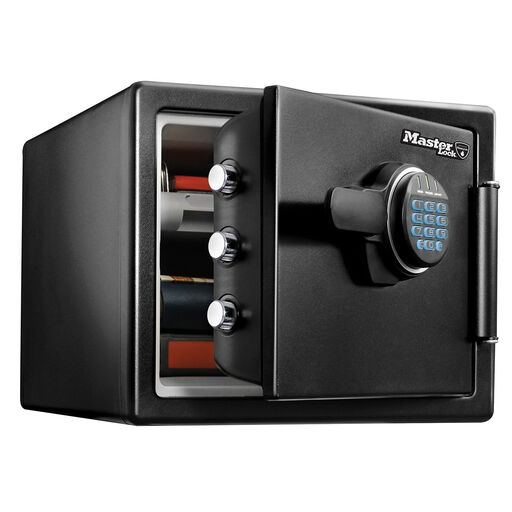
Who is it for? The perfect balance for family use. Its 22.8L capacity comfortably stores documents, electronics, and valuables. The backlit digital keypad is a real plus for daily use.
It provides a clear answer to the mounting dilemma: its technical sheet specifies that the ETL waterproof certification (24h in 12 cm of water) is only valid if the safe is not bolted down. The user is informed, so there are no nasty surprises.
High-level protection (UL/ETL 1h at 927°C / 1700°F) against fire, water, and impact. Its well-designed interior, with a shelf and lighting, makes organisation easy.
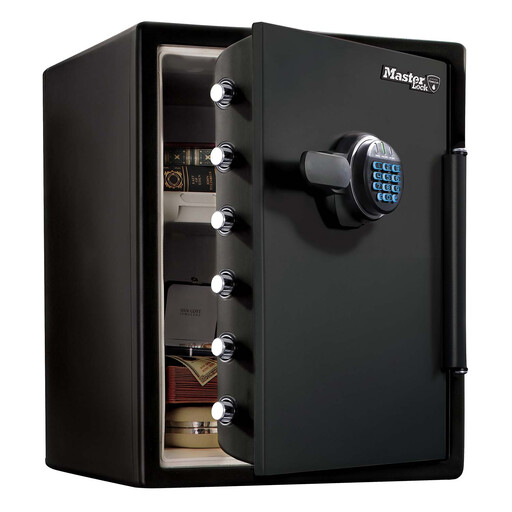
Who is it for? For small businesses or families with significant storage needs. Its large 56.5L volume and six steel locking bolts make it a fortress for documents, backups, and high-value items.
This model is completely transparent about its advanced certifications (UL/ETL for fire, water, and impact). It even provides the mounting kit while stating in black and white that using it will void the waterproof guarantee.
Its XXL capacity and reinforced physical security (6 locking bolts, pry-resistant hinge). The interior is spacious and perfectly arranged with a drawer and LED lighting.
Discover our full selection of products that meet our strict selection criteria and current safety standards.
For optimal fire protection, the golden rule is to place the safe as low as possible (ground floor or basement), as heat always rises. Avoid proximity to potential fire sources. A discreet corner or the inside of a closet are ideal locations.
Absolutely. Digital media are much more sensitive than paper: they can be destroyed by heat and humidity long before paper begins to char. You must look for a safe with a specific ETL certification for digital media. It guarantees that the internal temperature and humidity levels will remain at levels that are safe for your data.
It all depends on your priority: theft or water damage. Bolting to the floor or wall is formidable against theft. However, as we've seen, drilling into the shell of a certified waterproof safe systematically voids this guarantee. If your main fear is flooding, it's better not to bolt it down. If the risk of theft is greater, mounting is recommended, but you must accept sacrificing the waterproofing. A few rare models are designed to be mounted without losing their protection, but a careful reading of the manufacturer's instructions is essential.