
Livraison le jour même ou le lendemain

Qualité garantie

Débloquez vos offres de bienvenue: Livraison GRATUITE | Jusqu'à -80 % | 30 jours d'essai gratuits à JoyPlus
Téléchargez l'application
A fire, a water leak or a break-in attempt can damage passports, notarised deeds, contracts, USB drives or jewellery in just a few minutes. Yet choosing a fireproof and waterproof safe isn't just about comparing prices and appearance.
Some features highlighted by manufacturers can prove insufficient in practice. Here are the pitfalls to avoid and the criteria to examine before placing your order.
A thick seal or lid doesn't necessarily mean the box will withstand immersion. To protect your documents after fire brigade intervention or in the event of flooding, check that immersion resistance has been validated, as indicated by the ETL certification found on certain Master Lock safes.
Fire resistance depends on several factors: exposure time, temperature, type of contents protected and classification method. A safe designed for paper documents doesn't necessarily offer the same level of protection for digital media. USB drives, CDs, DVDs and external hard drives may have their own specific certification.
For example, a UL classification of half an hour at 843°C is not the same as a classification of one hour at 927°C. These values correspond to the declared characteristics for the product in question and are not interchangeable.
A compact safe may seem practical, but insufficient internal height will force you to fold A4 sheets, certificates or folders. Meanwhile, a key lock means you have to keep spare keys in a separate place, whereas a digital combination lock requires you to monitor the batteries and manage the code carefully.
Before ordering, measure the documents you want to protect and check the internal dimensions, rather than relying solely on the external dimensions.
For use at home or in the office, choose a specification sheet that clearly distinguishes:
A water-resistant safe can enhance the security of a home, but it doesn't replace basic precautions: keep it away from heat sources, close the lid fully and follow the manufacturer's care instructions.
A capacity of 4.9 litres is sufficient for a small set of passports, cards, certificates and digital media. Models of 7.8 or 10 litres offer more space for storing A4 documents flat.
Also consider weight and portability. A portable safe with a handle is easy to carry. Conversely, a model intended to stay in an office or cupboard should be installed in a discreet, hard-to-remove location.
A key safe doesn't rely on batteries and remains simple to use. However, the keys must be kept outside the safe, in a place accessible to authorised people, but not right next to it.
A digital combination safe avoids the need to manage a physical key. However, you need to plan for battery replacement and keep the master code in a separate, secure place. For a remote worker, a family or a small business, the best choice depends mainly on your usage habits and the number of people authorised to access the contents.
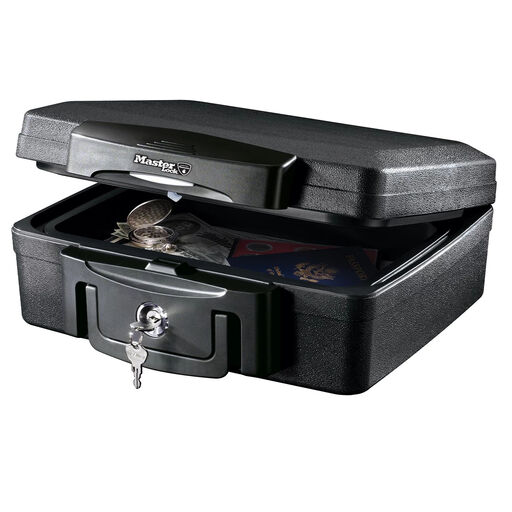
Why this choice suits this profile: Its compact size is ideal as a first safe for keeping passports, ID documents, USB drives and small valuables at home.
The specification mentions a UL classification of half an hour at 843°C for documents, as well as ETL verification for immersion. It doesn't rely on a simple promise of waterproofing.
4.9L capacity, integrated handle, key lock and stated protection for digital media.
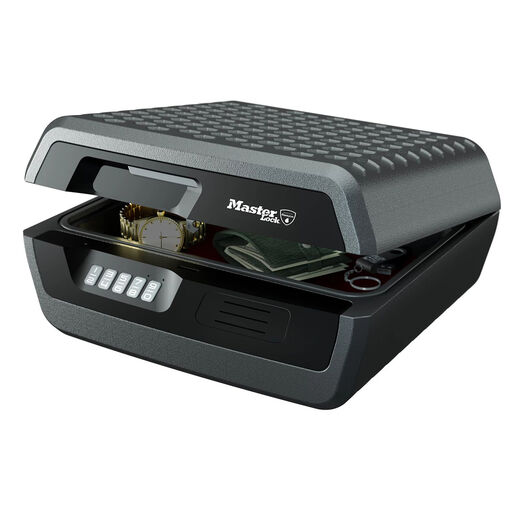
Why this choice suits this profile: This model is designed for those who regularly access their documents and don't want to rely on a physical key.
The specification distinguishes between protection for documents and digital media, and states that the unit is not designed for prolonged immersion.
10L, A4 flat storage, programmable user combination, master code and keypad usable in silent mode.
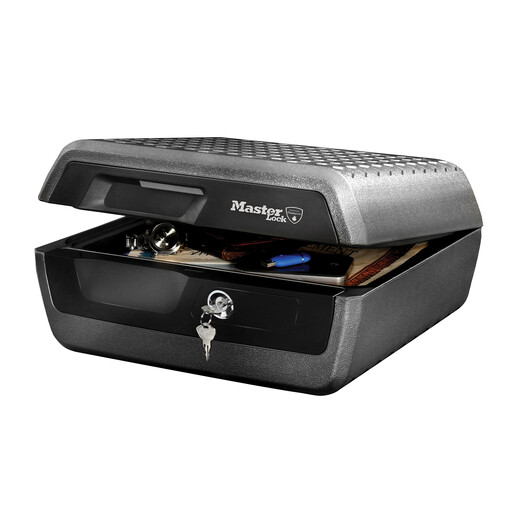
Why this choice suits this profile: Its capacity and size are suitable for a household or small office that stores several paper files and digital media.
The internal dimensions of 13.6 × 32.1 × 23.2 cm are stated for storing A4 sheets flat, avoiding unpleasant surprises about the actual capacity.
Stated UL classification for one hour at 927°C, ETL verification against immersion and two keys supplied.
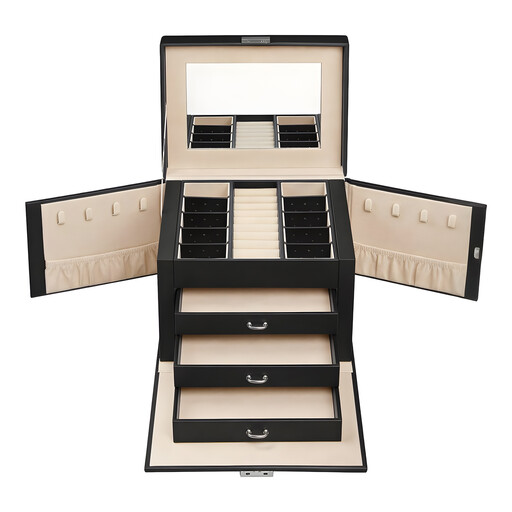
Why this choice suits this profile: This lockable jewellery box lets you organise rings, earrings, bracelets and necklaces, without claiming to offer fire protection.
The compartments, side hooks and three drawers prevent pieces from mixing together and chains from getting tangled.
Four levels, integrated mirror, carry handle, velvet interior lining and two keys supplied.
We've put together a comprehensive, real-time updated selection of products that meet these demanding criteria as well as European safety standards.
A portable safe primarily protects its contents; it does not necessarily provide a permanent anti-theft fixing. For a fixed installation, check that the model and support allow for suitable fixing.
Yes, some models of 7.8 or 10 litres are designed to accommodate A4 sheets flat. Always check the internal dimensions: the capacity in litres alone doesn't tell you the actual width available.
The duration of fire protection depends on the stated classification. It does not correspond to the general lifespan of the safe. Regularly inspect the lid, seals, lock and exterior condition, then check the warranty and the manufacturer's recommendations.
It can be suitable for small jewellery if the internal space is sufficient, but it doesn't necessarily offer practical storage. For necklaces, rings and earrings, a secure storage box or a jewellery organiser with a mirror will be more suitable. A travel jewellery case, a jewellery box with drawers or a lockable model meet an organisational need, not a fire and water certification.