
Livraison le jour même ou le lendemain

Qualité garantie

Débloquez vos offres de bienvenue: Livraison GRATUITE | Jusqu'à -80 % | 30 jours d'essai gratuits à JoyPlus
Téléchargez l'application
Protecting your most valuable possessions against fire, water, and theft is a natural concern. Important documents, family heirlooms, digital media holding a lifetime of data... a fire or flood can destroy everything in an instant. Faced with this risk, a fireproof and waterproof safe is the clear solution. However, the market is flooded with models that make impressive claims but often prove disappointing, or even useless, when disaster strikes.
As a product expert at Joybuy, my mission is to help you navigate the options. Here are the pitfalls to avoid and the essential criteria for making an informed choice.
Investing in a safe is an act of foresight. But be warned: marketing sometimes highlights features that mask critical weaknesses.
To ensure your investment is a wise one, rely only on objective data. Here are the three non-negotiable points.
Forget marketing slogans and trust only the standards. The two key certifications are:
The choice depends on your habits and desired security level.
Before buying, take a precise inventory of what you plan to store. The volume in litres is a good indicator, but it's the internal dimensions that truly matter. Make sure the safe can hold A4 documents flat without folding them. Features like adjustable shelves, key hooks, or door pockets are valuable convenience features for organising your belongings.
To help you see how these criteria translate in practice, here are a few models suited to different needs.
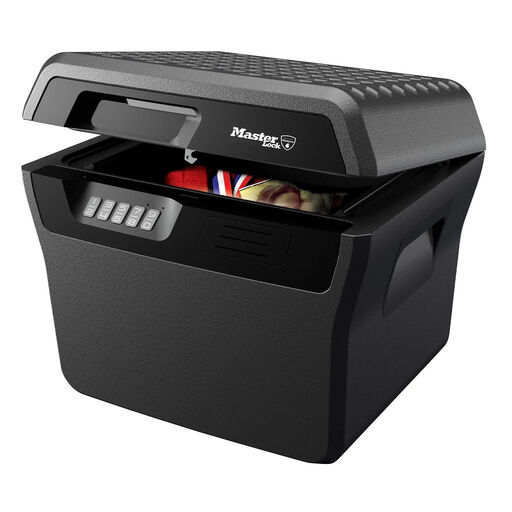
Why it's right for you: Perfect for individuals looking to secure their first important documents (passports, birth certificates, contracts) and some digital media. Its compact and portable design makes it easy to store in a closet or wardrobe.
This Master Lock model has clear certifications: UL for paper (30 min at 843°C) and ETL for digital media (same duration, same temperature), as well as for water submersion. It thus avoids the pitfall of two-tiered protection.
Certified and versatile protection (paper, digital, water) in a compact size, ideal for home use.
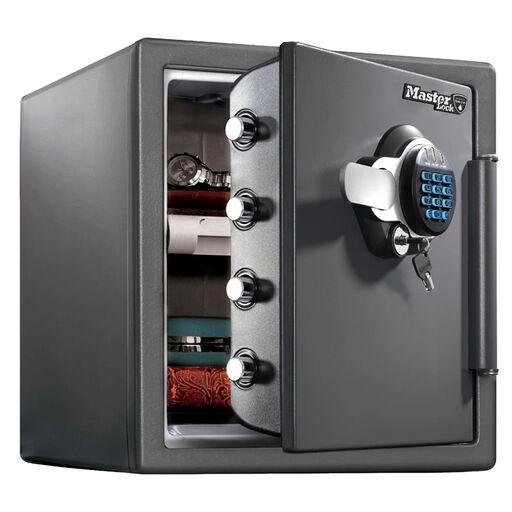
Why it's right for you: Designed for small businesses, independent professionals, or families with valuable assets. Its generous volume and superior fire resistance offer maximum peace of mind.
With a UL certification of 2 hours at 927°C, it outperforms entry-level competitors. Its dual lock (digital code + key) makes unauthorised opening nearly impossible, even if one of the two access methods is compromised.
Extra-long fire protection (2 hours) and rock-solid access security thanks to the dual lock system.
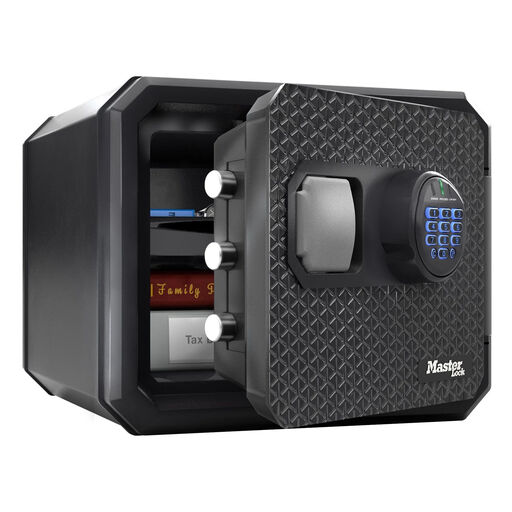
Why it's right for you: The perfect solution for those who want to bolt their safe to the floor (for maximum theft protection) without sacrificing its waterproof rating. An excellent compromise for mixed use, at home or in the office.
It brilliantly solves the mounting dilemma. This model comes with a patented waterproof bolt-down kit, allowing it to be securely anchored to the floor while maintaining its ETL waterproof certification.
The ability to bolt down the safe without compromising on water resistance, thus combining anti-theft and anti-flood protection.
We have curated a complete selection of products that meet these rigorous selection criteria and current standards.
1. What is the difference between fire protection for paper and for digital media? The cellulose in paper only begins to degrade at 177°C. In contrast, data storage media like USB drives, hard drives, or DVDs can be irreversibly damaged at temperatures as low as 120°C, and sometimes even lower with prolonged exposure. This is why it's crucial to choose a safe with an ETL certification specifically validated for digital media if you plan to store such items.
2. Is it mandatory to bolt a safe to the floor? It's not mandatory, but it is highly recommended for effective theft protection. A small safe that isn't bolted down can simply be carried away by burglars, who can then take their time opening it elsewhere. If you choose to bolt it down, either ensure the model is designed for it without losing its waterproof rating, or be prepared to accept this trade-off if the risk of flooding is negligible in your area.
3. What is the battery life for a digital safe? Generally, the batteries in a digital safe last between one and two years with normal use. Most models have a low-battery indicator to warn you well in advance. As a precaution, it's a good idea to change them once a year to avoid any issues. Most importantly, keep the backup key (if the model has one) in a secure location, but never inside the safe itself