
Livraison le jour même ou le lendemain

Qualité garantie

Débloquez vos offres de bienvenue: Livraison GRATUITE | Jusqu'à -80 % | 30 jours d'essai gratuits à JoyPlus
Téléchargez l'application
Protecting your important documents, family keepsakes, or digital media is a top priority. In the face of a fire or flood, a good safe can literally save everything. The problem? The market is flooded with models making marketing promises that are often misleading. To choose the right one, you need to know how to decipher technical specifications and not be swayed by advertising claims.
Before you invest, here are the most common pitfalls to watch out for to avoid any unpleasant surprises:
To get a clearer picture, focus on these three technical parameters. They are what determine the true level of security for your home and office.
These are the only truly reliable performance indicators, as they are not awarded by the brands themselves but by independent laboratories.
The choice of lock is a trade-off between ease of use and level of security.
Carefully assess what you plan to store. An 18-litre safe might be enough for passports and a few hard drives, but you'll need to aim for over 50 litres for A4 binders, laptops, or bulkier valuables.
Mounting is another crucial point. A safe that isn't bolted down can simply be carried away by burglars. Most models come with a floor-mounting kit. Be careful to check if this installation voids the waterproof certification. Some rarer models offer dedicated waterproof bolting kits.
Rather than an exhaustive list, here are options that cater to distinct user profiles, taking into account security criteria and the pitfalls to avoid.
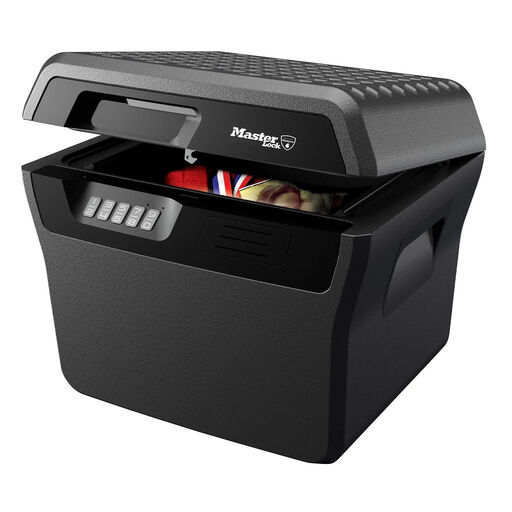
Best for: Securing essential documents (passports, property deeds, wills) and digital media (USB drives, hard drives) for the whole family. Its compact size allows it to be easily hidden in a closet or cabinet.
This model doesn't just make vague promises. It clearly displays its certifications: UL for 30 minutes of document protection at 843°C and ETL for digital media protection at the same temperature, as well as for water immersion.
Certified protection for both documents and digital media. Its programmable digital combination lock is more secure than a simple key.
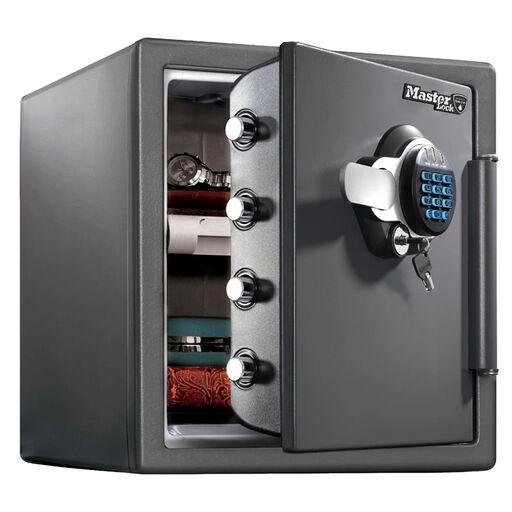
Best for: Small to medium-sized businesses or individuals requiring maximum protection. Its 2-hour fire resistance is a decisive asset for critical archives and files. The dual lock is perfect for secure, shared access control.
It bypasses the "weak lock" pitfall by requiring dual authentication (code + key). Its UL certification for 2 hours at 927°C is a high-level performance feature, far beyond vague marketing claims.
Extended 2-hour fire protection. Dual-locking system for maximum security. Well-organised interior with shelves and lighting.
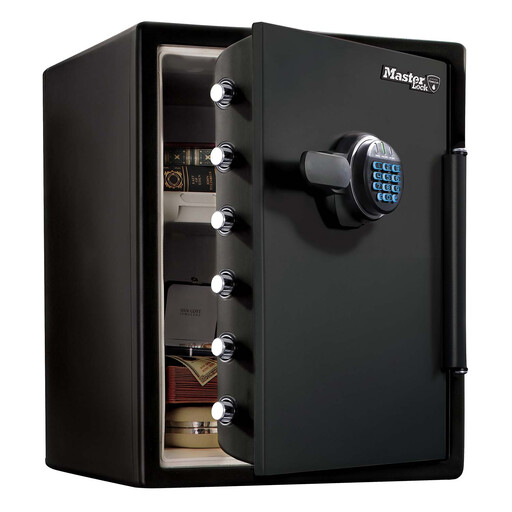
Best for: Families or anyone needing to store a large volume of items: binders, photo albums, jewellery, electronics... Its interior layout with a tray, drawer, and LED light makes organisation much easier.
This model is transparent about the waterproofing pitfall: its description specifies that the ETL water protection certification is only valid before it is bolted down. This allows the user to make an informed choice between maximum theft protection (by bolting it) and flood protection.
Very large 56.5 L capacity with an optimised interior layout. Certified UL/ETL protection against fire, water (before bolting), and impact.
But protecting your valuables isn't limited to the walls of your home. Property protection solutions also exist for when you're on the go: a high-security bike lock is essential in the city, while a robust utility van lock will secure your professional equipment.
Explore our full selection of products that meet our strictest criteria for security and reliability.
These are performance labels issued by independent laboratories, guaranteeing that the product has been tested according to strict protocols. UL primarily focuses on fire resistance for paper documents. ETL tests a wider range of protections, including fire resistance for digital media (USB drives, CDs), water resistance (immersion), and impact resistance (drops). These certifications are a much more reliable guarantee of quality than simple marketing claims.
For optimal theft protection, bolting it down is highly recommended. A safe weighing less than 100 kg can be easily carried away by burglars to be opened later at their leisure. However, be aware: on many models, the drilling required for installation voids the waterproof guarantee. If protection against water damage is your priority, check if the model offers a waterproof bolting kit or consider not bolting it down.
Maintenance is minimal but crucial. Remember to replace the batteries in the digital lock once a year, or as soon as the low battery indicator lights up. Always use high-quality alkaline batteries of the same brand. To clean the keypad, avoid harsh chemicals; a soft, slightly damp cloth is sufficient. Finally, and most importantly, keep the backup key (if provided) and master codes in a secure location, but NEVER inside the safe itself.