
Livraison le jour même ou le lendemain

Qualité garantie

Débloquez vos offres de bienvenue: Livraison GRATUITE | Jusqu'à -80 % | 30 jours d'essai gratuits à JoyPlus
Téléchargez l'application
Protecting your most valuable possessions is a top priority. Whether it's irreplaceable documents (property deeds, passports) or items of high sentimental and financial value, the mere thought of losing them in a fire or flood is a source of anxiety. A fireproof and waterproof safe is the obvious solution, but navigating the market can be overwhelming, with a dizzying array of marketing claims where it's easy to get lost.
As Head of Product Curation at Joybuy, my mission is to help you gain some clarity. Let's break down the pitfalls to avoid and the essential criteria for making an informed choice that's perfectly suited to your needs.
Technical jargon and manufacturer promises can easily mislead you. Here are three key things to watch out for to ensure you don't regret your purchase:
To choose a model that will live up to its promises in a disaster, focus on these three objective parameters.
The protection of paper documents from fire is the primary mission of a fireproof safe. The most recognized certifications are from Underwriters Laboratories (UL) and Intertek (ETL). They guarantee that the temperature inside the safe will remain below a critical threshold for a specified period.
Check the ETL certification for water protection. It specifies the immersion depth and the duration for which the contents will remain dry. For example, a certification for "24 hours in 20 cm (8 inches) of water" offers real peace of mind in case of flooding or firefighter intervention. Don't forget to check the conditions, especially the impact of floor mounting on this protection.
A good home safe or professional safe must be robust. Pay close attention to the following elements:
Here are a few models that meet specific needs, all evaluated based on objective performance criteria.
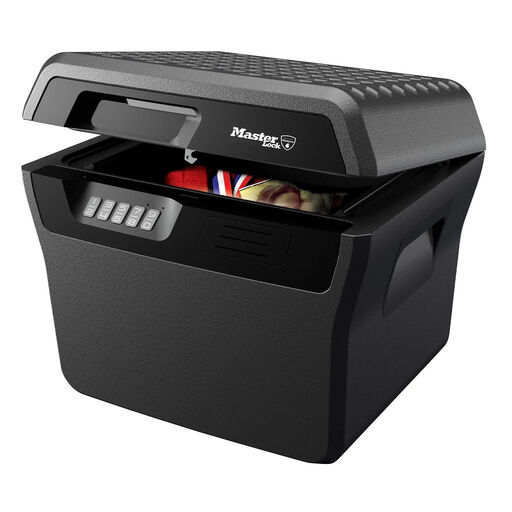
Why we recommend it: Ideal as a starter safe or for securing essential documents (ID papers, contracts) and a few valuables. Its size allows you to store A4 documents flat and slide it into a cupboard. It's an excellent **small fireproof safe** for home use.
It doesn't just make an empty promise. It displays clear certifications: UL for fire (30 min at 843°C / 1550°F) and ETL for water and digital media protection. A guarantee of verifiable performance.
Dual certification (fire and water) for documents and digital media, in a compact and affordable format.
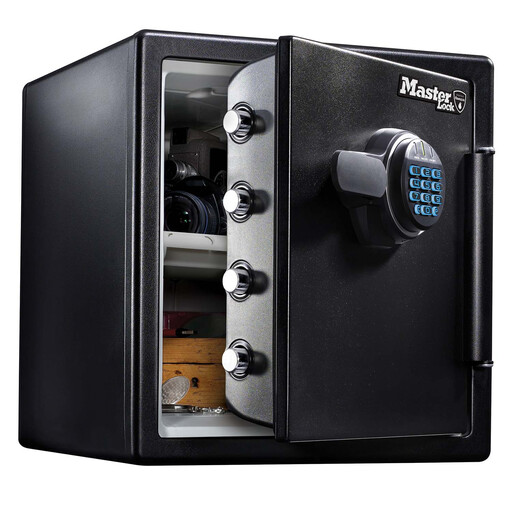
Why we recommend it: With its 33.6-litre capacity and well-designed interior (shelf, door storage), it's perfect for centralising a whole family's documents or a small business's important files. The backlit digital lock is a real everyday convenience.
It counters the pitfall of a high-tech lock on a flimsy body. It features four large live-locking bolts and a pry-resistant hinge. It's even ETL certified to withstand a 4.5-metre (15-foot) drop during a fire, proof of its unwavering toughness.
An excellent balance of capacity, interior organisation, and certified triple protection (fire, water, drop).
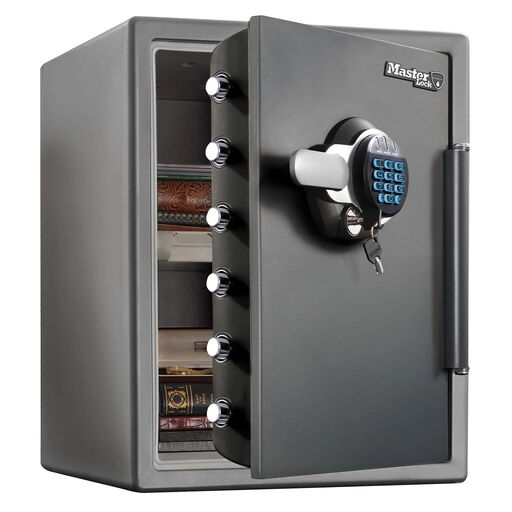
Why we recommend it: For professionals or individuals with high-value assets or a large volume of confidential documents. Its 2-hour fire protection (UL classified) and dual-locking system (code + key) offer a maximum level of security.
It directly addresses the risk of insufficient fire protection. With a fire resistance of 2 hours at 927°C (1700°F), it provides a much greater safety margin than standard models, a critical asset in a major fire.
Extended fire protection and enhanced access security through a mandatory dual-locking system.
We have curated a complete range of safes that meet our strict selection criteria and current security standards.
Bolting the safe to the floor is highly recommended to prevent the theft of the safe itself. However, be aware: this operation almost always voids the waterproof certification, as drilling breaks the integrity of the shell. You must therefore make a trade-off: prioritise protection against theft or against water. Finally, never mount a safe to a wall, as this would void its fire resistance.
Digital media (USB drives, hard drives, CDs) are much more fragile than paper. They can be damaged by heat long before paper begins to char (as low as 50-60°C / 122-140°F) and are also very sensitive to humidity. If you want to protect these types of items, make sure the safe has a specific ETL certification for digital media. This guarantees a much lower internal temperature and humidity level than the standard for paper.
Under normal use, the batteries in a digital lock last for a year or more. Most models are equipped with a low-battery indicator. We recommend replacing them once a year as a precaution. And what if the batteries die? Don't panic: almost all quality digital safes come with a backup key that allows you to override the system. Keep this key in a safe place, but most importantly, never inside the safe itself