
Livraison le jour même ou le lendemain

Qualité garantie

Débloquez vos offres de bienvenue: Livraison GRATUITE | Jusqu'à -80 % | 30 jours d'essai gratuits à JoyPlus
Téléchargez l'application
Protecting your valuable documents and assets from fire or flood is a top priority. But with a market saturated with confusing marketing claims, how can you navigate your options? To help you avoid costly mistakes, we're breaking down the common pitfalls to sidestep and the essential criteria to check before you buy.
Buying a safe is an investment in your peace of mind, so it's crucial to get it right. Here are the three classic mistakes that could turn your purchase into a disaster.
To avoid buying blind, rely on concrete, verifiable data. Here are the three pillars of a smart choice.
The true value of a fireproof and waterproof safe isn't measured in promises, but in certifications. They are your only real insurance. The two key labels to demand are:
The choice of lock is a trade-off between simplicity and convenience.
Before you even start browsing models, take inventory of what you want to protect: passports, property deeds, USB backups, jewellery, etc. Measure your largest documents (like those A4 sheets!) and compare their dimensions to the safe's interior dimensions, never the exterior ones. A portable safe might seem like a good idea, but make sure its capacity will meet your needs today... and tomorrow.
To move from theory to practice, here is our selection of models that check all the right boxes, each tailored to a specific need.
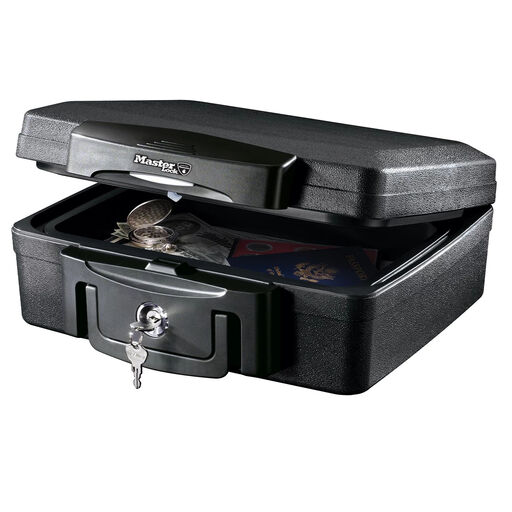
Why we recommend it: Perfect for securing passports, ID cards, and digital media. Its compact size and handle make it an excellent portable safe, just as practical at home as it is in the office.
This model doesn't just make promises: it features UL and ETL certifications that validate its resistance to fire and full submersion. A true guarantee.
Its key lock is synonymous with reliability and simplicity: no batteries to change, no electronic failures to worry about. The protection is also certified for digital media.
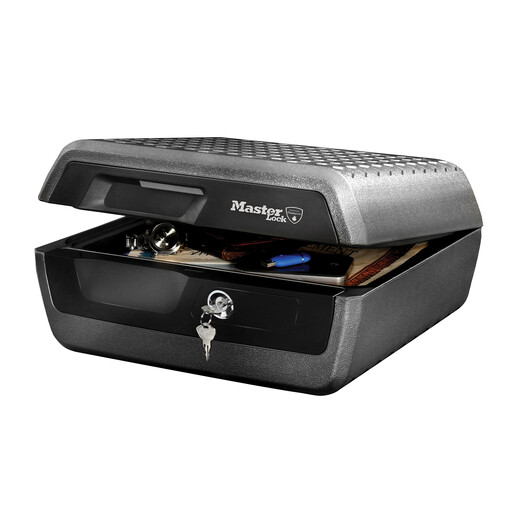
Why we recommend it: Essential for archiving contracts, deeds, and important files. Its 10-litre capacity is designed to hold A4 documents flat, without needing to bend or fold them.
No more dimension headaches! The interior space is calibrated for the A4 format, saving you from the unpleasant surprise of having to force your papers inside.
Top-tier fire protection, certified UL for 1 hour at 927°C. Its tubular key lock offers enhanced security compared to a standard key.
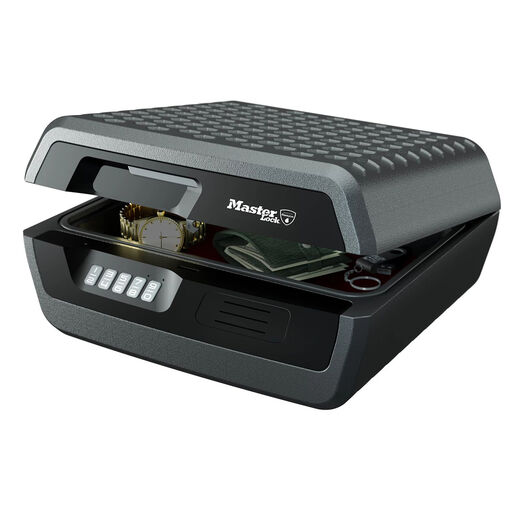
Why we recommend it: The perfect solution for those who want to combine security with convenience. The programmable digital lock provides immediate access without sacrificing protection for your documents and valuables.
Here, technology doesn't come at the expense of security. This model includes the essential UL and ETL certifications for fire and water, proving you can have the best of both worlds.
The programmable digital lock offers a user code and a master code. Conveniently, its keypad can be silenced for discreet access. It is also designed to hold A4 documents flat.
Discover our full selection of safes and security boxes that meet our criteria for security and certification.
They are your best allies. They prove that an independent laboratory has pushed the product to its absolute limits. A fire protection certification (UL or ETL) indicates a duration (e.g., 30 minutes, 1 hour) and a maximum temperature (e.g., 843°C) during which the interior remains protected. For waterproofing, the ETL label guarantees resistance to complete submersion.
By definition, no, it's designed to be mobile. However, to deter theft, it's best to hide it in a discreet location or inside a piece of furniture. Keep in mind that its primary mission is protection against fire and water, rather than resistance to a break-in, unlike a heavy safe that is bolted to the wall or floor.
This is THE essential question. The golden rule: never, ever leave the keys (not even the spare!) inside the safe. Entrust them to a trusted person or hide them in a secure location known only to you. And please, forget the movie-style hiding spots like under the doormat or in a flowerpot.