
Livraison le jour même ou le lendemain

Qualité garantie

Débloquez vos offres de bienvenue: Livraison GRATUITE | Jusqu'à -80 % | 30 jours d'essai gratuits à JoyPlus
Téléchargez l'application
When faced with the unpredictability of a fire or flood, protecting your most valuable documents (property deeds, passports, contracts) and digital media (USB drives, hard drives) isn't a luxury—it's an absolute priority. However, the market is a jungle of marketing claims that are often vague or even misleading. As a product expert for Joybuy, I'm here to separate fact from fiction and guide you toward the right choice.
Before you make a purchase, let's review the three classic pitfalls that could turn your investment into a complete waste of money when disaster strikes.
To avoid these traps, you must stick to objective, verifiable criteria. Here are the three points to examine closely before choosing your fireproof and waterproof safe.
The real protection for your documents against fire and water relies on one thing only: standards tested and validated in a laboratory. Forget the marketing slogans and demand these two certifications:
A product without these labels is a risky gamble: there's no guarantee it will protect your belongings when disaster strikes.
Don't be fooled by the external dimensions. The only number that matters is the internal dimensions. Compare them to the size of an A4 sheet (21 x 29.7 cm). To keep your contracts, deeds, or diplomas intact, you need an A4 document storage box that can hold them flat without folding. A good portable safe must combine protection with practicality.
The choice of lock is primarily a matter of personal preference, a trade-off between security and ease of use.
Instead of an endless catalogue, we've selected models that meet specific needs, all validated against the security and practicality criteria we've just discussed.
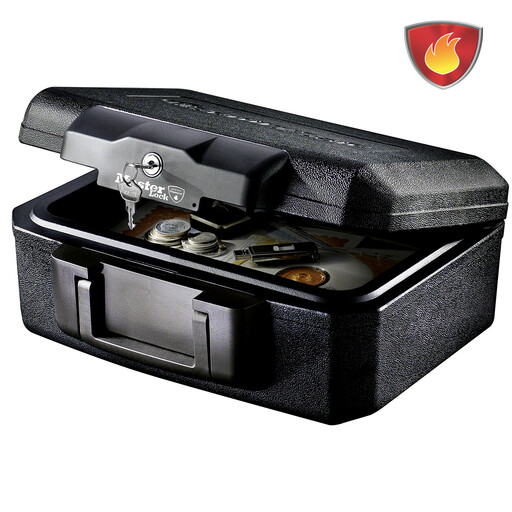
Why we chose it: Perfect for certified, first-line protection. It allows you to secure a few key documents (passports, family records) and digital media. Its compact size and handle make it a fireproof security case that's easy to store or grab in an emergency.
No false promises here: it's UL and ETL certified, guaranteeing 30 minutes of fire resistance at 843°C (1550°F) to protect both paper and digital media.
Certified protection in a portable format. Its key lock is a guarantee of simplicity and hassle-free use.
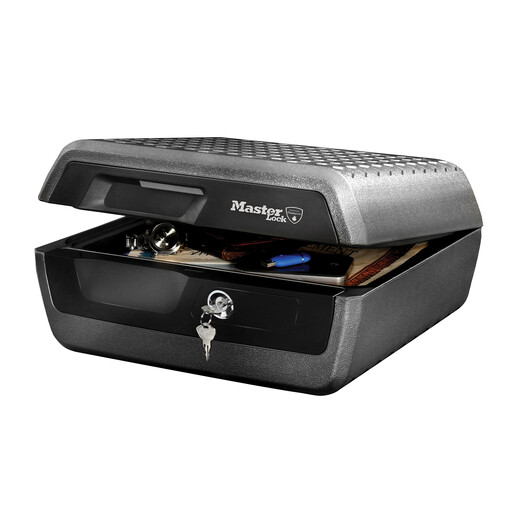
Why we chose it: For those who want absolute peace of mind and refuse to compromise. It combines high-level fire protection with full immersion waterproofing, all in a format capable of holding A4 documents flat.
It sets the bar very high with a UL certification for one hour at 927°C (1700°F) and an ETL certification verifying its immersion waterproofness. Its interior capacity is designed for A4 documents.
Top-tier dual certification (fire and water). The tubular key lock adds an extra layer of security.
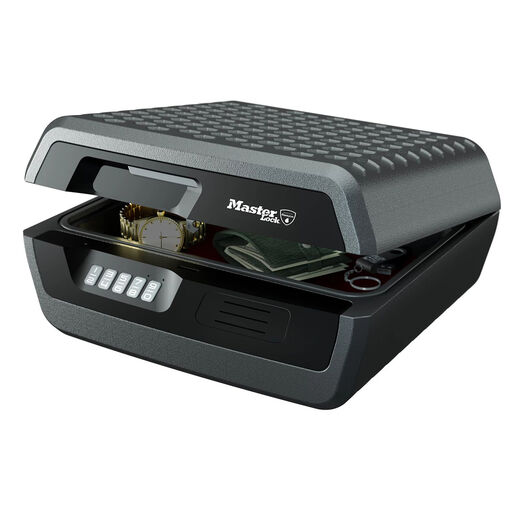
Why we chose it: The perfect solution for those who no longer want to bother with keys. This model combines the same certified fire and water protection with a programmable digital lock. It's the ideal balance between high security and user convenience.
It features the same UL and ETL certifications (fire and water) as its key-operated counterparts, with the added flexibility of a code. Its interior space is also sized to hold A4 documents flat.
Simple and practical keyless access, thanks to the digital lock. Complete protection against both fire and water.
We have put together a complete selection of products that meet these demanding security criteria.
Not always. Paper only begins to degrade at 177°C (350°F), but your USB drives and hard drives can be damaged at temperatures as low as 120°C (250°F). To effectively protect your digital data, it is essential to choose a safe with the ETL certification specifically for multimedia storage. It's the only one that guarantees the internal temperature will not exceed this critical threshold.
Don't panic! If you have a Master Lock fireproof safe or one from another major brand, you can usually order replacement keys from customer service. You will just need to provide the safe's serial number and proof of purchase. Pro tip: always keep one of the original keys in a separate, secure location, well away from the safe itself.
For maximum effectiveness, place your portable safe on the lowest level of your home, such as the ground floor or basement. Why? Because in the event of a fire, upper floors are at risk of collapsing. Also, avoid damp areas (like an untreated cellar or a bathroom) if your model is not certified waterproof. Finally, storing it in a closet or under a piece of furniture is a good trick to keep it out of sight.