
Livraison le jour même ou le lendemain

Qualité garantie

Débloquez vos offres de bienvenue: Livraison GRATUITE | Jusqu'à -80 % | 30 jours d'essai gratuits à JoyPlus
Téléchargez l'application
A fire or flood can strike without warning, threatening to turn irreplaceable belongings and documents to ash. Faced with this risk, a fireproof and waterproof safe isn't a luxury, but an essential precaution. But be warned: the market is a minefield where marketing promises often hide nasty surprises. To help you make an informed decision, our guide breaks down the pitfalls to avoid and the real criteria to check before you buy.
Investing in security shouldn't be a blind decision. Here's a rundown of common mistakes that could render your purchase useless in a disaster.
To make an informed choice, focus on these three technical parameters. They are what separate a gimmick from reliable protection for your home safe or office safe.
Protecting documents in a fire relies on strict certifications. The most recognised are those issued by Underwriters Laboratories (UL) and Intertek (ETL). They guarantee that the safe's internal temperature will remain below a critical threshold for a specified duration.
A good waterproof safe must clearly display its level of resistance. Here again, ETL certification is the standard: it can verify, for example, that a safe protects its contents even after 24 hours of immersion in 8 inches (20 cm) of water. A critical point to watch for: this waterproofing is often only guaranteed if the safe is not bolted down, as the mounting holes can compromise the seal.
Security against theft primarily depends on the safe's physical design. Scrutinise the following elements:
There's a solution for every need. Here is our selection of models that check all the boxes, adapted for different user profiles.
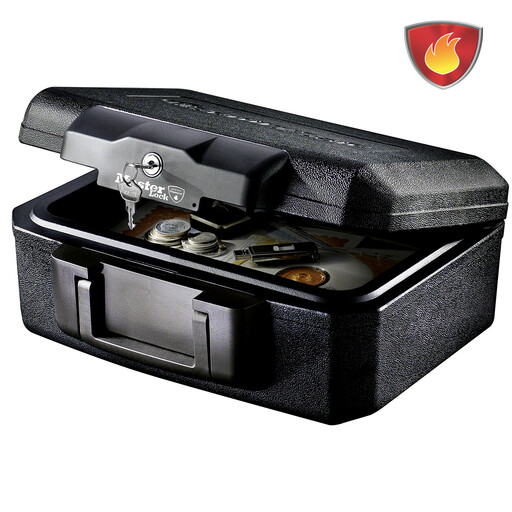
Why we recommend it: Ideal for securing essential documents (passports, property deeds, family records) and some digital media. Its compact footprint and carrying handle make it especially practical for discreet home use.
It doesn't just make a vague "fire-resistant" promise. It has clear certifications: UL for documents (30 min at 1550°F/843°C) and ETL for digital media, offering verified protection.
Certified protection for documents and digital media in a compact, portable design. The key lock ensures simple and reliable access, without depending on batteries.
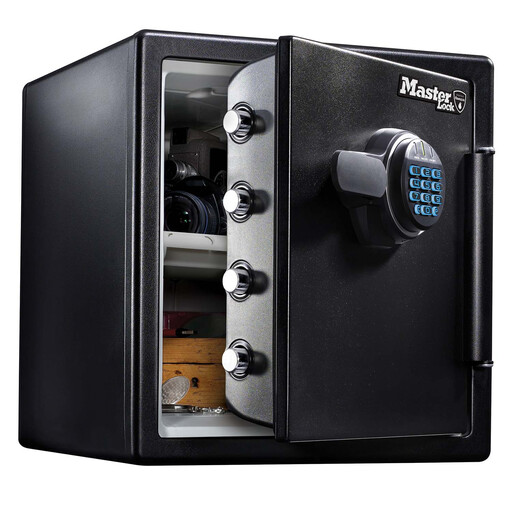
Why we recommend it: For families or small businesses that need to protect a wider variety of assets: documents, jewellery, digital backups, and valuables. Its 33.6L capacity offers an excellent balance between volume and footprint.
It combines fireproof protection (1 hour at 1700°F/927°C) with waterproof protection (ETL verified for 24 hours in 5 in./12 cm of water). It avoids the pitfall of false waterproofing claims by clearly stating its immersion resistance conditions.
Enhanced physical security with four live-locking bolts and a pry-resistant hinge. The well-designed interior includes a shelf and LED lighting.
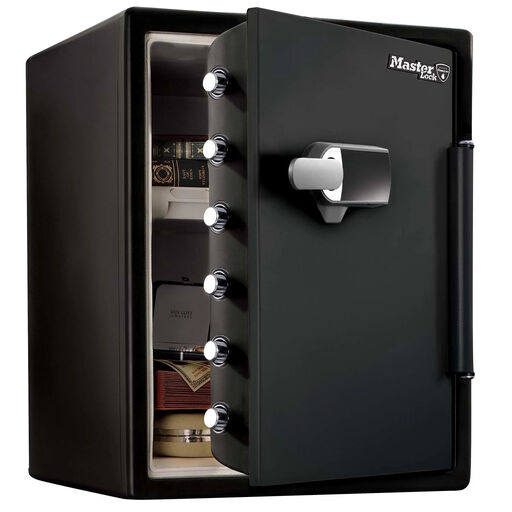
Why we recommend it: Designed for SMBs or discerning individuals. Its large capacity and integrated alarm make it a true fireproof security cabinet for protecting confidential documents, cash, and valuable electronic equipment.
It goes beyond simple document protection by offering a specific ETL certification for digital media (1 hour at 1700°F/927°C). It doesn't neglect physical security, thanks to its six live-locking bolts and deterrent alarm.
Maximum protection: fireproof, waterproof (8 in./20 cm for 24 hours), and pry-resistant with an alarm. Its large volume and well-designed interior layout (drawer, tray) ensure optimal organisation.
Explore our full selection of products that meet our strict security criteria and industry standards.
Bolting a safe to the floor is an effective measure against the theft of the safe itself. However, be careful: it is imperative to consult the manufacturer's instructions. For many fireproof and waterproof models, drilling into the safe to bolt it down will compromise, or even void, the waterproof certification. You will therefore have to choose between maximum protection against theft and optimal protection against water damage.
Digital media like USB drives, hard drives, or CDs are much more sensitive to heat than paper. They can be damaged at temperatures as low as 250°F (120°C). A certification for paper (which tolerates up to 350°F / 177°C) is therefore completely inadequate. If you want to protect digital data, ensure the safe has a specific ETL certification for digital media.
Yes, digital safes are powered by batteries (usually AA batteries). They are therefore completely autonomous and unaffected by power outages. Most models have a low-battery indicator and come with a backup key to handle any eventuality. Just remember to keep this key in a secure location... and most importantly, outside of the safe