
Livraison le jour même ou le lendemain

Qualité garantie

Débloquez vos offres de bienvenue: Livraison GRATUITE | Jusqu'à -80 % | 30 jours d'essai gratuits à JoyPlus
Téléchargez l'application
Protecting our most valuable possessions is a natural instinct. But when faced with the risk of fire or water damage, a standard safe is no longer enough. You need a solution with dual, or even triple, protection. The market is flooded with models, but how can you distinguish a true fortress from a simple metal box with overhyped marketing claims?
As a product expert at Joybuy, I'm here to separate fact from fiction for you. Let's scrutinize the pitfalls to avoid and the essential criteria for choosing a fireproof and waterproof safe that will truly deliver on its promises.
Don't be fooled by marketing. Too many buyers regret their choice when they discover critical flaws after the safe is installed. Here are the three most common mistakes.
To make the right investment, focus on objective and verifiable features. Here are the three non-negotiable points to examine.
Protecting documents from fire and water relies on strict standards. Ignore marketing slogans and look for these two labels:
A home safe certified by both of these labels will offer you unparalleled peace of mind.
Fire and flood protection is useless if the safe can be forced open in minutes. Analyse the following points:
The volume should meet your current and future needs. A large 50L safe or bigger is often a smart investment for professional use or for families wanting to store archives, electronics, and valuables. For more limited use, a 20 to 30-litre model may suffice. Pay attention to the layout: adjustable shelves, drawers, or door storage help optimize space and keep your belongings perfectly organized.
Because every need is unique, here is our recommendation for discerning users, along with suggestions for other profiles.
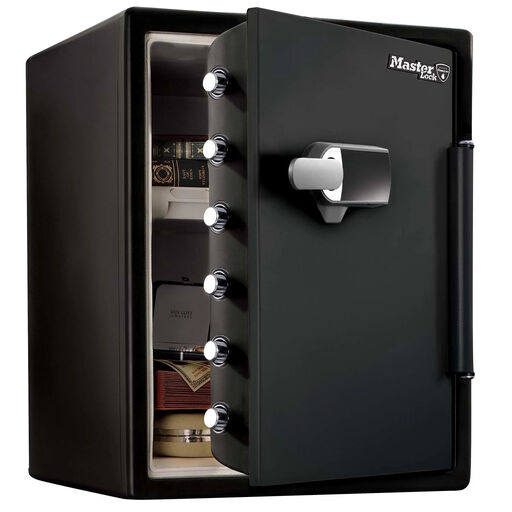
Why this model stands out: With its generous 56.5L capacity, this Master Lock safe meets the needs of professionals (small businesses, independent practitioners) and individuals who need to protect a large volume of assets: A4 documents, binders, electronics, and valuables.
It doesn't just make promises: it is UL and ETL certified for 1 hour at 927°C (paper and digital media) and ETL verified for 24-hour immersion in 20 cm of water. No more ambiguity—the protection is guaranteed.
3-in-1 protection: anti-fire, flood protection, and anti-theft with a built-in alarm. Its interior is optimized with a deep tray, a drawer, and a convenient LED light.
We have curated a complete range of products that meet these strict selection criteria and current safety standards.
1. Can a fireproof safe be bolted to the floor or wall? It is strongly recommended to bolt it to the floor with the provided mounting kit to prevent theft. However, be aware: this operation can compromise its certified water resistance, as drilling breaks the waterproof seal. On the other hand, you should never bolt a fireproof safe to a wall, as this would void its fire resistance certification.
2. Does a fireproof safe also protect USB drives and hard drives? Not automatically. Digital media (USB drives, hard drives, CDs, DVDs) are much more sensitive to heat than paper. To protect them, the safe must have a specific certification for digital media (usually ETL), which guarantees that the internal temperature will not exceed their critical threshold (around 120°C).
3. What is the lifespan of a fireproof and waterproof safe? The steel structure is designed to last for decades. However, the seals that provide fire and water resistance can degrade over time, so it is advisable to check their condition periodically. Most importantly, a fireproof safe is a single-use product: after surviving a fire or flood, it must be replaced, even if it perfectly protected its contents.