
Livraison le jour même ou le lendemain

Qualité garantie

Débloquez vos offres de bienvenue: Livraison GRATUITE | Jusqu'à -80 % | 30 jours d'essai gratuits à JoyPlus
Téléchargez l'application
Protecting your important documents, digital media, and valuables is a top priority. In the event of a fire or flood, a fireproof and waterproof safe is the ultimate protection. But the market is flooded with models making vague promises. Our mission at Joybuy is to help you cut through the noise and identify the criteria that truly matter for a confident and lasting purchase.
To ensure you don't regret your purchase, here are the most common pitfalls to avoid:
To avoid these disappointments, rely on objective technical specifications. Here are the three essential checkpoints.
The decisive factor for a fire-resistant safe is its certification. The most recognised labels are UL (Underwriters Laboratories) and ETL (Intertek). These independent organisations subject safes to rigorous tests: they verify their ability to maintain an internal temperature below a critical threshold for a defined period while the exterior is exposed to extreme heat.
Protection against water is just as crucial, whether from a flood or from firefighting efforts. ETL certification for water submersion guarantees protection for a given depth and duration (e.g., 24 hours in 20 cm of water).
Also, check if the manufacturer mentions drop resistance (e.g., a 4.5-metre drop), which ensures the safe won't burst open if a floor collapses during a fire.
The choice of locking system depends on your preferences for security and convenience.
Finally, carefully assess the capacity in litres. List what you want to protect (A4 papers, passports, hard drives, jewellery) to choose a volume suited to your needs, whether for a home safe or for an office.
To guide your choice, we have analysed several models to meet different needs.
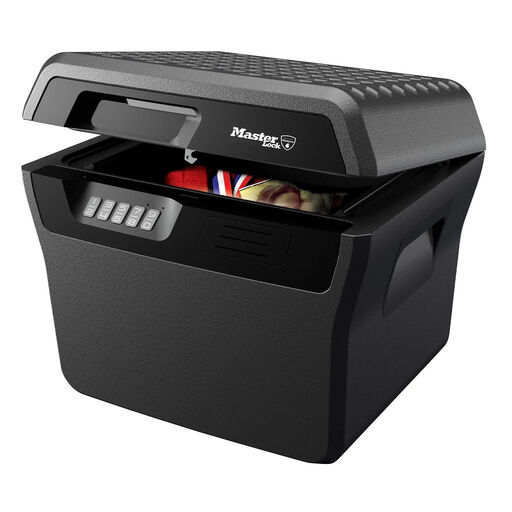
Why we recommend it: Perfect for securing essential documents (passports, property deeds) and some digital media at home. Its compact size allows it to be placed discreetly in a cupboard.
This Master Lock safe has clear certifications: UL for documents and ETL for digital media and water. You're buying verified protection, not just a promise.
Certified protection for documents and digital media (USB drives, CDs). Programmable digital combination lock for simple and secure access.
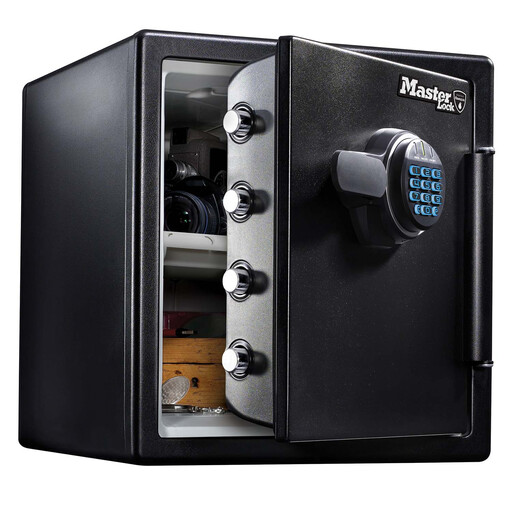
Why we recommend it: With its 33.6-litre capacity and interior organisation (shelf, door pocket), it's perfect for families or small businesses that need to protect a larger volume of documents and valuables.
The technical sheet clearly states that the water resistance is valid before bolting down. This transparency prevents you from unintentionally compromising your safe's protection.
1-hour UL fire protection at 927 °C and resistance to a 4.5-metre drop. Its organised interior with LED light makes access and storage easy.
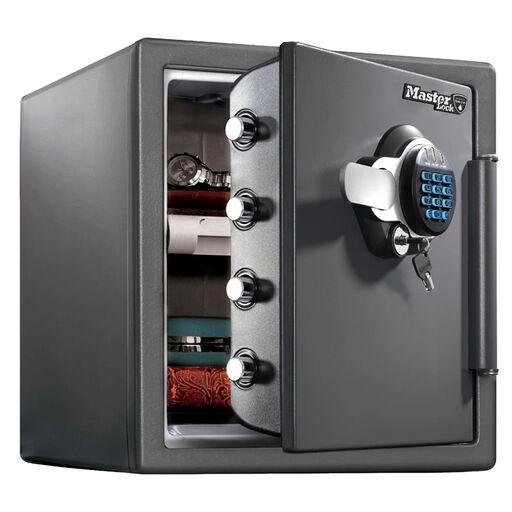
Why we recommend it: Designed for those seeking absolute peace of mind. Its extended fire protection and dual-locking system make it a top-tier choice for irreplaceable items or a demanding professional environment.
It goes beyond standard protections with a 2-hour UL certification and water resistance up to 20 cm. The dual lock system (digital + key) mitigates the potential failures of a single mechanism.
Superior 2-hour fire protection at 927 °C. Enhanced security, requiring both the code and the key to be used simultaneously for opening.
A certified safe is an investment in your peace of mind. While these models meet specific needs, other solutions exist for organising and protecting your belongings on a daily basis.
We have compiled a comprehensive list of products that meet strict quality criteria.
Bolting the safe to the floor is recommended to deter a thief from simply carrying it away. However, it is imperative to check if this action compromises the waterproof certification. Some models, like the Master Lock 23L (101023185), come with a special waterproof bolting kit that preserves this protection. For others, you will have to choose between maximum protection against theft (bolted) and optimal protection against water (unbolted).
In common parlance, these terms are often used interchangeably. Technically, no material is completely "fireproof". The more accurate term is "fire-resistant". This is why it is essential to rely on certifications (UL/ETL), which quantify this resistance in terms of duration and temperature, rather than on vague marketing adjectives.
Maintenance is simple. Replace the batteries once a year or as soon as the low battery indicator lights up to avoid getting locked out. Use high-quality, brand-name alkaline batteries. Clean the keypad with a soft, dry cloth. Avoid any liquid cleaning products that could seep in and damage the electronic components. Always keep the backup key or master code in a secure location—but of course, outside the safe.