
Livraison le jour même ou le lendemain

Qualité garantie

Débloquez vos offres de bienvenue: Livraison GRATUITE | Jusqu'à -80 % | 30 jours d'essai gratuits à JoyPlus
Téléchargez l'application
Identity papers, family heirlooms, backup hard drives… Keeping your most valuable possessions safe from disaster is a top priority. In the event of a fire or flood, a fireproof and waterproof safe is an indispensable ally. The only catch: the market is a jungle of models with often vague promises. As product experts, our mission is to help you decipher the spec sheets and make a truly informed choice, away from the marketing hype.
Before you start, watch out for these 3 common and potentially costly pitfalls:
To avoid falling into these traps, here are the objective technical criteria to scrutinise. They are your best guide for comparing models without being misled.
Forget the marketing slogans. Your first instinct should be to look for the seals from independent laboratories like UL (Underwriters Laboratories) or ETL (Intertek). Here's how to decode them:
Key or digital code, that's a matter of personal preference. The physical robustness of the safe, however, is non-negotiable.
Take a precise inventory of what you plan to store. A small fireproof security case or a portable safe will suffice for passports and a few A4 documents. For binders, laptops, or bulkier items, a larger-capacity professional safe will be necessary. A friendly tip: always opt for a slightly larger size than you currently need. It's easy to accumulate new items to protect over time.
We have selected a few models that cater to specific needs, all of which have been vetted against our objective criteria.
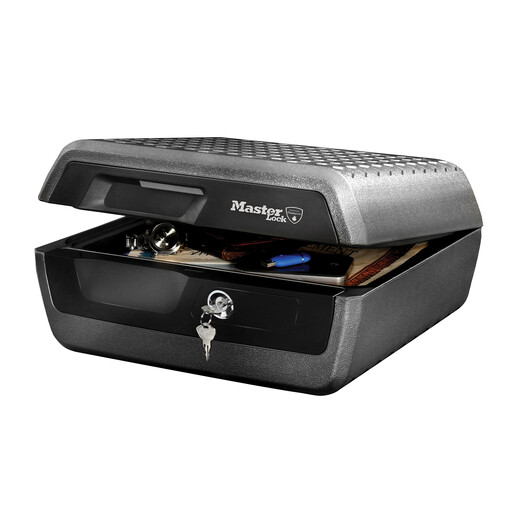
Why we recommend it: It's perfect for securing essential administrative documents (ID papers, property deeds, passports) and some digital media. Its case format fits easily into a closet while offering certified protection for your most precious belongings.
This model is transparent, clearly displaying its certifications: UL 1-hour at 927°C for paper and ETL for water submersion. No vague marketing, just facts.
Its tubular key lock is a guarantee of reliability and simplicity. Practical bonus: its interior layout allows you to store A4 documents without folding them.
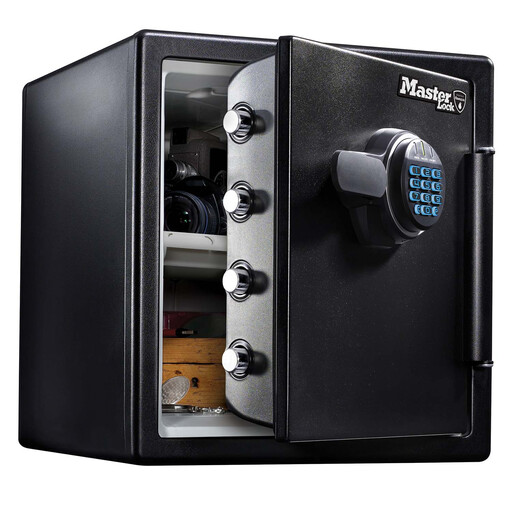
Why we recommend it: With its 33.6-litre capacity and digital lock, it's the ideal compromise for a family or small business looking to protect documents, electronics, and various valuables.
The manufacturer is honest about the notorious waterproofing pitfall: the ETL certification (24h submersion in 12 cm of water) is only valid if the safe is not bolted down. This transparency allows you to make a fully informed choice.
It combines UL 1-hour fire protection at 927°C with solid physical construction (four locking bolts, pry-resistant hinge) and a well-designed interior (LED lighting, shelf).
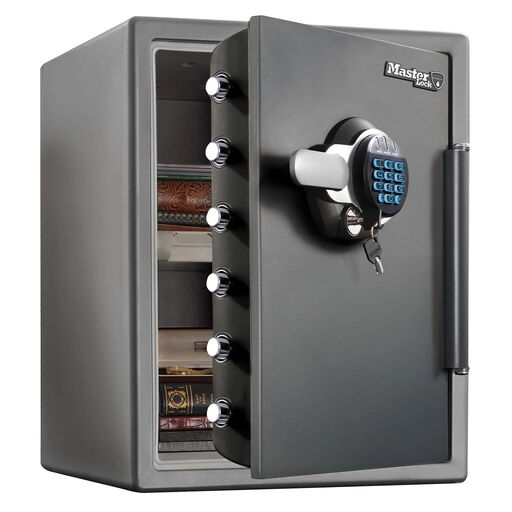
Why we recommend it: Designed for professionals or individuals who refuse to compromise on security. Its generous 56-litre capacity and high level of protection make it a fortress for the most sensitive assets and documents.
Here, security goes far beyond the lock. It relies on solid steel construction, six locking bolts, and a pry-resistant hinge bar. The dual authentication (code + key) adds an extra layer of access control.
The manufacturer claims top-tier fire protection: UL certified for 2 hours at 927°C. It is also ETL verified for 24 hours of submersion in 20 cm of water. That's enough to let you sleep soundly.
Explore our full selection of products that meet our strict selection criteria and current standards.
While a safe's steel structure can last for decades, the same isn't true for its waterproof seals and fire-retardant materials, which degrade over time. Refer to the manufacturer's manual, but as a general rule, inspecting (and potentially replacing) the seals every 5 to 10 years is good practice to ensure maximum protection.
Not necessarily, or at least, not with the same level of effectiveness. Fire resistance and burglary resistance are two distinct specialities, governed by different standards. A model optimised for fire may have a thinner shell than a true anti-burglary safe. For dual-purpose protection, look for models that combine fire certifications (UL/ETL) with serious physical security features: thick steel, multiple locking bolts, and pry-resistant hinges.
The ideal location should be both discreet and structurally sound. A ground floor or basement is preferable, ideally on a concrete slab. Anchoring it to the floor (when the model allows without losing its waterproof rating) is the best way to deter thieves from carrying it away. Avoid areas with high humidity or significant temperature fluctuations.