
Livraison le jour même ou le lendemain

Qualité garantie

Débloquez vos offres de bienvenue: Livraison GRATUITE | Jusqu'à -80 % | 30 jours d'essai gratuits à JoyPlus
Téléchargez l'application
Protecting what matters most—irreplaceable documents, family heirlooms, sensitive digital data—is a clear priority. When faced with the risks of fire or flood, a fireproof and waterproof safe provides true peace of mind. However, the market is flooded with products making tempting promises that can sometimes hide serious weaknesses.
As a Product Expert at Joybuy, my mission is to help you see things more clearly. Together, let's break down the most common pitfalls to help you make an informed choice, far from the siren calls of marketing.
To make the right choice, focus on technical and verifiable criteria. Here are the three points to scrutinize.
The protection of documents against fire is the primary mission of these safes. The most reliable certifications are issued by independent laboratories like UL (Underwriters Laboratories) and ETL (Intertek). They guarantee that the safe's contents will remain intact according to a rigorous testing protocol.
A good waterproof case for documents must also protect against water, whether during a flood or from firefighters' hoses. The ETL Verified for Water Submersion certification specifies the conditions of this protection, for example, complete immersion under 20?cm of water for 24 hours. Be mindful of installation conditions that could void this guarantee.
The choice between a digital safe and a key-operated safe primarily depends on your habits and desired ease of use.
Rather than an endless list, here are three models that meet specific needs, selected for their reliability and compliance with standards.
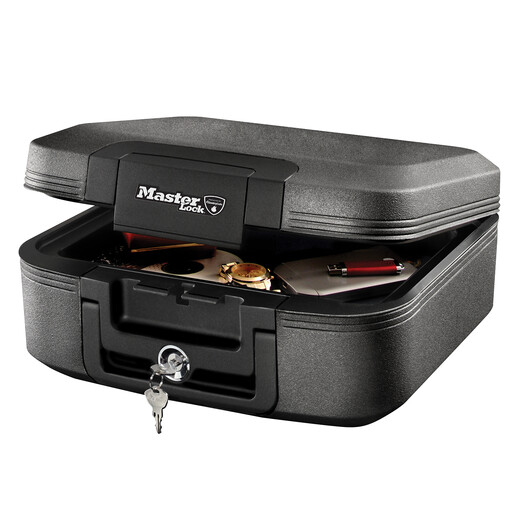
Best for ? Ideal for individuals looking to secure essential documents (passports, birth certificates, contracts) and some digital media. Its carrying handle makes it a practical companion, both at home and on the go.
The UL and ETL certifications are clearly specified for paper and digital media, avoiding marketing ambiguity. Its portable case format requires no bolting down, which keeps its waterproof certification intact.
Certified protection for paper and digital media (30 min at 843 °C). Its volume is optimized for storing A4 documents flat.
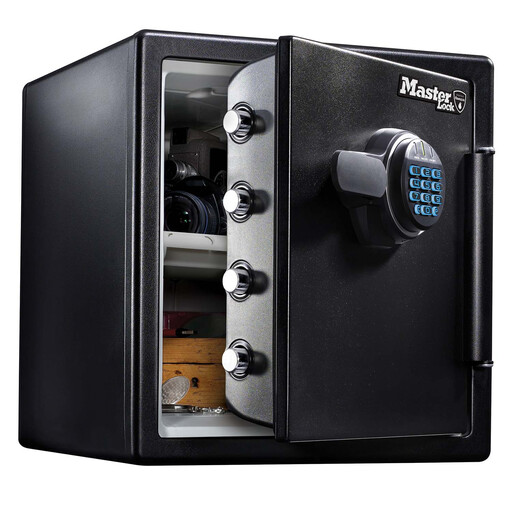
Best for ? Perfect for family or home office use. Its 33.6L volume provides ample space for binders, electronic devices, and valuables, with the convenience of digital access.
The technical sheet transparently states that the waterproof guarantee is only valid if the safe is not bolted down. This honesty allows you to make an informed choice about installation.
High-level fire protection (1h at 927 °C) and resistance to a 4.5m drop. Its interior is well-organized with a shelf, door storage, and LED lighting.
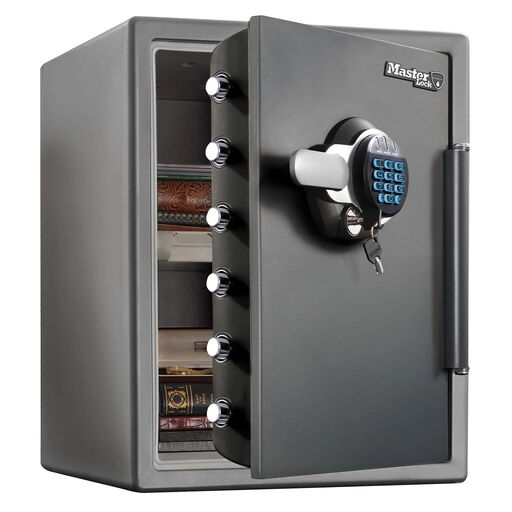
Best for ? Designed for small businesses, SMEs, and independent professionals. This professional safe offers maximum protection for archives, critical data, and valuable assets, thanks to its generous volume and dual security.
It boasts top-tier performance (2-hour fire resistance at 927 °C), clearly defined and certified by UL/ETL. There is no room for ambiguity.
Its dual lock (digital code + key) creates a double barrier against break-ins. Its 56L capacity and 6 solid steel locking bolts make it a true fortress.
We have curated a complete selection of products that meet our strict selection criteria and current safety standards.
For theft protection, it is highly recommended to bolt down any safe weighing less than 450?kg. However, as we've discussed, this can compromise its waterproof seal. Read the manufacturer's instructions carefully. Some models, like the 23L Master Lock safe, come with a waterproof bolting kit that preserves the certification even after installation.
Digital media (USB drives, hard drives, DVDs) are destroyed at a much lower temperature than paper. Paper begins to degrade around 177?°C, while digital media can be damaged at just 120?°C. This is why it is crucial to verify that the safe has a specific ETL certification for digital media if you plan to store sensitive data inside.
Maintenance is simple. It is advisable to replace the lock's batteries once a year, or as soon as the low battery indicator lights up. Always keep the backup key (if provided) and the master code in a secure location, separate from the safe itself. The golden rule?: never, ever store the backup key inside the safe.