
Livraison le jour même ou le lendemain

Qualité garantie

Débloquez vos offres de bienvenue: Livraison GRATUITE | Jusqu'à -80 % | 30 jours d'essai gratuits à JoyPlus
Téléchargez l'application
Protecting your most valuable possessions from fire, water, or theft is a top priority. Identity documents, property deeds, family heirlooms, digital backups... To keep these items secure, choosing a safe isn't a decision to be taken lightly. The problem? The market is saturated with often misleading marketing claims. Before you decide, it's crucial to know the pitfalls to avoid in order to invest in protection that is truly effective and suited to your needs.
The 'Fire-Resistant' Claim Without Certification: Many products boast of being 'fire-resistant', but this claim is meaningless without official certification. A true fireproof safe must be tested by an independent laboratory like UL (Underwriters Laboratories) or ETL (Intertek). Without this proof, you risk ending up with a simple metal box that will offer no protection in a fire.
Waterproofing Compromised by Bolting Down: A fireproof and waterproof safe is designed to withstand a flood or water from fire hoses. However, a crucial detail is often overlooked: most models lose their waterproof certification once they are bolted to the floor. Drilling through the safe to bolt it down creates an entry point for water. You must therefore choose between theft protection (bolting it down) and water protection, unless the model offers a specific waterproof bolting kit.
To make an informed choice, ignore the marketing hype and focus on objective specifications. Here are the three essential points to scrutinise.
This is the non-negotiable criterion. Look for the UL or ETL logos on the product sheet.
A burglar-resistant safe is about more than just its lock type.
The capacity, expressed in litres, should match your current and future needs. Think about the items you want to protect: A4 documents should be able to be stored flat. A good interior layout (adjustable shelves, key hooks, LED lighting, door pockets) makes all the difference in daily use for easily organising and accessing your belongings.
To help you see more clearly, we have selected models that check all the right boxes, matching them with typical user profiles.
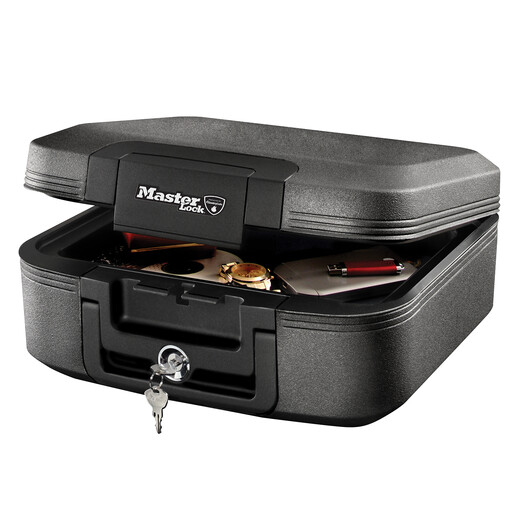
Why it's a great choice: Perfect for those who need to protect essential documents (passports, birth certificates, USB drives) and be able to transport them easily. This fireproof chest can be stored in a cupboard or taken with you in an emergency.
It has clear certifications: UL and ETL for fire resistance (paper and digital media) and ETL for water immersion. Verified protection, not just claims.
Its capacity allows for storing A4 documents flat. Its carrying handle and tubular key lock make it a solution that is both practical and secure.
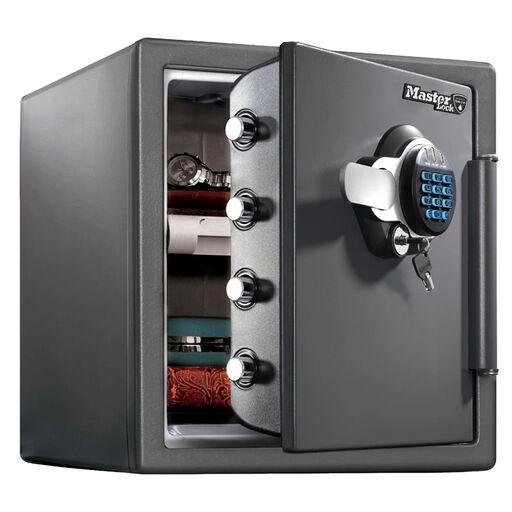
Why it's a great choice: An excellent compromise for a home safe. Its 33-litre volume is sufficient for family documents, a few valuables, and digital backups, without being too bulky.
It offers superior fire protection with a 2-hour UL certification at 927°C. Its technical sheet specifies that the water protection is valid before bolting down, preventing any unpleasant surprises.
The dual-locking system (digital combination + key) is a major security asset. The interior is well-designed with lighting, adjustable shelves, and a door pocket.
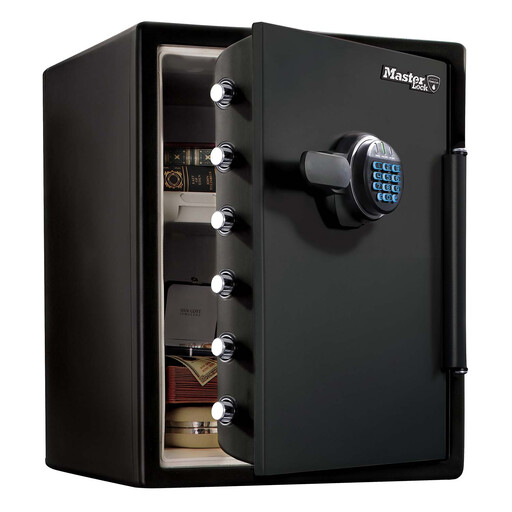
Why it's a great choice: For professionals (small businesses, freelancers) or individuals with a large volume of valuables. This professional safe offers a large capacity and enhanced security features.
It doesn't just rely on a digital lock. Its robust steel construction with six locking bolts and a pry-resistant hinge makes it a true burglar-resistant safe, going beyond mere promises.
Its large 56.5L capacity is optimised with a multi-position tray and a drawer. The UL/ETL certifications cover fire (1hr at 927°C), water (20 cm immersion), and resistance to a 4.5-metre drop.
We have analysed and compiled a complete selection of products that meet these strict security criteria.
For optimal fire protection, it is advisable to place the safe on the ground floor or in the basement, as heat rises. Choose a discreet location, out of sight, such as in a cupboard or a low-traffic corner. Avoid placing it near potential heat sources.
Bolting the safe to the floor is an effective security measure against theft, as it prevents a burglar from carrying the safe away. The downside: this action can compromise the safe's waterproofing. If the risk of flooding is high in your area, it is better to opt for a heavy model that is difficult to move, without bolting it down. Some rarer models come with a waterproof bolting kit that solves this dilemma.
The battery life for a digital safe varies depending on usage, but it is generally one to two years. Most models are equipped with a low-battery indicator to warn you. It is recommended to change the batteries once a year as a precaution. Always keep the backup key (if provided) in a safe and accessible place, but never inside the safe itself.