
Livraison le jour même ou le lendemain

Qualité garantie

Débloquez vos offres de bienvenue: Livraison GRATUITE | Jusqu'à -80 % | 30 jours d'essai gratuits à JoyPlus
Téléchargez l'application
Protecting important documents, memories, and valuables is a concern we all share. When faced with the risk of fire, flood, or theft, a fireproof safe is a common-sense solution. However, the market is flooded with models making tempting promises that can be confusing. Behind the marketing, certain crucial details can turn a good investment into a worthless box in the event of a disaster.
Before you make a decision, it's essential to understand the most common pitfalls so you can invest in security that truly meets your expectations.
To make an informed choice, it's better to focus on objective, verifiable features rather than marketing claims. Here are the three points to scrutinise.
The true value of a fireproof safe is measured by its certifications, issued by independent laboratories like UL (Underwriters Laboratories) or ETL (Intertek).
The type of lock should be chosen based on your habits and the desired level of security.
A small safe may be sufficient for a few documents, but a larger home safe will be necessary for binders, laptops, or valuable objects. Anticipate your future needs and choose a size slightly larger than your current requirement.
The anti-burglary design is just as important: check the steel thickness, the presence of active locking bolts (which engage into the body of the safe), and a pry-resistant hinge. For maximum security, the safe must be securely bolted to a load-bearing wall or, preferably, a concrete slab.
To put theory into practice, here are some options suited for different profiles, selected for their transparent specifications and verified performance.
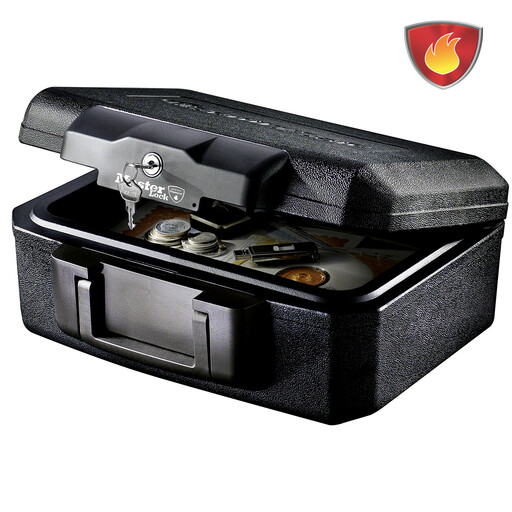
The user profile: Perfect for a first-time purchase or for securing essential documents (passports, birth certificates, contracts) without investing in a large safe. Its carrying handle makes it practical for those who need to move their documents occasionally.
This model doesn't just make a vague promise. It clearly displays its UL and ETL certifications, guaranteeing 30 minutes of protection at 843°C / 1550°F for documents and digital media. You know exactly what you're buying.
Certified protection for paper and digital media (USB drives, CDs). Simple and reliable key lock. Compact and portable design.
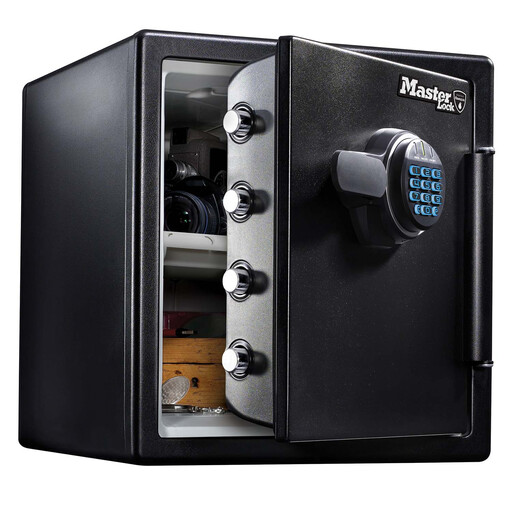
The user profile: An excellent all-rounder for home or home office use. Its 33.6L capacity can store binders, electronics, and valuables, while its certified fire and water protection provides real peace of mind.
This safe is transparent about the limitation of its water protection: the ETL certification is only valid before it is bolted down. This honesty allows the user to choose between maximum anti-theft security (bolting) and flood protection.
1-hour fire protection at 927°C / 1700°F (UL) and drop protection (ETL). Digital combination lock with a backlit keypad. Organised interior storage.
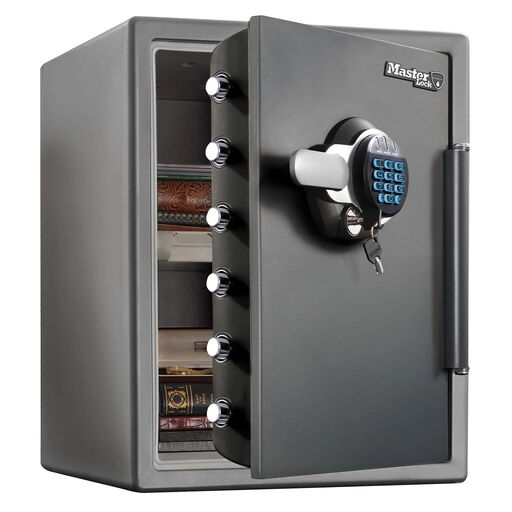
The user profile: Designed for demanding environments, this high-capacity safe offers a very high level of protection. It is perfect for businesses, collectors, or anyone looking to secure strategic assets or irreplaceable items.
It goes well beyond standard protection by offering 2 hours of fire resistance at 927°C / 1700°F. Its dual-lock system (key + code) avoids the pitfall of a single high-tech lock that could become a single point of failure.
2-hour fire protection (UL). 24-hour water protection in 20 cm / 8 in of water (ETL). Dual-locking security system. Heavy-duty construction with six active locking bolts.
Sometimes, discretion is the best form of protection. If your goal is to hide valuables from plain sight, an alternative solution might be more suitable.
Not always, and rarely with the same effectiveness. The "fireproof" label only guarantees heat resistance. Protection against break-ins depends on very different criteria: steel thickness, the number and type of bolts, hinge strength, and more. For complete security, look for a model that combines a serious fire certification with a proven anti-burglary design.
The ideal location is a discreet and hard-to-reach spot, like a closet or an inconspicuous corner. For optimal theft protection, it should be securely bolted to the floor (preferably a concrete slab) or a load-bearing wall using the provided mounting kit. Avoid basements if the safe is not certified waterproof. Remember, as we've seen, bolting the safe to the floor can void the waterproof warranty on some models.
Generally, you can expect 1 to 2 years of battery life for a digital safe or biometric safe, depending on your frequency of use. Most models are equipped with an indicator light to warn you when the batteries are low. It's a good idea to replace them once a year as a preventive measure. Pro tip: keep the backup key (if provided) in a secure location—and never inside the safe itself