
Livraison le jour même ou le lendemain

Qualité garantie

Débloquez vos offres de bienvenue: Livraison GRATUITE | Jusqu'à -80 % | 30 jours d'essai gratuits à JoyPlus
Téléchargez l'application
Protecting what matters most, whether it's official documents, family heirlooms, or valuables, is a top priority. A fireproof safe seems like the obvious solution, but the market is flooded with models whose promises don't always stand up to the test of fire—both literally and figuratively. Before you invest, it's crucial to know how to sidestep the most common marketing traps to avoid making a useless, or even dangerous, purchase.
Our team of experts has analyzed the market to help you see things more clearly. Here are the essential points to watch for to make an informed and secure choice.
Buying a safe isn't a decision to be taken lightly. Certain features, though highlighted by manufacturers, actually hide critical weaknesses.
To make the right choice, rely on objective, verifiable data. Here are the three technical criteria to scrutinize.
This is the non-negotiable criterion. The most recognized certifications are issued by Underwriters Laboratories (UL) and Intertek (ETL). They guarantee that the safe has maintained an internal temperature below a critical threshold for a specified duration while being exposed to extreme heat.
A good safe must offer all-around protection.
The choice of mechanism depends on your needs and desired security level.
Finally, carefully assess the capacity you truly need. A home safe for a few documents and some jewelry will not have the same dimensions as a model designed for storing business binders.
To move from theory to practice, here is our selection of models that meet specific needs while adhering to the objective criteria we've just detailed.
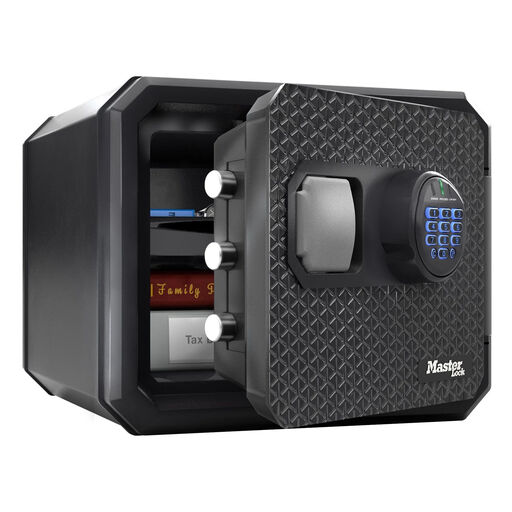
Why it stands out: Perfect for individuals looking to secure essential documents (passports, deeds) and a few valuables. Its compact size allows it to be discreetly placed in a closet or under a desk.
It boasts multiple certifications: UL (1h at 927 °C) for fire and ETL for water. Its waterproof bolting kit allows it to be anchored to the floor without compromising its water protection, a rare and highly valuable feature.
Automatic bolt-locking upon closing and its renowned waterproof bolting kit included.
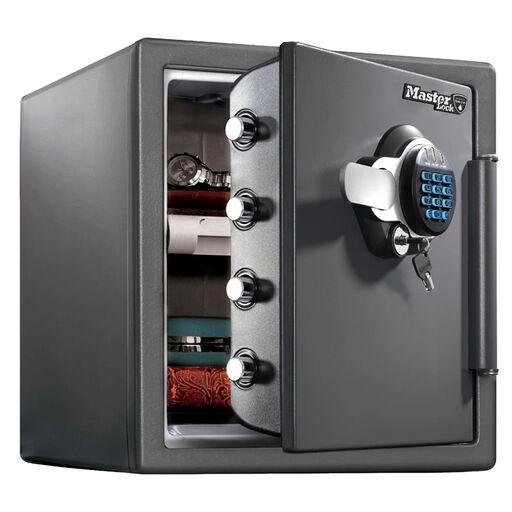
Why it stands out: Designed for independent professionals, small businesses, or individuals with high-value assets. Its superior protection and dual lock meet the highest security demands.
It goes a step further with a UL-certified fire protection of 2 hours at 927 °C. The dual-locking system (requiring both code + key) creates a robust double barrier against any unauthorized access, far surpassing a simple digital lock.
Extended 2-hour fire protection and a dual lock (key + code) for uncompromised security.
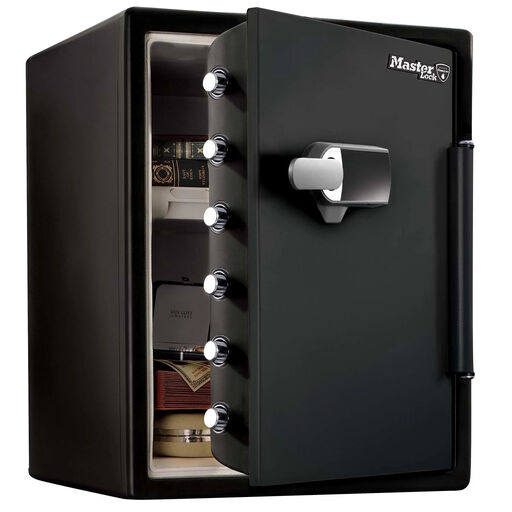
Why it stands out: For those who need significant storage capacity (archives, collections, electronics) and want active security in addition to passive protection. Ideal for a home office or small business.
Beyond its UL/ETL fire and water certifications, it integrates an audible alarm that triggers upon any attempt to pry it open or move it. It doesn't just withstand an attack—it alerts you.
Extra-large (XXL) capacity, comprehensive certifications, and an integrated deterrent alarm.
We have analyzed and selected a full range of safes that meet our strictest security criteria.
Absolutely. Bolting it to the floor is crucial to prevent a burglar from simply carrying the safe away. However, be careful: improperly bolting it down can void its fireproof or waterproof properties. Some models, like the 23L Master Lock mentioned, come with a special bolting kit that preserves the waterproof seal. For other models, drilling into the safe to bolt it down usually voids the waterproof warranty. Always read the manufacturer's instructions carefully. Finally, never bolt a fireproof safe through the wall, only through the floor, as this can compromise its fire resistance.
Not always. Digital media (USB drives, hard drives, SSDs) are far more sensitive to heat than paper. A safe certified only for paper (UL Class 350 standard) will not be enough to protect them. To secure electronic media, you must choose a safe that has a specific ETL certification for digital media. This guarantees that the internal temperature will not exceed 121?°C.
The steel structure of the safe is built to last a lifetime. The lifespan of the electronic system (keypad, fingerprint reader) depends on the quality of its components and how often you use it. It most often runs on standard AA batteries. Most models alert you when the batteries are low and always include a backup key for emergency access in case of failure. It is therefore vital to keep this key in a secure location... and, of course, outside the safe