
Livraison le jour même ou le lendemain

Qualité garantie

Débloquez vos offres de bienvenue: Livraison GRATUITE | Jusqu'à -80 % | 30 jours d'essai gratuits à JoyPlus
Téléchargez l'application
Protecting your important documents, family heirlooms, or digital media is a top priority. When faced with the risk of fire or flood, a fireproof safe stands out as the obvious solution. However, the market is flooded with models making tempting claims that, in the event of a disaster, prove to be disappointing at best and completely useless at worst.
As a product specialist at Joybuy, my mission is to help you navigate the options. Before you make a decision, it's crucial to avoid the most common pitfalls so you don't invest in a false sense of security.
To sort through the options, focus on objective technical specifications. Here are the three essential points to verify before you buy.
Never rely on marketing claims alone. The only proof of performance that matters is a certification from an independent laboratory like UL (Underwriters Laboratories) or ETL (Intertek).
The ETL waterproof certification is just as crucial. It specifies the level of protection:
Note: Bolting the safe to the floor, while recommended for theft prevention, can compromise its waterproof seal. Some models offer a special bolt-down kit that preserves this barrier. Be sure to check this detail in the product specifications.
The choice of locking mechanism depends on your use case and security needs.
To put theory into practice, here is a selection of models that meet specific needs, all evaluated against the objective criteria we've just covered.
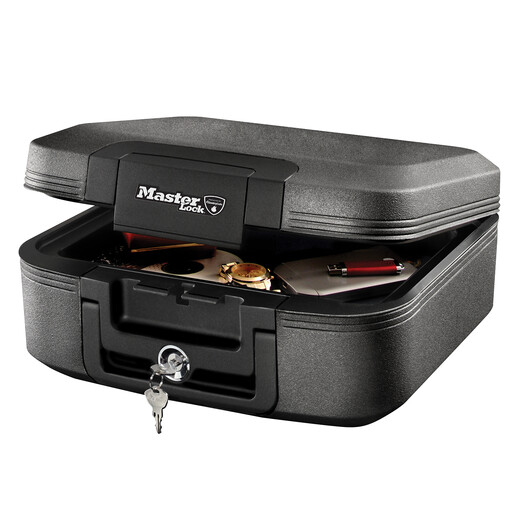
Why this model stands out: Ideal for individuals looking to secure essential documents (passports, property deeds, etc.) and some digital media. Its fireproof security chest format with a handle makes it easy to store in a closet or grab in an emergency.
This model displays clear certifications: UL for documents, and ETL for both digital media and water immersion. It doesn't just make vague promises.
Certified dual protection (fire and water) in a compact, portable design that can hold A4 documents flat.
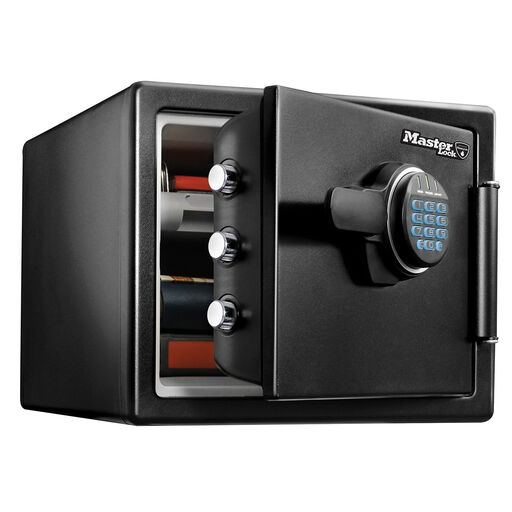
Why this model stands out: This is the perfect balance for family or semi-professional use. Its 22.8 L capacity can store binders, electronic devices, and valuables. Its digital lock with a backlit keypad offers convenient daily access for a family or a small business.
It combines high-level fire protection (1 hour at 927°C / 1700°F) and certified water protection (ETL), and even goes further: it's certified to withstand a 4.5-meter (15-foot) drop, simulating a floor collapse.
The perfect balance of generous capacity, robust certified protection, and the convenience of digital access.
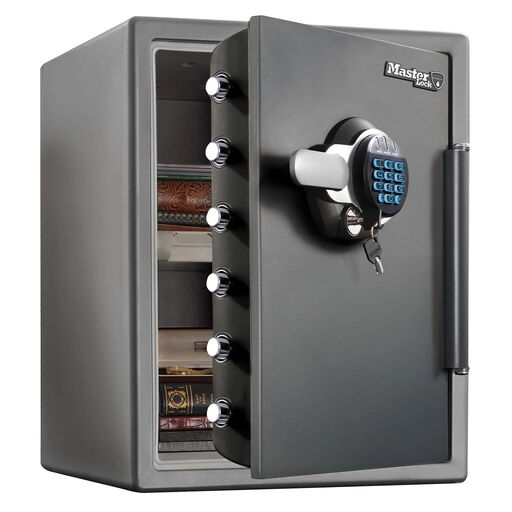
Why this model stands out: Designed for small businesses, collectors, or anyone requiring maximum security. Its large 56 L capacity and interior organization (shelf, door storage) allow for storing bulky archives, equipment, or high-value items.
It takes protection to the highest level with extended fire resistance (2 hours at 927°C / 1700°F) and a dual lock (digital code + physical key), making access impossible without both credentials.
The longest fire protection on the market, coupled with enhanced access security from the dual lock. For complete peace of mind.
We have compiled a comprehensive, up-to-date selection of products that meet these strict selection criteria and current safety standards.
To maximize fire protection, place the safe as low as possible (on the ground floor or in the basement), as heat always rises. For theft prevention, the ideal is to bolt it to the floor (if the model allows without compromising the waterproof seal) in a discreet location.
It all depends on your preferences and use case. A key lock is simple and reliable, without depending on batteries. Its only drawback is having to manage the key and keep it in a safe place. A digital lock is more convenient for frequent access and avoids the need to handle a physical key, but it relies on batteries that you'll need to remember to change. Models with a backup key offer the best of both worlds.
No, and this is an absolutely critical point. Digital media (USB drives, hard drives, CD/DVDs) are far more sensitive to heat than paper. A safe certified only for paper (UL Class 350 standard) will not protect your electronic data. For that, it is imperative to choose a model with the specific ETL certification for digital media, which guarantees the internal temperature will remain much lower.