
Livraison le jour même ou le lendemain

Qualité garantie

Débloquez vos offres de bienvenue: Livraison GRATUITE | Jusqu'à -80 % | 30 jours d'essai gratuits à JoyPlus
Téléchargez l'application
Protecting your important documents, memories, and valuables from fire is a no-brainer. Yet, the market for fireproof safes is a jungle of confusing, and often misleading, marketing claims. Making the wrong choice is not just a waste of money; it's the illusion of security you don't actually have. As product experts, our mission is to help you see clearly. Let's break down the common pitfalls and the essential criteria for investing in peace of mind.
Before you even start comparing models, it's crucial to know the classic mistakes that lead to deep buyer's remorse.
To navigate these pitfalls, rely on objective data. Here are the three technical criteria you must verify.
The most reputable certifications come from independent laboratories like UL (Underwriters Laboratories) and ETL (Intertek). They are the only guarantee of measured, reliable performance.
Waterproofing is also validated by ETL certification. It is expressed as a duration of submersion under a given depth of water (for example, 24 hours in 8 inches of water). Warning: Most manufacturers state clearly that this protection is only guaranteed if the safe is not bolted down. Drilling into the safe to secure it will, by definition, void its waterproof seal.
The security of a home safe isn't just about its resistance to the elements.
To illustrate these criteria in action, here is a selection of models that meet specific needs.
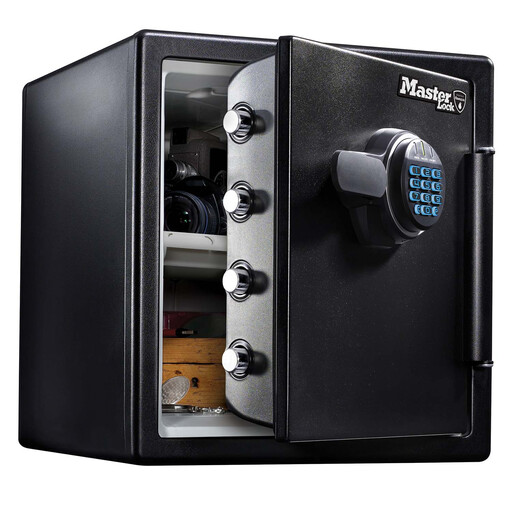
Why it's a great pick: Perfect for a family looking to secure important papers (passports, property deeds, contracts) and a few valuables. Its 33.6L volume offers an excellent balance between capacity and a compact footprint.
It doesn't just settle for a vague "resistant" claim. It boasts clear certifications: UL for 1 hour at 927°C and ETL for waterproofing (up to 12 cm for 24h), which protects you from nasty surprises.
A perfect balance of certified protection (fire and water), good anti-theft security (4 locking bolts), and a well-designed interior volume for a family's needs.
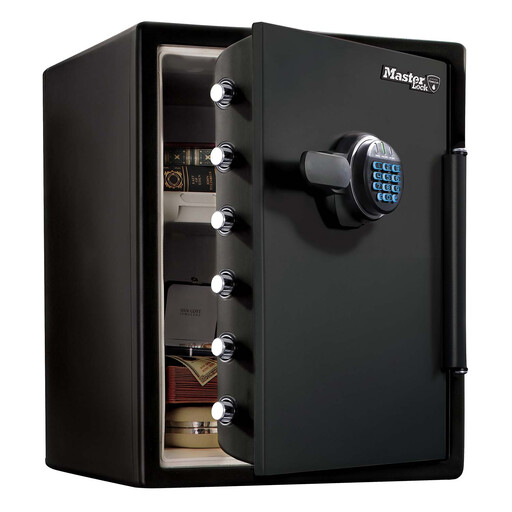
Why it's a great pick: Ideal for an office, a small business, or a family with significant assets to protect. Its large capacity allows for storing entire binders, electronic equipment, and numerous valuables.
It counters the risk of theft: in addition to its deterrent weight, it comes with a bolt-down kit. Its security is reinforced by six locking bolts, making it extremely difficult to force open.
Its XXL capacity (56.5L) combined with dual certified protection (UL/ETL fire for 1h at 927°C and water), all with a very practical interior layout (tray, drawer, LED lighting).
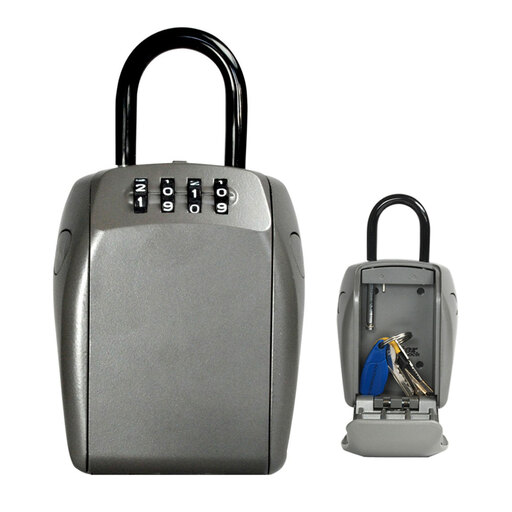
Why it's a great pick: This isn't a traditional safe, but an ingenious solution to a common problem: secure key sharing. Perfect for short-term rentals (like Airbnb), helping out a neighbour, or giving access to a home care provider without making multiple key copies.
It solves the "key hidden under the doormat" headache. It provides a sturdy, weather-resistant shelter secured by a customisable code.
Its versatility. Thanks to its removable shackle, you can hang it on a doorknob, fence, or gate without any tools or drilling. Ideal for temporary or rental use.
Explore our full selection of products that meet our most demanding security criteria.
The ideal spot is discreet, not easily accessible, and protected from moisture. Favour the ground floor or basement: in a major fire, upper floors can collapse. A corner on a load-bearing wall is an excellent location for bolting it down.
For any safe under 1000 lbs (approx. 500 kg), bolting it down is highly recommended to deter thieves from carrying it away. However, as we've seen, this can compromise its certified waterproofing. You have to make a trade-off: is the primary risk theft or water damage? For a home safe in an apartment, the risk of theft often takes priority. In a house in a flood-prone area, the dilemma is more complex.
Under normal use, a set of batteries (usually AAs) lasts between one and two years. Most quality models, like those from Master Lock, include a low-battery indicator to alert you well in advance. It is therefore crucial to keep the backup key (if one is provided) in a safe place—but most importantly, outside of the safe itself.