
Livraison le jour même ou le lendemain

Qualité garantie

Débloquez vos offres de bienvenue: Livraison GRATUITE | Jusqu'à -80 % | 30 jours d'essai gratuits à JoyPlus
Téléchargez l'application
Keeping your most valuable possessions safe from fire, water, and theft is a top priority. A fireproof safe presents itself as the obvious solution. The problem is, the market is flooded with models that make sometimes misleading claims. Choosing the wrong product isn't just a waste of money; it's embracing a false sense of security. As the Head of Product Selection at Joybuy, I'm here to guide you and help you avoid the common pitfalls.
Before you make a decision, here are the 3 most common traps that could cost you dearly:
To make an informed choice, it's essential to understand a few technical concepts. This is your best insurance against unpleasant surprises.
A safe's ability to protect its contents from fire is measured by independent certifications. The most recognised are:
Always check the duration (30 min, 1 hour, 2 hours) and the type of protection (paper, digital media) covered by the certification.
A good fireproof and waterproof safe must also stand up to floods and break-in attempts.
Finally, the safe must fit your daily needs.
To illustrate these criteria in practice, here is our selection of models suited to different needs.
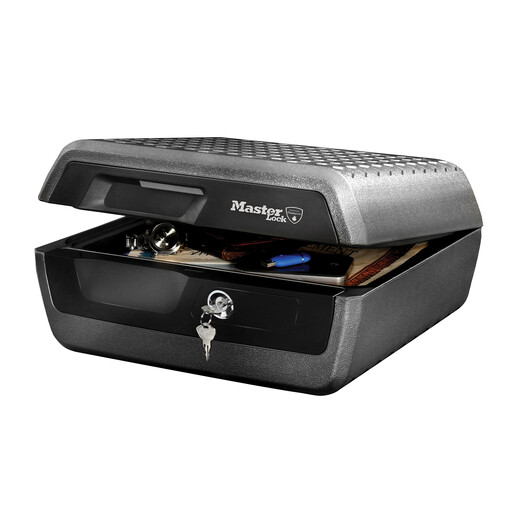
Why we recommend it: Perfect for individuals or self-employed professionals who want to secure their important documents (deeds, passports, contracts) and some digital media. Its fireproof security case format allows it to be stored discreetly in a cupboard or wardrobe.
This model offers dual certified protection: UL for paper documents (1 hour at 927°C) and ETL for digital media and water submersion. It thus addresses the first two common pitfalls.
Comprehensive UL and ETL certifications. The interior is designed to hold A4 documents flat, which is very practical for daily use.
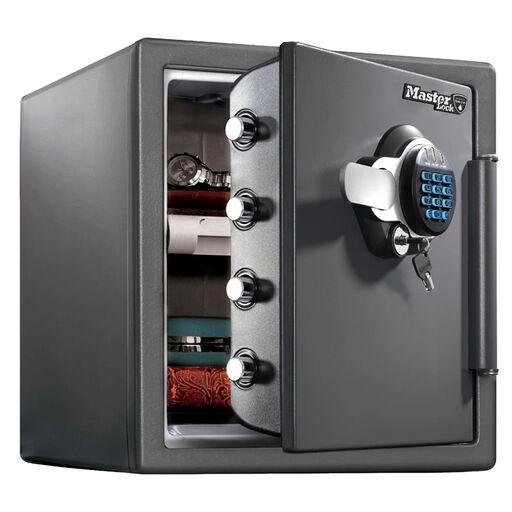
Why we recommend it: With its 33-litre capacity and dual-locking system (code + key), this Master Lock safe is the enhanced security solution for a family or small business needing to manage multiple access levels while protecting documents and valuables.
It offers superior 2-hour fire protection (UL), water protection (ETL), and a robust construction with 4 locking bolts. The mandatory dual lock (code and key) enhances security against unauthorised access.
Extended 2-hour fire protection. The dual-locking system is a major asset for strict access control in a professional or shared environment.
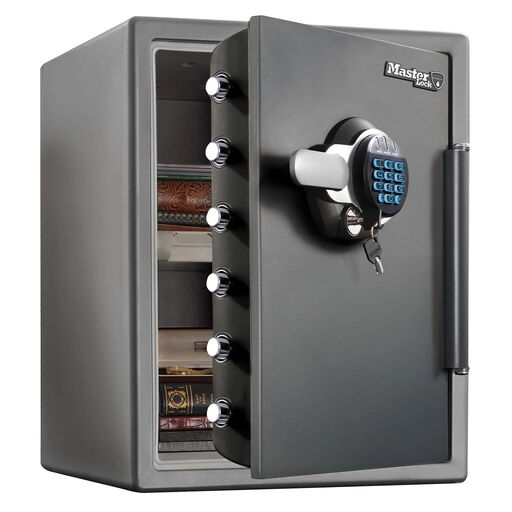
Why we recommend it: For collectors, professionals, and anyone seeking a large storage volume without compromising on security. Its large 56-litre capacity allows for storing binders, electronic equipment, and bulky valuables.
This safe checks all the boxes on our list: 2-hour fire protection (UL), water protection (ETL), and a very robust construction with six live locking bolts and a pry-resistant hinge bar. It addresses all three pitfalls by offering a complete solution.
Very large 56L capacity. 2-hour fire protection and a high level of physical security thanks to its six locking bolts.
Discover our full selection of products that meet our rigorous selection criteria and current safety standards.
Yes, it's essential for effective burglar protection. Most safes come with a bolt-down kit. Without it, a burglar could simply carry the safe away to open at their leisure. Be careful, however: on some models, drilling the necessary holes for bolting can void the waterproof certification. Read the manufacturer's instructions carefully. Wall mounting is not recommended as it may compromise the fire resistance.
Digital media (USB drives, hard drives, CDs) are much more sensitive to heat than paper. They can be irreversibly damaged as soon as the internal temperature exceeds 121°C. Paper, on the other hand, only begins to degrade around 177°C. This is why it is crucial to choose a safe with a specific ETL certification for digital media if you plan to store any.
Maintenance is very simple. Use high-quality alkaline batteries and replace them once a year, or as soon as the low battery indicator lights up. Keep the keypad clean by wiping it with a dry cloth. Finally, keep the backup key and/or master code in a secure location—and most importantly, never inside the safe itself.