
Livraison le jour même ou le lendemain

Qualité garantie

Débloquez vos offres de bienvenue: Livraison GRATUITE | Jusqu'à -80 % | 30 jours d'essai gratuits à JoyPlus
Téléchargez l'application
Passports, legal documents, contracts, USB drives, jewellery and cash all deserve protection against risks at home and in the office. But a fire- and water-resistant safe can have significant limitations if its certifications, dimensions or installation requirements are misunderstood.
A fire-resistant safe does not necessarily protect against water. Likewise, a water-resistant model is not necessarily designed to be fixed to the floor. Here are the key points to check before choosing a safe for your home or office.
The term ‘fire-resistant’ usually refers to a specific duration and temperature. It may also distinguish between paper documents and digital media, which cannot withstand the same heat thresholds.
Water resistance should be assessed separately. In particular, check the stated immersion time and water depth, as well as the conditions under which this protection remains valid.
A portable safe can be convenient, but its weight and fixing system have a direct impact on how well it resists theft. Conversely, some models lose their water resistance once bolted down.
So read the instructions carefully. On some safes, floor fixing is compatible with water resistance when you use a specific kit. On others, it may compromise this feature.
Capacity in litres does not always give you a clear idea of the usable space inside. Internal dimensions are essential if you need to store A4 sheets flat, folders, hard drives or document wallets.
Also think about the internal layout. An adjustable shelf, light, door pocket or separate compartment can stop everything getting piled together.
A UL classification generally means that fire resistance has been assessed according to a defined test protocol. Here’s what to look for:
ETL Verified means that Intertek has verified the features stated by the manufacturer. This may relate to water resistance, the ability to remain closed after a drop, or protection for digital media. So it’s better to check exactly what each claim covers than to rely on the word ‘certified’ alone.
A water-resistant safe should specify the level of protection it claims to offer. For example, immersion to a depth of 12 cm for 24 hours does not mean the safe can remain fully submerged for a long period.
Also check whether this protection remains valid after the safe has been fixed in place. This is essential if you plan to install it in a cupboard, on the floor or in a professional office.
Choosing between a digital safe and a key-lock model mainly comes down to your habits.
If you use your safe regularly, check how to replace the batteries, whether there’s a low-battery indicator and what emergency access options are available.
A portable safe is a good choice if you want an installation that doesn’t require any work, or need to move your documents from time to time. For a business, self-employed professional or family with a large archive, a bigger model with shelves that can be fixed in place is often more practical.
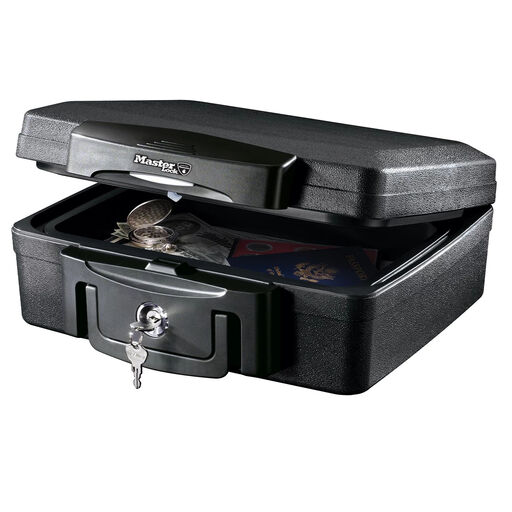
Why it’s a good fit: Its compact design and handle make it ideal for keeping passports, small documents and digital media safe at home or in the office.
Its specifications distinguish between protection for documents and for digital media. ETL also states that it is water-resistant when fully submerged.
UL classification for 30 minutes at 843 °C, key lock with two keys and an integrated handle.
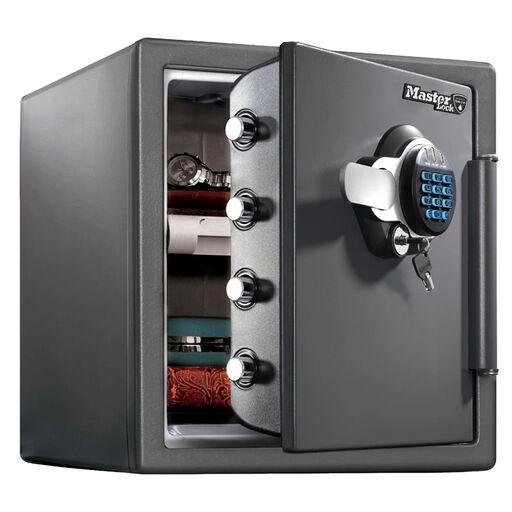
Why it’s a good fit: With a 33-litre capacity, backlit keypad and practical interior layout, this safe is well suited to regular use at home or in the office.
The protection levels are clearly stated: UL for 2 hours at 927 °C and ETL for protection against water up to 20 cm deep for 24 hours, before fixing.
Four locking bolts, digital keypad, emergency key, interior light and adjustable shelves.
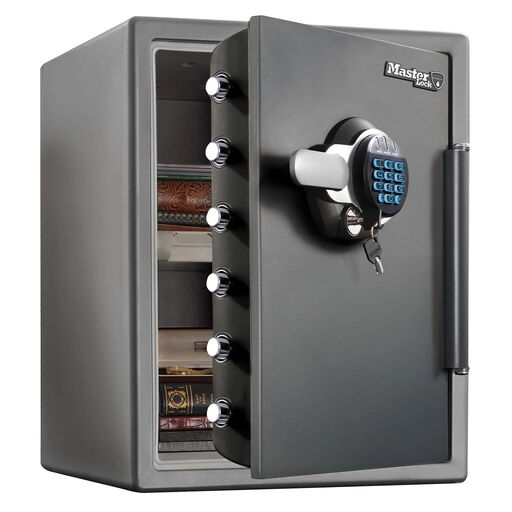
Why it’s a good fit: Its capacity makes it suitable for storing files, digital media and valuables in a business or a large home.
The product details explain that water resistance depends on how the safe is installed: bolting it down may compromise this feature, whereas fire protection remains in place as long as the safe is closed.
Six locking bolts, interior light, drawer, adjustable tray and UL protection for one hour at 927 °C.
We’ve put together a comprehensive, regularly updated list of products that meet these strict selection criteria and comply with European safety regulations.
It depends on the model. Some safes retain their water resistance when installed with a purpose-designed fixing kit. Others lose this feature once bolted down. Always check the instructions and the conditions attached to the ETL classification before installation.
The stated duration refers to a resistance test, for example 30 minutes, 1 hour or 2 hours at a specified temperature. It does not guarantee protection in every situation. To keep the safe working properly, keep it closed, maintain the lock and replace the batteries in digital models as instructed.
A keypad makes frequent opening easier and lets you change the code. A key-lock model avoids the need to manage batteries, but you must keep the spare key accessible without storing it in the safe. To decide, consider how often you’ll open it, how many people will use it and how much control over access you need.