
Livraison le jour même ou le lendemain

Qualité garantie

Débloquez vos offres de bienvenue: Livraison GRATUITE | Jusqu'à -80 % | 30 jours d'essai gratuits à JoyPlus
Téléchargez l'application
A set of fine-tip felt pens may seem easy to choose… until the ink bleeds through the pages, the nib becomes crushed or half the colours are left at the bottom of the pencil case. For students, illustrators, architects and bullet journal enthusiasts, a few criteria really do make all the difference.
Before buying fineliners or fine-tip felt pens, check three things: the stated line width, the type of ink and the exact contents of the set. This helps you avoid choosing based solely on the number of colours or attractive packaging.
A nib advertised as 0.4 mm will not necessarily produce an exactly identical line on every type of paper. The pressure applied, the texture of the sheet and the shape of the nib all affect the result. For diagrams, outlines and note-taking, 0.4 mm felt pens generally offer a good balance between fine lines and readability.
For illustration details or technical drawings, a set offering several sizes — 0.20 mm, 0.25 mm, 0.30 mm or 0.50 mm, for example — lets you create a hierarchy of lines without changing your graphic style.
A set of 45 or 65 shades can be an appealing choice for colouring, mandalas and creative compositions. For lessons, revision notes or annotating plans, 15 to 20 carefully chosen colours are often enough.
Look at how the shades are distributed: whether black, grey, warm and cool colours are included, as well as shades that are sufficiently distinct on white paper. A set of coloured felt pens should above all suit the way you work, rather than simply displaying a large number of references.
Waterproof pigment pens are designed to offer better water resistance once dry, according to the features provided by the manufacturer. However, this does not guarantee compatibility with every felt pen, watercolour or type of paper.
For mixed-media work, test the pen on the surface you intend to use: allow the ink to dry, then apply colour over it. This precaution reduces the risk of smudging and lets you check the actual drying time.
A fibre nib is suitable for writing, drawing and journalling alike. When protected by a metal sheath, it withstands use with a ruler or stencil more effectively. This is a real advantage for architects, students and anyone who regularly draws straight lines.
Precision pens designed for technical drawing benefit from offering several thicknesses. A 0.1 mm nib is used for the finest details, while a 0.5 mm or 0.7 mm nib is better suited to visible outlines and headings.
Water-based ink is very common in note-taking pens and coloured sets. It provides smooth lines on everyday paper, but may bleed through thin sheets depending on their weight.
Pigment inks are often preferred for illustration pens, ink drawing and work requiring crisp, long-lasting lines. However, descriptions such as “water-resistant”, “lightfast” or “archival” should be viewed as features stated in the product listing, rather than as a guarantee that applies regardless of storage conditions.
A soft pencil case slips easily into a bag. A rigid or metal box offers better protection for the pens and makes it easier to organise them by colour or size. Also check that the caps close properly and that storage instructions are clearly provided.
To prevent the pens from drying out, replace each cap immediately after use and store the pen according to the manufacturer’s recommendations. Some models are specifically designed to be stored horizontally.
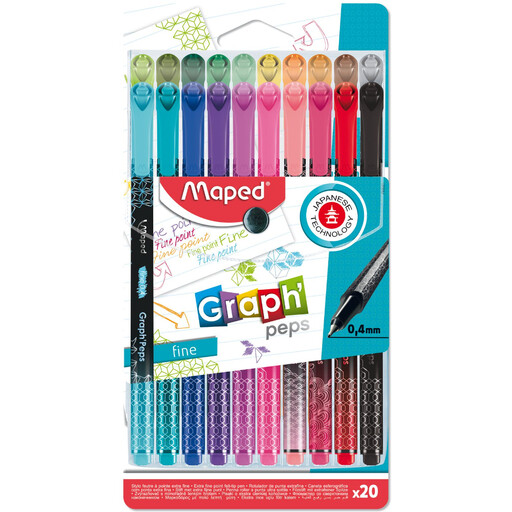
Why this choice suits this user: With 20 colours, this set is ideal for getting started with bullet journalling, revision notes and everyday drawing without building up a large collection.
The 0.4 mm line width is clearly stated, while the palette remains varied enough for both schoolwork and creative use.
Fine metal nib, triangular barrel and quick-drying water-based ink, according to the product listing.
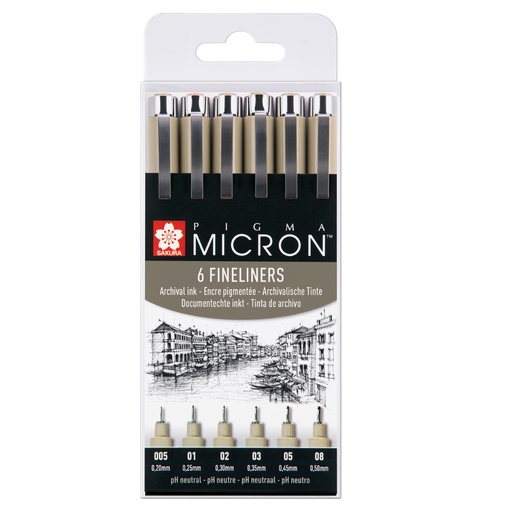
Why this choice suits this user: This all-black set is aimed at illustrators and artists who prefer to vary line weights rather than work with a multicoloured palette.
The set focuses on several nib sizes rather than an artificially inflated number of colours. Check the exact dimensions in the product listing before ordering.
Six black pens with pigment ink, described in the product listing as water- and light-resistant.
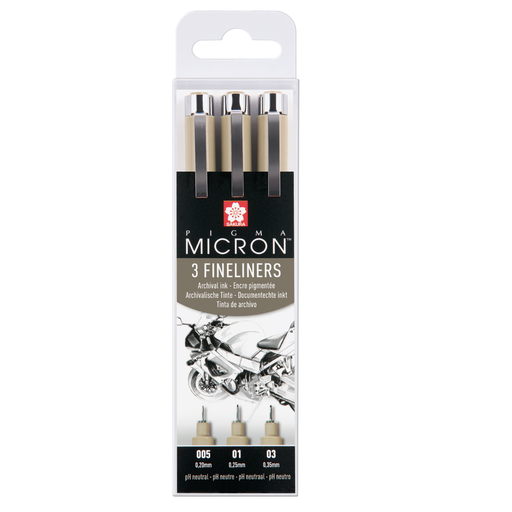
Why this choice suits this user: Technical artists, architects and fans of detailed illustration will appreciate the very fine nibs in this range.
According to the product listing, references 005, 01 and 03 correspond respectively to line widths of 0.20 mm, 0.25 mm and 0.35 mm, rather than a single nib presented as suitable for everything.
Pigment ink described as water- and fade-resistant, with three sizes designed for precision work.
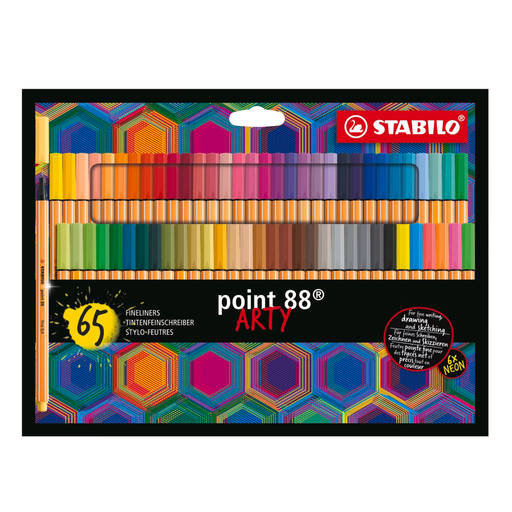
Why this choice suits this user: Regular bullet journal users, mandala artists, pixel artists and colouring fans have a complete palette in a single set.
The contents are clearly detailed: 65 shades, including 6 fluorescent colours, with a 0.4 mm metal nib. This lets you compare the palette with your actual needs.
0.4 mm line, metal-protected nib and 96% bio-based plastic according to the manufacturer’s mass-balance calculation.
We have put together a complete, real-time updated selection of products that meet these demanding criteria and European safety regulations.
For note-taking, diagrams and bullet journalling, a line width of 0.4 mm is a versatile choice. For illustration details or technical drawing, sizes from 0.1 to 0.3 mm offer more precise control, but require a light touch and a smooth, even sheet of paper.
Water resistance alone is not enough to determine the risk of show-through. The type of paper, its weight and the amount of ink applied also play a part. Test the pen on the intended surface, especially when using the thin pages found in notebooks and journals.
Its lifespan depends on how often it is used, the pressure applied, the paper and how securely the cap is replaced. A protected metal nib will generally cope better with ruler-guided lines, while a very fine nib should be used without pressing down. Storing the pen closed and away from heat helps preserve the ink and fibre.