
Livraison le jour même ou le lendemain

Qualité garantie

Débloquez vos offres de bienvenue: Livraison GRATUITE | Jusqu'à -80 % | 30 jours d'essai gratuits à JoyPlus
Téléchargez l'application
A fine-tipped fineliner pen can help you structure notes, sketch diagrams, fill in a bullet journal or add detail to drawings. However, not all sets are created equal depending on your intended use. A tip that flattens, ink that bleeds through the paper or poorly chosen colours can quickly turn an appealing purchase into a disappointment.
Before choosing a set of fine-tipped pens, it’s worth examining a few concrete criteria rather than relying solely on the number of colours or an attractive package.
A fine tip doesn’t necessarily guarantee a consistent line. The stated diameter, for example 0.4 mm, tells you the line width, but stability also depends on the tip design. An unprotected fibre can deform under pressure, especially when using a ruler or stencil.
Pens with a metal-tipped sleeve have a casing around the fibre. This design can be better suited to repeated tracing and precision pens used daily.
A set of 65 shades can be great for drawing or colouring, but it’s not necessarily relevant for note-taking. For revising, annotating documents or creating revision cards, an assortment of 10 to 20 colours is often more than enough. Compact storage also makes it easier to carry in a student bag.
On the other hand, fans of mandalas, pixel art or bullet journaling may want a broader palette to differentiate categories and colour zones.
Even good ink can bleed through very thin paper. For note-taking or using pens in a bullet journal, check the paper weight of your notebook and test on a spare page. Water-based inks are common in this category, but their performance varies depending on the surface.
Storage matters too. A pencil case, rigid case or roll-up pouch helps you find colours quickly and reduces losses. Always replace the cap firmly after each use. Storing them flat, in a dry place away from direct sunlight, helps preserve the ink flow.
For fine writing, diagrams and outlines, 0.4 mm fine-tipped pens offer a good balance between readability and precision. A 0.3 mm tip, like the one stated on the STAEDTLER Triplus Fineliner set, can suit tighter details and technical drawing.
However, line width isn’t everything. A tip reinforced with a metal sleeve is preferable if you often use a ruler or stencil. For colouring small areas, also look at the consistency of the ink flow and the pen’s ability to start smoothly without skipping.
Fineliners typically use water-based ink. It works well with most notebooks and office paper, but can behave differently depending on the paper. To avoid smudging, let the ink dry before closing a notebook or running your hand over an annotation.
Pens designed for note-taking generally favour readable shades and relatively fast drying. For drawing and colouring, colour variety and even coverage become more important. Don’t automatically assume an ink is indelible or water-resistant unless this feature is clearly stated on the product page.
A set of fine-tipped pens with 10 to 15 pieces is suitable for simple daily use. Sets of 20 to 30 colours offer more possibilities for mind maps, planners and colour coding. Beyond that, check that the case remains practical and that the extra shades genuinely match your projects.
Some compact models, especially mini versions, slip more easily into a pencil case. Roll-up pouches are convenient to carry and give you a quick overview of the available colours.
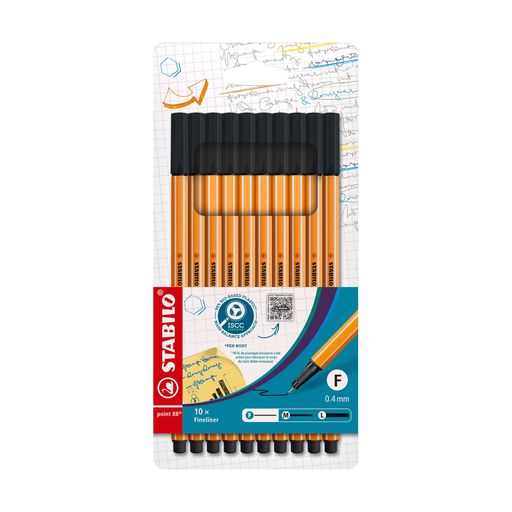
Why this choice suits this profile: This set of 10 black pens is ideal for students and users who want to start with a single shade for notes, outlines and diagrams.
The limited format stops you paying for colours you won’t use. The 0.4 mm tip with metal protection reduces the risk of deformation during tracing.
10 black pens, 0.4 mm tip, made in Germany as stated, and a cardboard case.
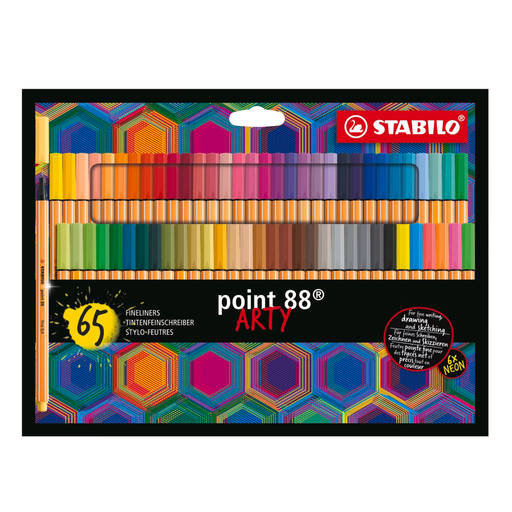
Why this choice suits this profile: Artists and bullet journal enthusiasts get an extensive palette for gradients, pixel art and detailed projects.
The number of shades is clearly stated and the set includes 6 fluorescent colours. The metal tip reduces the risk of deformation from repeated pressure.
65 colours, 0.4 mm tip, cardboard and plastic case stated as 96% bio-based material according to the product page.
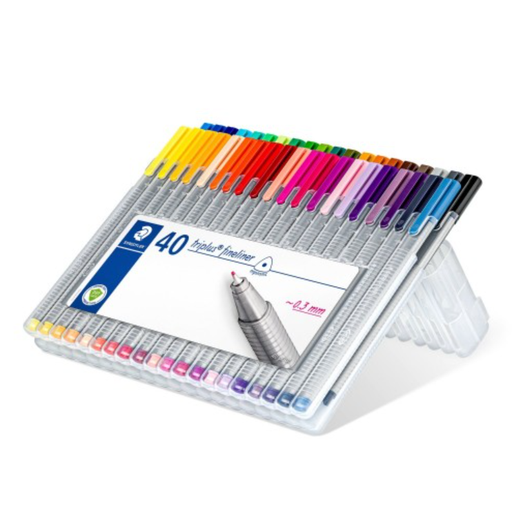
Why this choice suits this profile: Users who switch between detailed drawing, mapping, presentations and note-taking can make the most of 40 colours in a compartment case.
The 0.3 mm diameter is stated precisely, rather than relying on a vague promise of an ultra-fine tip. The case with 40 slots helps keep each pen in its place.
0.3 mm fibre tip, triangular barrel and an assortment of 40 colours presented in a polypropylene case.
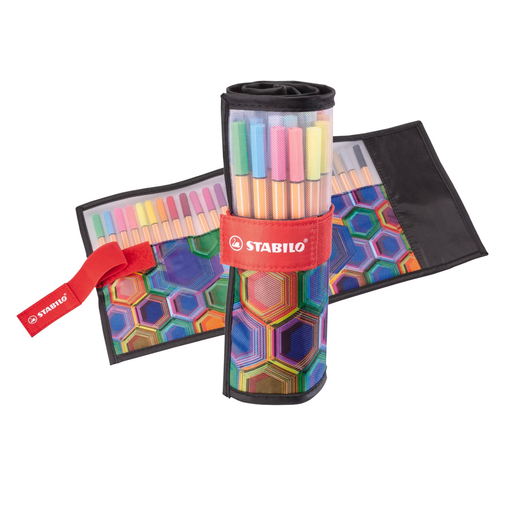
Why this choice suits this profile: The roll-up storage is designed for people who draw or annotate in different places and want to carry their pens without a rigid box.
The set clearly distinguishes its 25 colours and includes a zipped compartment. The 0.4 mm tip protected by a metal sleeve is suitable for repeated outlines.
25 selected shades, 0.4 mm tip and a nylon roll-up case with zip closure.
We’ve put together a comprehensive, real-time updated list of products that fully meet these strict selection criteria and European safety regulations.
The 0.3 mm is suitable for tight details, precise diagrams and some small handwriting. The 0.4 mm produces a slightly more visible line, ideal for notes, outlines, bullet journaling and colouring small areas. The choice depends on the paper, the size of your handwriting and the pressure you apply.
Yes, pens for bullet journaling are used to write headings, draw frames, create calendars and add colour coding. However, test the ink on a spare page to check it doesn’t bleed through the paper or smudge when you use a highlighter over it.
Close the cap carefully after each use, store the set in a dry place and avoid direct light. A well-organised case also reduces the risk of caps being put back on incorrectly. How long the pen lasts then depends on how often you write, the pressure you apply and the surface you use.