
Livraison le jour même ou le lendemain

Qualité garantie

Débloquez vos offres de bienvenue: Livraison GRATUITE | Jusqu'à -80 % | 30 jours d'essai gratuits à JoyPlus
Téléchargez l'application
A set of fine coloured pens might seem simple to choose. Yet between tips that flatten, inks that bleed through paper and unbalanced colour palettes, some purchases can quickly disappoint. Students, bullet journal enthusiasts, teachers, illustrators and creative colouring fans don’t all expect the same thing from their pens.
Here are the criteria to consider before buying, along with a selection suited to different uses.
A tip advertised as 0.4 mm won’t necessarily give the same result as another of the same diameter. The quality of the fibre, the presence of a metal casing and the consistency of the ink flow all directly affect the sharpness of the line.
For diagrams, outlines and note-taking, a fineliner with a reinforced tip is generally a safe choice. A very fine tip, such as 0.3 mm, is more comfortable for details, but requires a light hand and sufficiently smooth paper.
A pen described as waterproof may resist water once the ink is dry. However, the result depends on the paper, drying time and the liquid used. Water-resistant ink isn’t necessarily compatible with watercolour, alcohol markers or non-porous surfaces.
If your drawing is to be coloured in afterwards, carefully check the product description and test on paper similar to what you’ll be using. Drawing pens with black pigment are often preferred for outlines, while water-based inks work well for writing and colouring on paper.
A set of 40 or 65 shades can be useful for colour-coding and detailed creations. However, the number of colours isn’t everything: a coherent, well-balanced palette matters more. For studying or meetings, 10 to 20 shades can be more than enough. For bullet journaling or colouring, a larger palette makes visual gradients and information hierarchy easier.
A metal-cased tip can be used with a ruler or stencil and withstands repeated pressure better. That said, it still doesn’t mean you should press too hard.
Water-based ink is common on coloured precision felt-tip pens. It dries quickly on most papers and suits note-taking, colouring and revision cards. On thin paper, always test for bleed-through.
Pigmented inks or those described as water-resistant are better suited to outlines that need to last. For claims like “waterproof”, “fade-resistant” or “non-toxic”, take the manufacturer’s information for what it is: stated characteristics. Also remember to check the usage precautions.
Storage directly affects the lifespan of your pens. A roll-up case is easy to carry, while a rigid box offers better protection in a bag. Replace the cap after each use and store pens horizontally when the instructions recommend it.
Caps and tips are small parts: in line with the warnings on the relevant product pages, these products are not suitable for children under 3 years old.
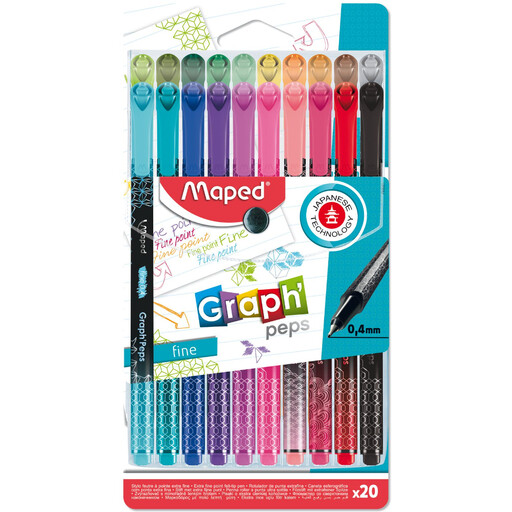
Why this set suits them: With its 20 colours, it covers everyday needs — notes, revision cards and creative activities — without cluttering up the pencil case.
The metal-cased 0.4 mm tip and triangular barrel improve both line control and comfort during long sessions.
20 shades, a 0.4 mm tip and a water-based ink described as quick-drying.
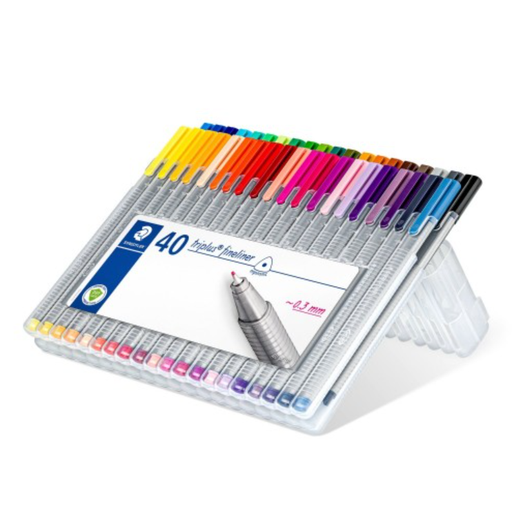
Why this set suits them: Its generous palette lends itself to colour-coding notes, mind maps, detailed drawing and bullet journaling.
The product page mentions a 0.3 mm tip and a 40-slot case: colours stay easy to spot and store.
An ergonomic triangular barrel, pigmented water-based ink and 40 assorted colours according to the product description.
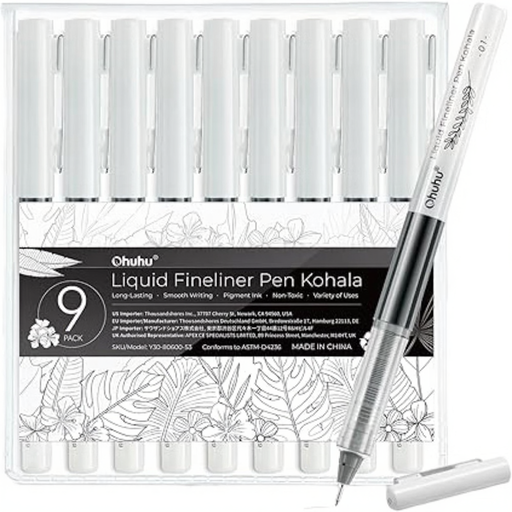
Why this set suits them: Illustrators, manga fans and mixed-media enthusiasts can vary line thicknesses without switching ranges.
The diameters, from 0.15 mm to 1.0 mm, are clearly stated and the set includes a brush tip. That means you can choose the right line for every detail.
A black pigmented ink described as water and alcohol resistant, in a transparent barrel with size markings.
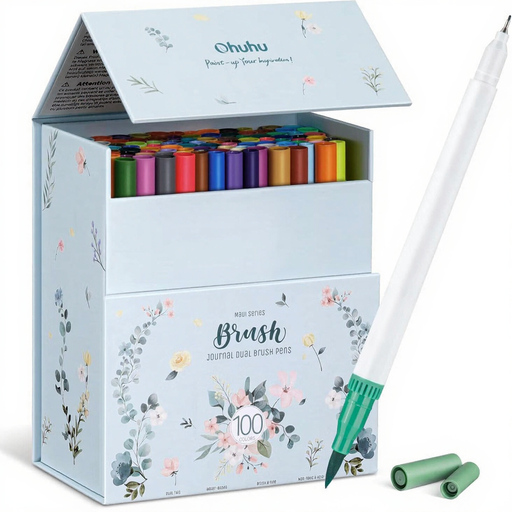
Why this set suits them: It’s designed for those who want to combine colouring, fine details, shading and lettering.
The dual tip means you don’t need to buy several sets. However, do plan for thick paper if you intend to work on water-blending effects.
Each pen combines a 0.4 mm fineliner tip with a flexible brush tip from 1 to 6 mm, plus a colour chart.
We’ve put together an updated selection of products that meet these criteria and the safety requirements applicable in the UK.
Yes, this width produces a legible line while remaining fine enough for margins, tables and colour-coding. If you write on very thin paper, though, test for show-through before filling an entire notebook.
It all depends on how often you use them, how much pressure you apply and how you store them. Closing each cap promptly, avoiding heat and storing pens according to the manufacturer’s recommendations all help prevent them from drying out. A metal-cased tip can also reduce deformation from use with a ruler.
It depends on the ink. Waterproof or pigmented pens are generally preferred for creating outlines before applying water, but always check the product page details. With water-based pens, the ink may dilute or bleed. Testing on your final paper is still the most reliable way to check the result.