
Livraison le jour même ou le lendemain

Qualité garantie

Débloquez vos offres de bienvenue: Livraison GRATUITE | Jusqu'à -80 % | 30 jours d'essai gratuits à JoyPlus
Téléchargez l'application
Hard water, inconsistent pressure or an underwhelming shower can make you want to replace your shower head as quickly as possible. However, a high-pressure filtered shower head should not be chosen solely based on the number of spray settings or its appearance. Some models make numerous claims, but their performance also depends on the installation, the available water pressure and filter maintenance.
Here are the key points to check when choosing a solution suited to your bathroom, without paying for features you will never use.
A shower head marketed as ‘high pressure’ does not necessarily increase the pressure in your plumbing system. It may simply concentrate the flow through finer nozzles. The result therefore depends on your installation’s water pressure, the condition of the hose and whether a flow restrictor is fitted.
To avoid disappointment, check that the nozzles are evenly distributed, look at the size of the spray plate and make sure a flow limiter can be used if the spray becomes uncomfortable.
A shower head with an anti-limescale filter requires a small amount of ongoing maintenance. A saturated cartridge can reduce the flow and make the spray less even. How often it needs replacing varies according to water quality and frequency of use.
Be wary of claims of permanent filtration. A shower chlorine filter or a system designed for hard water must be replaced in accordance with the manufacturer’s recommendations. It does not turn water into drinking water and is not a medical device.
Most shower heads sold in France use a standard G1/2 connection, but it is still best to check compatibility before placing your order. A supplied hose can also make a difference if the old one is clogged with limescale, too short or awkward to handle.
Filtered models can contain various materials, such as activated carbon, calcium sulphite, KDF or mineral beads. Manufacturers present these as capable of reducing certain components in the water. To get a clearer picture, check the composition listed in the product specifications, along with the recommended replacement frequency.
In the case of a shower head for hard water, the filter does not replace a water softener installed throughout the plumbing system. It only acts on the water passing through the shower head.
A water-saving shower head should provide sufficient coverage without unnecessarily increasing the flow rate. Reported water-saving figures should be treated with caution, as they depend on water pressure, shower duration and the selected setting.
Silicone nozzles generally make it easier to clean away deposits. Wiping them regularly limits limescale build-up around the openings and helps maintain an even spray.
A multifunction handheld shower head may offer three, five or six settings: rain, massage, concentrated spray or mist. A 5-setting shower head is often suitable for varied everyday use. A 6-jet shower head offers more options, provided the dial remains easy to turn with wet hands.
Choosing between a black or chrome shower head mainly depends on your bathroom style and how tolerant you are of limescale marks. Dark finishes tend to show white deposits more clearly, while chrome coordinates easily with existing accessories.
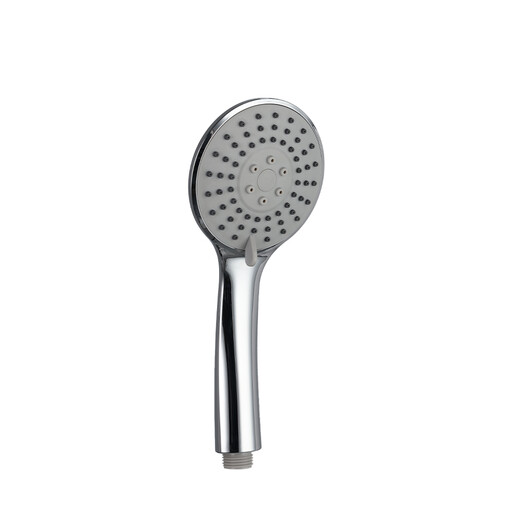
Why this choice suits this profile : Its compact design and three settings cover the needs of a first installation or a bathroom used by several people.
It avoids paying for a multitude of settings that are rarely used and makes it easy to check compatibility with a standard installation.
Three spray modes, an integrated switch and a chrome/grey finish suited to both showers and baths.
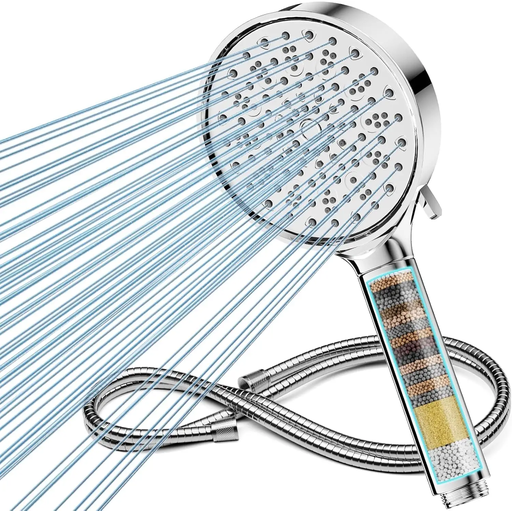
Why this choice suits this profile : This model combines a pre-installed filter cartridge, six modes and a hose, allowing you to replace several components in a single order.
The specifications state that it has a universal G1/2 connection and a pre-installed filter, reducing the need for additional purchases and helping to prevent installation errors.
A filtration system advertised as having 20 layers, six modes and a 124 × 124 mm spray plate, with hose included.
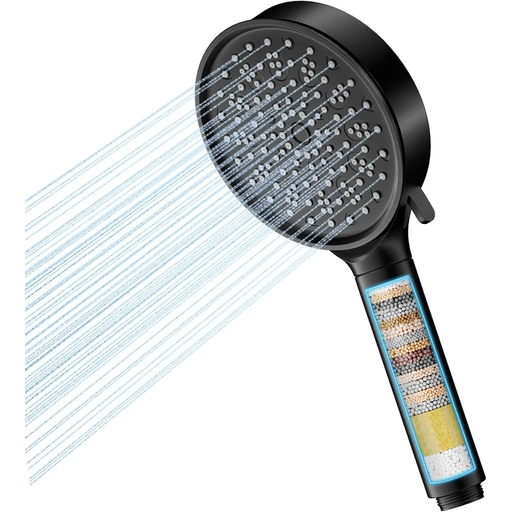
Why this choice suits this profile : Its black finish, six settings and filtration system are aimed at households that use the shower frequently and want a range of options.
The cartridge is pre-installed, and the product specifications recommend replacing it every three to four months, or as soon as the flow decreases. This makes maintenance easier to plan.
Six modes, G1/2 connection, 124 mm spray plate and a flow limiter supplied separately, according to the product specifications.
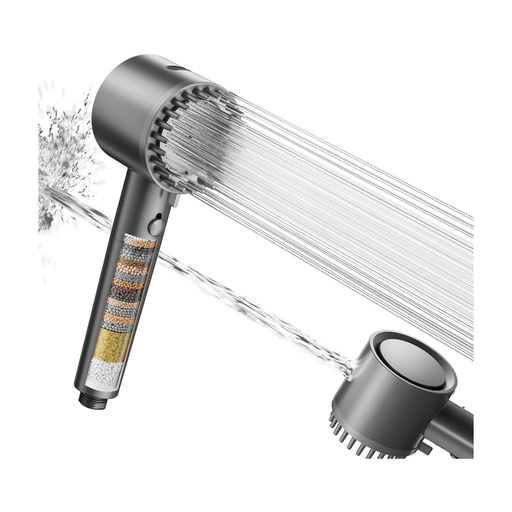
Why this choice suits this profile : Its five modes, 1.5 m hose and standard connection are suitable for families, children or occasional shower enclosure cleaning.
The tangle-free hose and pre-installed cartridge simplify installation and everyday handling.
Five modes, 1.5 m hose, 1/2-inch connection and a cleaning tool mentioned in the specifications.
We have created a complete, real-time updated list of products that fully meet these strict selection criteria and European safety regulations.
Installing a handheld shower head with a G1/2 hose connection can generally be done by hand after turning off the water supply. Remove the old shower head, check the seal and screw on the new model without overtightening. If the leak persists, the seal may be incorrectly positioned or the thread may be incompatible.
To maintain a consistent flow:
It may retain or treat certain components, depending on the technology used, but its action is limited to the water passing through the shower head. It does not replace a water softener for the whole house. Check the filter composition and the conditions of use specified by the manufacturer.
This varies according to water hardness, the volume of water used and how often you shower. For several models featured here, the specifications state that the cartridge should be replaced every three to four months, or sooner if the flow decreases. This recommendation should be adjusted to the actual conditions in your home.
Not necessarily. A more concentrated spray may reduce rinsing time, but water consumption mainly depends on the actual flow rate and duration of use. To compare two models, check the available flow-rate data and choose the economical setting when one is provided.