An individually wrapped filled wafer is a good option if your child needs a snack they can eat without bread or cutlery. A pot of chocolate spread is better if you’re planning to provide something to eat it with. Before choosing, check the ingredients and allergens for the specific product, as well as the school’s rules and any applicable individual healthcare plan (PAI). The Nutri-Score is optional in France, according to the Ministry of the Economy, and does not replace checking the label.
Who are these formats for?
Parents looking for a snack that needs no preparation
An individually wrapped filled wafer can be eaten without bread or cutlery. Nutella France describes B-ready as an individually wrapped wafer: it’s a ready-to-eat product, not a portion of chocolate spread on its own.
Families who need to consider allergens at school
The exact recipe and the school’s rules matter more than the format alone. For a pupil with a food allergy, the French Ministry of National Education says an individual healthcare plan (PAI) can set out adjustments, including dietary requirements.
Shoppers comparing portions and ingredients
A filled wafer, a single-serve pot and a jar aren’t eaten in the same way. Comparing their individual weights, ingredients and nutritional information can help you choose the right format for the snack you have in mind.
What should you check before buying?
First, decide whether the snack needs to be ready to eat or whether you can provide bread or something else to eat it with. In either case, you’ll still need to check the recipe and the school’s rules.
Individually wrapped filled wafer
Choose this if: your child needs to be able to eat it as it is, without anything to eat it with or any utensils.
Bear in mind: the wafer and its filling make up a complete recipe, unlike a portion of chocolate spread on its own.
Pot of chocolate spread
Choose this if: you want a separate portion of spread and plan to provide something to spread it on or eat it with.
Bear in mind: you’ll also need to pack something to eat it with and, depending on how it’ll be used, a utensil.
| What to consider |
What to check |
Who it matters to |
| Ready-to-eat snack |
Tell the difference between a filled wafer and a pot of chocolate spread; check the weight per item. |
If I’m packing a snack to take out without bread or cutlery, I look for something my child can eat as it is. Around 42% of shoppers prioritise this independence. |
| Allergens and school |
Check the allergens on the specific pack; confirm the school’s rules and any applicable PAI. |
When packing a snack for school, I need to know whether the recipe is suitable for my child and follows any adjustments in place. This is the main concern for around 33% of shoppers. |
| Ingredients and quantity |
Compare the ingredients, weight per item and nutritional values per 100 g, then per portion where given. |
When I’m choosing between a wafer and a separate portion of chocolate spread, I want to understand what each portion contains. Around 25% of shoppers put this comparison first. |
Which common mix-ups should you avoid?
-
Mistaking a filled wafer for a portion of spread on its own
A wafer has a biscuit casing and a filling. If you’re specifically looking for sweets or chocolate spread to spread on something, it’s a different product.
First decide what kind of snack you want, then compare the ingredients and quantities of products in the same category.
-
Assuming the Nutri-Score is compulsory
The French Ministry of the Economy says the Nutri-Score is an optional additional label in France. Its absence does not, on its own, mean that a product is non-compliant.
If it’s shown, read it alongside the ingredients list and nutritional declaration rather than using it as your only way to choose.
-
Assuming the allergens in one product apply to all the others
Nutella B-ready contains ingredients derived from wheat and barley, among others. This doesn’t automatically tell you what’s in other wafers, pots or jars of chocolate spread.
Check the ingredients list and allergens on every pack you buy, particularly if you switch recipe or format.
-
Buying a multipack of spread portions without checking its size
Portions can come in large multipacks: Nevejan, for example, sells Nutella pots in a pack of 120, each weighing 15 g. A pack this size may not be right if you only need a few snacks.
Before choosing a multipack, check the number of items, the weight of each pot and the date shown on the packaging.
A large pack will also need space to store any portions you don’t use straight away.
Brands to know when comparing formats
These examples mainly help you tell an individually wrapped wafer apart from chocolate spread in a jar. A brand being listed here doesn’t mean all its products are available in every format.
Nutella
Nutella France describes B-ready as an individually wrapped filled wafer, distinct from its chocolate spread in a jar.
- B-ready is ready to eat; the 10-piece product featured below weighs 22 g per item.
- This product contains hazelnuts, milk, soya, wheat and barley, among other ingredients. Check that it’s suitable for your child.
Carrefour Classic'
Carrefour France lists, among other products, a 400 g jar of Classic' hazelnut and cocoa spread.
- A jar works well for serving at home or preparing a portion before you leave.
- A jar on its own isn’t an individual ready-to-eat snack.
Auchan Pasta Cao
Auchan France lists Pasta Cao, a hazelnut and cocoa spread, including in a 400 g jar.
- This format lets you prepare the amount you want to serve separately.
- If the snack is going to be eaten out, you’ll need to provide something to eat it with and prepare the portion.
An individually wrapped wafer available on Joybuy
This selection features an individually wrapped filled wafer that can be eaten without bread or cutlery. Before packing it for school, check the allergens and any applicable rules.
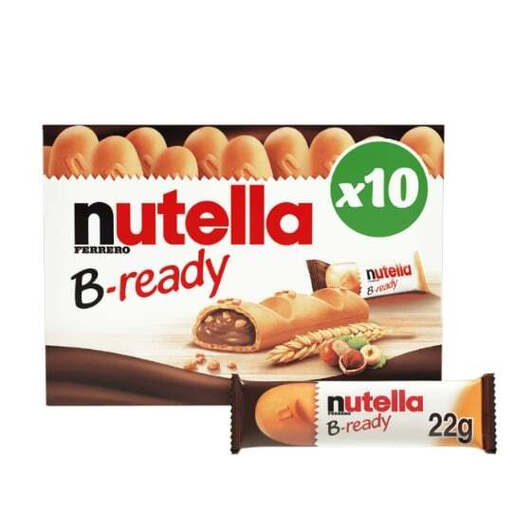 Image unavailable
Nutella B-ready, 10 × 22 g
The ten individually wrapped wafers are a handy snack to eat without bread or cutlery. The pack states that it contains 220 g in total, or 22 g per wafer. This product contains hazelnuts, milk, soya, wheat and barley, among other ingredients. Check the label on the pack you buy, the school’s rules and any applicable PAI.
View on Joybuy
Frequently asked questions
Is the Nutri-Score compulsory on these products in France?
No. According to the French Ministry of the Economy, the Nutri-Score is optional and supplements the mandatory nutritional declaration for prepacked foods. Its absence isn’t enough to judge a product: compare its ingredients and nutritional values too.
What should you check on the packaging of an individual snack?
Start with the product name, ingredients list, allergens, quantity and nutritional information. The French Directorate-General for Competition, Consumer Affairs and Fraud Control reminds consumers that allergenic ingredients must be highlighted on the label.
Does Nutella B-ready contain ingredients derived from wheat and barley?
Yes. Information about Nutella B-ready lists wheat and barley, among other ingredients. If your child needs to avoid certain ingredients, check the list on the specific pack before choosing this wafer.
Can you pack a filled wafer for school?
Check the school’s rules before putting it in your child’s school bag. For a pupil with a food allergy, the French Ministry of National Education says an individual healthcare plan (PAI) can set out dietary adjustments that must be followed.


