People eating on the go
If you don’t have a surface to prepare something on or a jar to reseal, a ready-to-eat individual bite may be more convenient than a spread. Check the ingredients before putting it in your bag.


If you want to eat without bread or utensils, choose an individually wrapped filled bite. It’s not a spread, though, so you can’t control how much you have. A mini pot is handy if you already have something to spread it on, while a small standard jar lets you serve your own portion. In every case, compare the nutritional information and check the allergens on the product you choose.
If you don’t have a surface to prepare something on or a jar to reseal, a ready-to-eat individual bite may be more convenient than a spread. Check the ingredients before putting it in your bag.
An individually wrapped item or a mini pot lets you decide in advance how much to take with you. However, the format alone tells you nothing about its nutritional content.
Sugars, fats and allergens matter more to you than the size of the pack alone. The DGCCRF notes that nutrition information is generally shown on prepacked foods; Nutri-Score, on the other hand, is voluntary in France.
First, work out whether you’ll be able to spread it on something. Then compare the nutritional information and ingredients for the format you choose.
| What to consider | What to check | Who is it for? |
|---|---|---|
| Eating without preparation | Check whether the product can be eaten as it is or needs something to spread it on, as well as the amount in each portion. | If I have nowhere to prepare my lunch, I want to be able to open a portion and eat it straight away. Around 40% of consumers put convenience first. |
| Nutritional information | Compare the sugars and fats per 100 g, then check the amount in the portion you’ll eat. | If I’m taking a small portion, I want to know what’s in it rather than judge by its size. Around 30% of consumers prioritise this comparison. |
| Ingredients and allergens | Read the ingredients list, check which allergens are highlighted and look for any “may contain” statements on the packaging. | If a recipe needs to meet my dietary requirements, the product name or an “organic” label isn’t enough. Ingredients that are suitable for their needs are the top priority for around 30% of consumers. |
The DGCCRF states that displaying it is voluntary in France. If it’s not shown, you should still check the nutrition information, which is generally required for prepacked foods.
Compare the values per 100 g, particularly sugars, fats, saturated fatty acids and salt. Use the Nutri-Score as extra information when it’s displayed.
A filled bite is ready to eat, whereas a mini pot contains a spread to serve on another food. Their small size doesn’t make them interchangeable at lunchtime.
If you can’t prepare your meal where you are, choose a ready-to-eat product. For a mini pot, remember to bring something to spread it on and a utensil to serve it.
These claims describe specific characteristics, but they don’t tell you the nutritional values or list of allergens on their own.
Check the ingredients and allergens, then compare the nutritional information per 100 g and for the amount you plan to eat.
Nutella describes B-ready as an individually wrapped filled wafer, not as a mini pot of spread.
Auchan’s cocoa and hazelnut spread comes in a 200 g jar, with no individual sachets.
The cocoa and hazelnut product featured by Auchan is an organic spread in a 270 g jar, not an individual portion.
For lunch on the go, these two products suit different needs: a filled wafer you can eat straight away, and a small amount of spread to enjoy with something to spread it on.
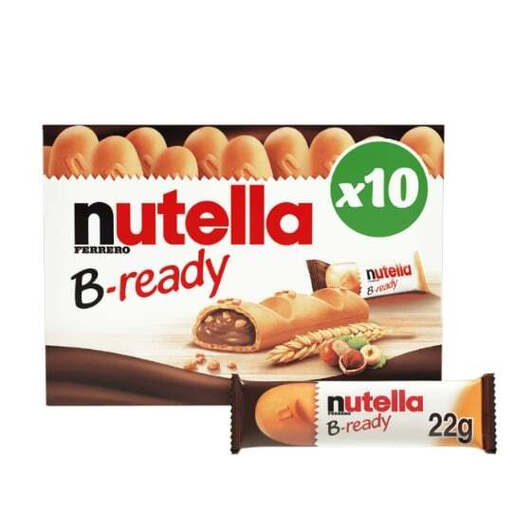 Image unavailable
This filled wafer is a good choice if you want to eat without bread or utensils. The pack is marked T10 and weighs 220 g. It isn’t a spread, so you can’t choose how much to have. Check the allergens on the packaging before eating.
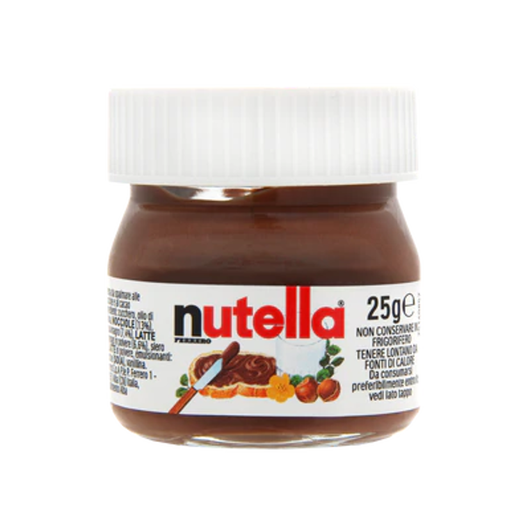 Image unavailable
This small amount of spread is handy if you want to take a portion with you rather than a large jar. Bring something to spread it on, and check the exact packaging, nutritional information and allergens on the product before choosing.
No. The DGCCRF says that Nutri-Score is voluntary in France. Nutrition information, however, is generally required on prepacked foods. Check the values per 100 g even if there’s no Nutri-Score.
Check the amount in each portion, then read the ingredients list and nutritional values per 100 g. The DGCCRF also notes that allergens must be highlighted in the ingredients list on prepacked foods.
No, not if you need to avoid these ingredients: the Joybuy product information lists hazelnuts and wheat containing gluten, as well as milk and soya. Always check the allergen information on the packaging of the item you receive.