
Livraison le jour même ou le lendemain

Qualité garantie

Débloquez vos offres de bienvenue: Livraison GRATUITE | Jusqu'à -80 % | 30 jours d'essai gratuits à JoyPlus
Téléchargez l'application
A print that peels off, stringing between parts, or a clogged nozzle can quickly turn a creative project into a spool destined for the bin. Choosing a filament for your 3D printer is therefore about more than just comparing colour and the price tag.
For hobbyists, makers, students and prototyping professionals in the UK, three mistakes crop up time and again:
Most desktop FDM 3D printers use a 1.75 mm PLA filament or a 1.75 mm PETG filament. Check your machine's manual before ordering. A 2.85 mm spool cannot be used in a system designed for 1.75 mm.
The stated tolerance is also worth your attention. Some PLA filaments from the JOYBUY x ANYCUBIC range, for example, have a tolerance of ±0.02 mm. A limited variation helps with more consistent feeding, but it does not remove the need to set the flow rate correctly or keep the nozzle clean.
A 1 kg 3D filament spool is suitable for users who print regularly and want to better assess the cost per object. Before starting a large print, always run a small test to validate your settings.
The temperatures printed on the packaging are a starting point, not a universal guarantee. Nozzle and bed temperatures, print speed and cooling must be adjusted according to your printer and model. After opening, store the spool in an airtight bag with a desiccant, away from moisture and heat.
For safety, never touch a hot nozzle, keep filament out of reach of children and pets, and ventilate the room in line with the precautions given by the manufacturer.
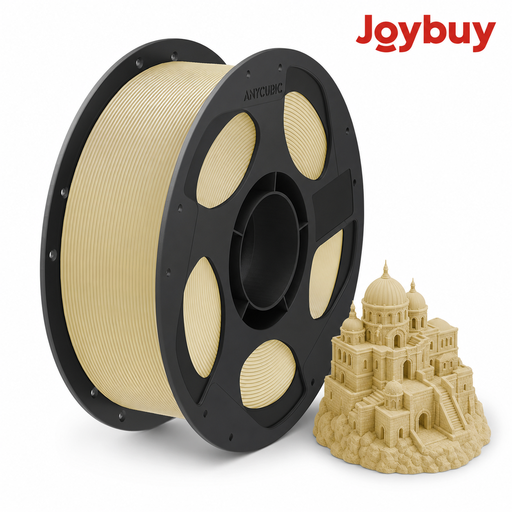
Why this choice suits this profile: this 1 kg spool of PLA in 1.75 mm provides a versatile foundation for learning to set up your printer, creating visual prototypes and printing models in a neutral shade.
The 1.75 mm diameter and stated tolerance of ±0.02 mm provide clear benchmarks before purchase, rather than leaving the decision to rest on a simple marketing promise.
A PLA presented as easy to print, with low warping and a 1 kg spool suited to everyday projects.
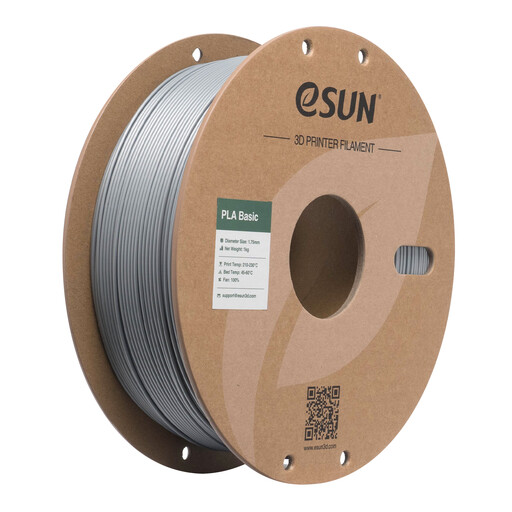
Why this choice suits this profile: this high-speed PLA filament is aimed at users with a fast machine who want to reduce their print times, within the real limits of their printer's capabilities.
The data sheet distinguishes a speed of up to 300 mm/s and a maximum flow rate of 35 mm³/s in a specific configuration. These values must therefore be compared against the limits of your own machine.
A 1.75 mm diameter, 1 kg packaging and a silver colour. Stated compatibility includes certain Bambu Lab, Creality and AnkerMake printers.

Why this choice suits this profile: this black PETG is aimed at functional parts, mechanical prototypes and objects where strength and moisture resistance take priority over the ease of printing of PLA.
The data sheet recommends a nozzle temperature between 220 and 250 °C, and a heated bed set between 60 and 80 °C: constraints that remind you that PETG cannot be set up like a one-size-fits-all PLA.
PETG in 1.75 mm, in black, with impact and water resistance as stated by the manufacturer, plus vacuum packaging with desiccant.
We have selected a comprehensive list, updated in real time, of products that meet these demanding criteria and European safety requirements.
PLA is generally the simplest starting point for printing figurines, decorative objects and visual prototypes. However, check the diameter your printer accepts, the nozzle diameter and the recommended temperatures. A black, white, red, blue or silver 3D filament also lets you build up a stock of common colours without immediately switching material.
The shelf life depends mainly on the material, the packaging and the amount of moisture absorbed. A spool properly sealed with a desiccant can remain usable for a long time. Conversely, a spool left in humid air can quickly cause inconsistent extrusion. If bubbles or stringing appear, drying in line with the manufacturer's recommendations may be an option.
The price varies by brand, finish and formulation. PETG may also require more adjustments, a higher temperature and a heated bed. To compare the two materials, do not just look at the spool price: take into account the price per kilogram, the print failure rate, the electricity consumption and the intended use.