People who want to compare sugar content
If you’re looking for a lower-sugar chocolate and hazelnut spread for the festival, the ‘of which sugars’ figure per 100 g lets you compare recipes without relying on the claim on the front of the pack.


When choosing a lower-sugar spread to share at a festival, start by comparing the ‘of which sugars’ figure per 100 g for products intended for the same use. The claim ‘no added sugars’ doesn’t tell you this figure on its own. Next, check the allergens, pack size and storage instructions for the jar you choose. In France, Nutri-Score is an additional guide when displayed, not a mandatory label.
If you’re looking for a lower-sugar chocolate and hazelnut spread for the festival, the ‘of which sugars’ figure per 100 g lets you compare recipes without relying on the claim on the front of the pack.
The jar size should suit the number of people and the amount you can serve and store once opened. A larger pack isn’t automatically the most practical choice.
Before offering a jar to the group, make sure you can check the ingredients and allergens for the exact product, and have another option ready if needed.
For a spread to take to a festival, start with the declared sugar content and ingredient suitability, then choose a pack size that works for serving. If shown on the product, Nutri-Score can help you interpret the nutritional information.
| Criteria | What to check | Who is it for? |
|---|---|---|
| Declared sugars | Compare the ‘of which sugars’ figure per 100 g for spreads intended for the same use, then consider the portion you’ll serve. The claim ‘no added sugars’ doesn’t replace this figure. | I want to choose a chocolate and hazelnut spread that genuinely contains less sugar than a classic recipe. Around 39% of consumers put this measurable reduction at the top of their needs. |
| Ingredients and allergens | Read the ingredients list and allergen information on the exact jar before sharing it. | If someone in the group needs to avoid certain ingredients, I need to be able to rule out an unsuitable jar before serving. This is the main concern for around 23% of consumers. |
| Pack size and storage | Choose the weight according to the number of people and check the storage instructions, especially after opening. | I’m planning to serve a group and want to avoid a jar that’s difficult to transport or store once opened. Pack size and serving arrangements come first for around 23% of consumers. |
| Reading the label | Use Nutri-Score if it’s displayed, but don’t let it replace checking the nutritional values and ingredients. | I need clear information on the label to compare jars, even if the Nutri-Score logo isn’t shown. Around 15% of consumers prioritise comparing this nutritional information. |
According to Santé publique France, producers choose whether to display Nutri-Score in France. So the absence of the logo doesn’t tell you how to rate the spread.
Check the nutritional information and ingredients list. Use the logo only as an additional guide when it’s present.
This claim doesn’t tell you the total amount of sugars. The product information from Lucien Georgelin and Nutella France gives sugar figures of 8.5 g and 56.3 g per 100 g respectively for the two chocolate and hazelnut recipes considered here.
Compare the ‘of which sugars’ figures on the same 100 g basis, then think about the portion you’ll serve.
The chocolate and hazelnut recipes considered here contain ingredients you should flag to the group. Lucien Georgelin lists hazelnuts and milk, and also warns that traces of other nuts may be present. Nutella France lists hazelnuts, milk and soya.
Check the label on the jar you buy before serving, and have a separate option ready if anyone mentions an allergy.
A large pack may suit a group, but you should also consider how much will be left and how to store it once the jar has been opened on site.
Choose a weight that suits the number of people and follow the storage instructions for the product you select.
Its 400 g chocolate and hazelnut spread with no added sugars is a specific product to consider if declared sugar content is your top priority.
The classic chocolate and hazelnut recipe serves as a point of comparison here for declared sugar content and jar sizes.
Its range of spreads lets you compare different pack sizes, including products in the Carrefour Classic' range.
Gerblé offers fruit spreads with no added sugars. This category shouldn’t be confused with chocolate and hazelnut spread.
For serving at a festival, this 400 g jar of Banania is a cocoa and banana spread, not the chocolate and hazelnut recipe used for the sugar comparison above.
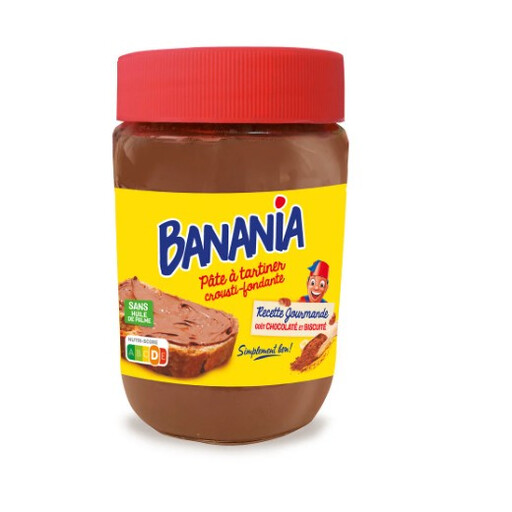 Image unavailable
The 400 g jar is worth considering depending on how many people you’re serving. To choose a lower-sugar spread, compare the ‘of which sugars’ figure for this cocoa and banana recipe with those of the other products you’re considering. Check the allergens on the exact jar before sharing it, too.
No. According to Santé publique France, producers choose whether to display it. Its absence doesn’t replace checking the product’s nutritional information and ingredients.
No. The claim isn’t enough to tell you the total amount of sugars. Check the ‘of which sugars’ figure per 100 g for the product you choose. The product information for the chocolate and hazelnut recipes considered here gives figures of 8.5 g for Lucien Georgelin and 56.3 g for Nutella France, on the same basis.
Check the information on the exact jar. For the recipes considered here, Lucien Georgelin lists hazelnuts and milk, and warns that traces of other nuts may be present; Nutella France lists hazelnuts, milk and soya.
Follow the instructions for the product you bought. For its 400 g chocolate and hazelnut spread with no added sugars, Lucien Georgelin advises storing it at room temperature, away from heat and moisture, and consuming it within a month of opening.