
Livraison le jour même ou le lendemain

Qualité garantie

Débloquez vos offres de bienvenue: Livraison GRATUITE | Jusqu'à -80 % | 30 jours d'essai gratuits à JoyPlus
Téléchargez l'application
A set of creative felt-tip pens and markers may seem appealing because of its wide range of colours. However, a generous palette does not guarantee precision or ink that is suitable for your chosen surface. Students, illustrators, colouring enthusiasts, teachers and bullet journal fans do not all expect the same things from their pens.
Before placing your order, focus on three key criteria: the nib, the type of ink and compatibility with the surface. This will help you avoid disappointing purchases, smudges and pens left forgotten at the bottom of a pencil case.
A 100-colour set may look tempting, but it will not necessarily replace a smaller selection of specialist pens. For taking notes or creating diagrams, 0.4 mm fineliners are often all you need. For colouring, gradients and lettering, brush pens offer a much wider range of effects.
So look at the distribution of nib types, not just the number of shades. A set offering two functions per pen may prove more practical than a large box filled with identical models.
Ink designed for paper will not necessarily be suitable for wood, glass or ceramics. Acrylic markers are designed for use on a range of surfaces, but their finish, opacity and durability should be checked according to your project.
For notebooks, choose ink that limits show-through on the reverse side. For a slate or whiteboard, choose an erasable formula. For a decorative project, take the time to check the preparation and drying instructions.
A dry nib is often the result of a cap that has not been closed properly or unsuitable storage. Brush pens and fine-nib pens are particularly sensitive to pressure and poor storage conditions. Replace the cap on each marker after use and follow the manufacturer’s recommendations, especially when horizontal storage is advised.
A metal nib, such as the one on the STABILO point 88, can be used with a ruler or stencil. It provides more consistent guidance for fine lines.
Water-based inks are very common for writing, colouring and watercolour pens. On sufficiently thick paper, they can be blended to create a watercolour-like finish. Always test how the paper reacts before working on a full page.
Acrylic inks are generally more opaque and are intended for a wide range of surfaces. Depending on the manufacturer’s instructions, they may be suitable for paper, wood, glass, metal, stone, plastic or fabric. However, test the ink on an inconspicuous area first, especially if the surface is valuable.
A set of 4 to 12 colours is suitable for focused use: at a desk, on a whiteboard, for monochrome sketches or with a warm colour palette. Assortments of 20 to 65 colours are better suited to illustrators’ needs. Large palettes of 60 or 100 shades are aimed at users who want to create colour charts and produce a greater variety of blends.
A blank colour chart, numbered colours and a storage box make everyday selection easier.
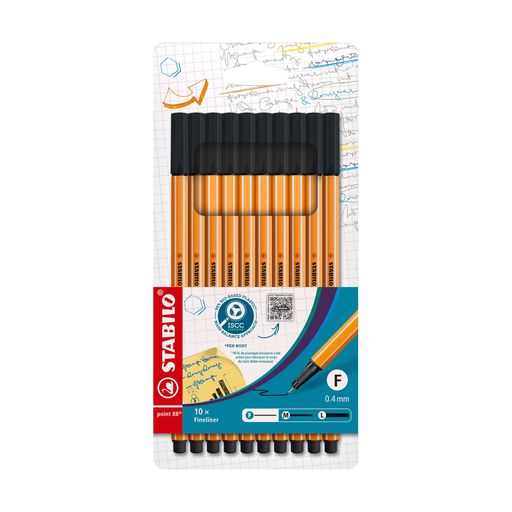
Why this choice suits this profile: This pack of 10 black pens is suitable for students and beginners in drawing, bullet journalling or structured note-taking, without requiring a large number of different products.
The 0.4 mm width is clearly specified and the nib, reinforced with a metal collar, is less likely to deform when drawing along a ruler.
0.4 mm fine nib, 10 black pens, with the bodies and caps made from 96 % bio-based plastic, according to the product information.
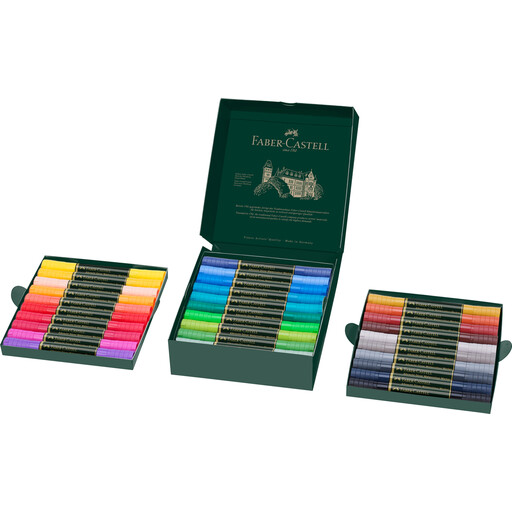
Why this choice suits this profile: Illustrators and watercolour enthusiasts get a well-organised set for sketching, painting and mixed-media projects.
The two nibs and water-soluble ink are clearly specified. You will not mistake it for an ordinary coloured pen without watercolour functionality.
30 markers, a flexible brush nib and a fine nib, with water-based ink described as highly pigmented and water-soluble.
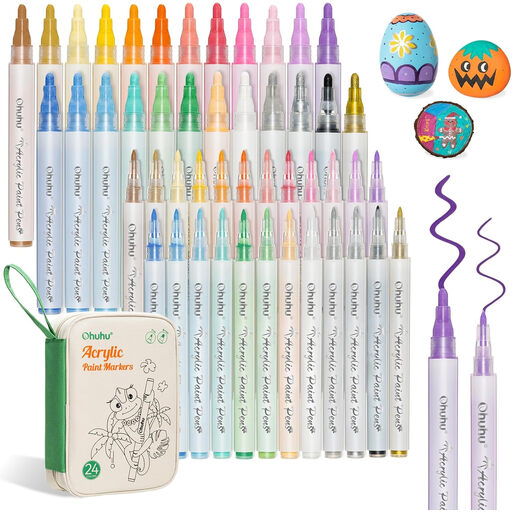
Why this choice suits this profile: This dual assortment is aimed at regular craft enthusiasts, personalising objects and projects that require several line formats.
The formats are detailed separately: 24 fine 0.7 mm nibs and 24 reversible round or chisel nibs. However, test the surface before use.
48 markers in 24 coordinated colours, water-based acrylic ink and stated compatibility with wood, glass, ceramics, stone, plastic and paper.
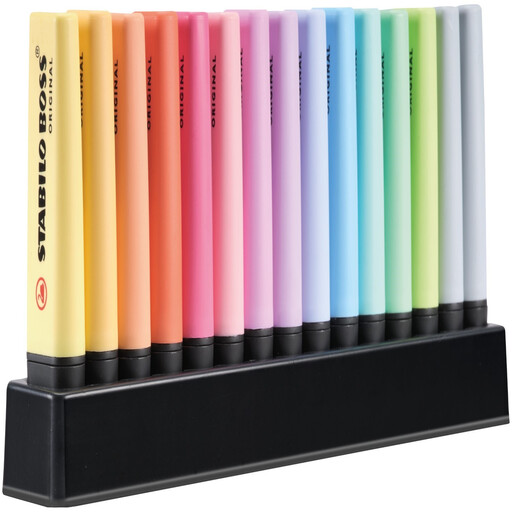
Why this choice suits this profile: Its pastel shades are ideal for revision notes, diaries, document organisation and subtle decoration.
The chisel nib offers two stated widths of 2 mm and 5 mm. This means you can underline finely or cover an entire line of text.
15 highlighters, transparent water-based ink, a stated anti-dry-out technology that works for up to 4 hours without a cap, and a stated writing capacity of up to 375 metres.
We have brought together a complete, real-time selection of products that meet these demanding criteria while complying with European safety regulations.
0.4 mm fine-nib pens are suitable for outlines, small annotations and regular writing. For headings and lettering, add brush pens. Pastel highlighters can complement the layout without completely obscuring the text.
It depends on the amount of ink applied and the paper weight. Test the pen on the notebook’s last page before you begin. To create water blends, thicker paper designed for wet techniques will help limit buckling.
Choose whiteboard markers or marker pencils specifically designed for non-porous surfaces. STABILO MARKdry, for example, is described as erasable with a dry or damp cloth, without solvents. Always check compatibility with your whiteboard before first use.