
Livraison le jour même ou le lendemain

Qualité garantie

Débloquez vos offres de bienvenue: Livraison GRATUITE | Jusqu'à -80 % | 30 jours d'essai gratuits à JoyPlus
Téléchargez l'application
A fast USB-C charger can power a smartphone, a tablet and sometimes even a laptop with just one adapter. But marketing claims like "ultra-fast charging", "65 W" or "compatible with all devices" aren't enough to make the right choice. The available power, charging protocols and included accessories vary significantly from one model to another.
Before you place your order, make sure you check these three points:
A 65 W fast charger doesn't necessarily deliver 65 W on each of its ports. On a multi-port model, the power is shared between two or three devices. The Baseus Small Cube Pro 2C+U 65 W, for example, claims up to 45 W + 20 W on its two USB-C ports. Its USB-A port can then change this distribution depending on the combination you use.
For a phone, 30 W is enough in most cases. For a MacBook Air or a USB-C-compatible laptop, 65 W gives you more headroom. Still, do check the power recommended by your device's manufacturer.
The term USB-C describes the connector, but not necessarily the charging speed. When you're choosing a charger for an iPhone, a charger for an iPad or a USB-C power adapter for a laptop, look for compatibility with Power Delivery, often shortened to PD.
A device only draws the power it can handle. So a more powerful charger won't necessarily speed up a smartphone that limits its own charging. Conversely, a model that's too weak may slow down the charging of a laptop.
Some adapters are sold without a cable. The Apple 35W Dual USB-C Port Power Adapter, for example, has two USB-C ports, but USB-C to USB-C or USB-C to Lightning cables are sold separately.
A charger with an integrated cable avoids this kind of oversight and reduces the number of accessories you need to carry. On the downside, if the cable gets damaged, replacing it is usually less straightforward than with a detachable cable. For an older iPhone or an iPad with a Lightning port, you'll always need a USB-C to Lightning cable.
Here are some practical benchmarks to compare against your devices' recommendations:
The total power stated doesn't guarantee the same charge on every port. Check the details for USB-C1, USB-C2 and USB-A outputs when they're available.
A multi-port USB-C charger is especially handy at the office, in the bedroom or when you're travelling. Two USB-C ports let you charge an iPhone and AirPods, or a phone and an iPad, for example. Four ports give you more options, but you still need to check the total power.
The PAVAREAL K10EU claims a total power of 30 W and can charge four devices at once. This setup may work well for several small devices, but it'll be less suitable for powering a demanding laptop while charging three other products.
GaN (gallium nitride) technology makes it possible to design compact chargers that can deliver high power. It's particularly useful when you're travelling or short on space, though it doesn't mean you can ignore the usage instructions or block the ventilation.
For France, choose a European plug that's compatible with your sockets. A charger that states an input of 110-240 V, 50/60 Hz can work with different voltages, but that doesn't replace checking the plug, the manual and the compliance information supplied with the product.

Why this choice suits this profile: With its 30 W and USB-A and USB-C ports, this charger covers the everyday needs of a phone, a tablet or accessories with different cables.
Having two types of ports means you don't have to buy a new accessory straight away if you still have a USB-A cable.
Stated power of 30 W and European plug. Check the power distribution before plugging in several devices at once.
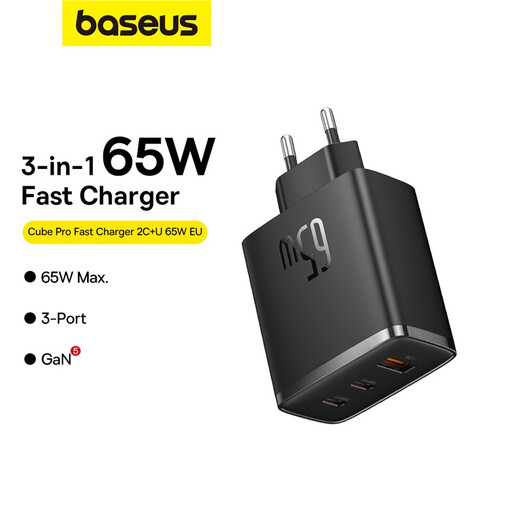
Why this choice suits this profile: Compact and featuring GaN technology, this charger is ideal for those who want to power several USB-C devices without being weighed down when travelling.
The output details let you anticipate the drop in power when the C1, C2 and USB-A ports are used at the same time.
Up to 65 W, GaN5 technology, two USB-C ports and one USB-A port. Output values vary depending on what's plugged in.
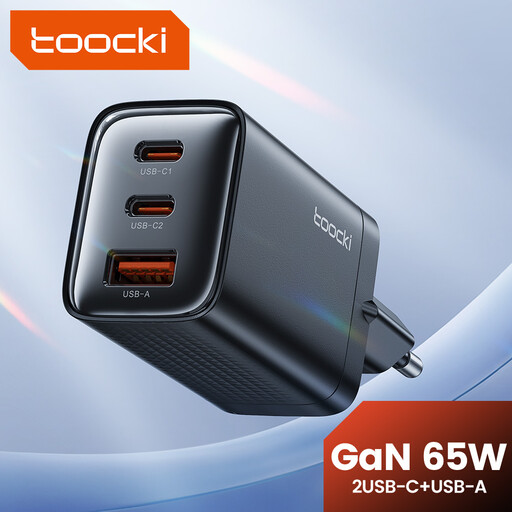
Why this choice suits this profile: With its stated 65 W, this model is aimed at users who regularly switch between a smartphone, a tablet and a USB-C laptop, at home or in the office.
Its three ports save you from having multiple plugs, but you need to check the power available depending on which combination of devices you're using.
Stated GaN technology, three ports and claimed compatibility with several families of laptops, phones and tablets.
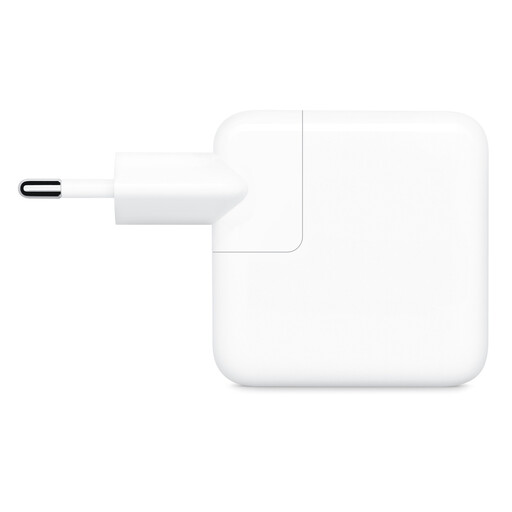
Why this choice suits this profile: Its two USB-C ports are well suited to mobile use with an iPhone, AirPods or an iPad, at home or in the office.
The presence of two ports is clearly stated, as is the fact that cables are sold separately. This way you avoid an unpleasant surprise when your order arrives.
Total stated power of 35 W, two USB-C outputs and a compact design. The power is shared between the connected devices.
We've put together a comprehensive list, updated in real time, of products that meet these demanding selection criteria and European safety requirements.
A 30 W model compatible with Power Delivery is generally suitable for charging compatible devices together, subject to the specific features of each model. Check the connector on your iPhone or iPad, then choose a suitable USB-C to USB-C or USB-C to Lightning cable.
No. The 65 W refers to the maximum power stated under certain conditions. The connected device negotiates the power it needs. Consumption also depends on the battery level, what you're doing with the device and how many devices are plugged in at the same time.
Use a cable in good condition, avoid moisture and extreme temperatures, don't cover the charger while it's running and unplug it during long periods of inactivity. If the casing, plug or cable shows any signs of warping or damage, stop using it and replace the affected part.