
Livraison le jour même ou le lendemain

Qualité garantie

Débloquez vos offres de bienvenue: Livraison GRATUITE | Jusqu'à -80 % | 30 jours d'essai gratuits à JoyPlus
Téléchargez l'application
Too slow, too bulky, or simply lost: the charger that originally came with your device often falls short. In the jungle of standards and power ratings, finding the perfect fast USB-C charger can be a real puzzle. Should you opt for a 30W, 45W, or even more powerful model? Is GaN technology just a marketing gimmick?
Don't worry, our guide is here to help you make sense of it all. We'll break down the technical jargon and present our selection of the best models to efficiently charge your smartphones, tablets, and laptops in 2026.
Before diving into our top picks, let's review the three key points to ensure you make the right choice.
Power, measured in watts (W), is the name of the game: it dictates the charging speed. But be aware, a 100W charger won't necessarily be faster for your smartphone than a 30W model. It's all about compatibility with your device's charging protocol.
Today, the standard that has become nearly universal is USB Power Delivery (PD). A Power Delivery charger communicates with your device (iPhone, Samsung, etc.) to deliver the perfect amount of power. The result is a charge that's both fast and completely safe.
Intrigued by the term "GaN charger"? Far from being a gimmick, it refers to the use of gallium nitride (GaN), a semiconductor material that replaces traditional silicon. In practical terms, chargers that use GaN are much smaller, lighter, and generate less heat at the same power output. This is a major advantage for anyone looking for a compact wall charger to slip into their bag for the office or on holiday.
A good charger isn't just fast; it must be safe above all. Ensure it includes protections against over-voltage, over-current, and overheating. The CE mark is essential, as it certifies the product's compliance with European standards. Don't overlook the cable, either: its quality is just as crucial. To harness the full power of your charger, you need a certified cable capable of handling the required current. Opting for a bundle that includes a charger with a suitable cable is often the simplest and safest solution.
Here are three options that meet different needs, selected for their performance, reliability, and convenience.
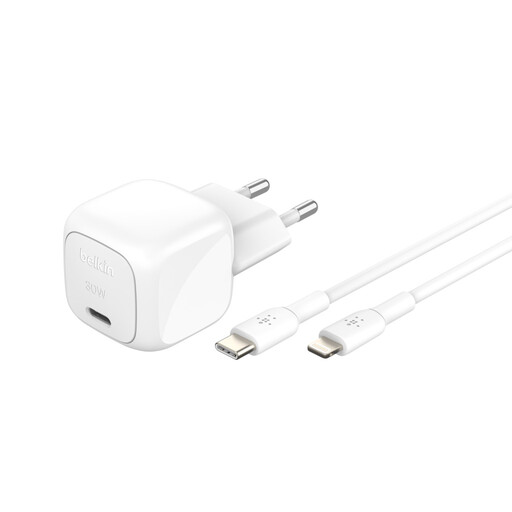
Why It Stands Out
This Belkin charger is a turnkey solution for users of Apple devices still equipped with a Lightning port. Its USB-C PD 3.1 certification ensures a fast and safe charge. According to the manufacturer, it can charge an iPhone 14 Pro from 0 to 50% in about 25 minutes. Its ultra-compact cube design is a major plus: it doesn't block adjacent outlets and is easy to carry.
Pros
Who Is It For?
Ideal for owners of iPhones (up to the 14 series) and iPads with a Lightning connector who are looking for a reliable, compact, and complete charging solution from a leading brand.
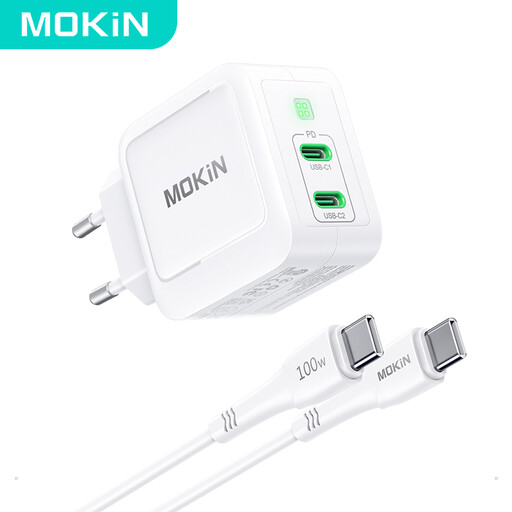
Why It Stands Out
This model focuses on power and versatility. With its 67W output and GaN technology, it can quickly charge a laptop like a MacBook Air, while being 50% smaller than an equivalent Apple charger. Its two USB-C ports allow you to charge two devices simultaneously, making it the perfect travel companion.
Pros
Who Is It For?
Perfect for digital nomads, whether professionals or students, who juggle multiple devices (laptop, smartphone, earbuds) and want a single, powerful, and compact USB-C power adapter to charge everything.
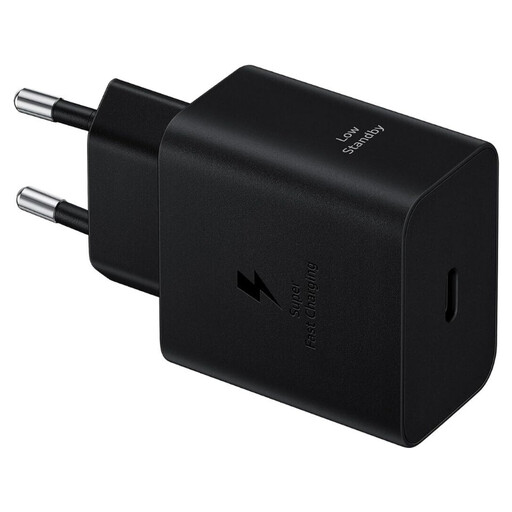
Why It Stands Out
This official Samsung adapter is designed to unlock the full potential of the "Super Fast Charging 2.0" technology on compatible Galaxy smartphones. It delivers 45W of power via the PPS (Programmable Power Supply) protocol, an extension of Power Delivery that adjusts voltage and current in real-time for an even more efficient and battery-friendly charge.
Pros
Who Is It For?
Essential for users of recent Samsung Galaxy smartphones (S, Note, Z series) who want the fastest possible charge with the peace of mind that comes from an official accessory.
This selection covers the most common needs. If you're looking for a model with more ports, a different power rating, or a specific design, feel free to browse our full catalogue.
? Explore Our Full Collection of Charging Adapters
Yes, it's completely safe. Thanks to the Power Delivery (PD) standard, the charger and the device communicate with each other. The charger will only deliver the maximum power that the device can accept. Using a 67W charger for a smartphone that only accepts 25W will not damage it; it will simply charge at 25W.
Gallium nitride (GaN) is a next-generation semiconductor that outperforms traditional silicon. For you, the benefit is direct: a compact wall charger that is lighter and generates less heat. It's a real advantage for high-power chargers (45W and up) and for frequent travellers.
While the USB-C connector has become universal, "fast charging" itself depends on various protocols. Most modern chargers use the USB Power Delivery (PD) standard, which is compatible with the majority of recent devices (Apple, Samsung, Google, etc.). However, some brands have their own proprietary technologies (like Samsung's "Super Fast Charging 2.0") that require a specific charger to deliver their full potential. A standard PD charger will still work, but it will cap the charging speed.