
Livraison le jour même ou le lendemain

Qualité garantie

Débloquez vos offres de bienvenue: Livraison GRATUITE | Jusqu'à -80 % | 30 jours d'essai gratuits à JoyPlus
Téléchargez l'application
USB-C has established itself as the universal connector for nearly all our devices, from smartphones to laptops. But while this standardisation is great news, it comes with a new challenge: how do you choose the right fast USB-C charger for your needs? Between the different wattages, technologies, and standards, it's easy to get lost.
Don't worry, this guide is here to break down the key criteria and help you find the reliable, high-performance charger that will power up your new iPhone 16, Samsung Galaxy S25, or even your MacBook Air.
Before we dive into our top picks, let's review the essential points to help you make the right choice.
Wattage, expressed in watts (W), dictates how fast your device will charge.
This is where Power Delivery (PD) technology comes in. This standard allows the charger and the device to "communicate" to adjust the power delivered to the optimal level, all in complete safety. It's a must-have: make sure your future USB-C power adapter is compatible.
Gallium nitride (GaN) is a next-generation semiconductor that is replacing silicon in modern chargers. A GaN charger offers two major advantages:
Are you constantly juggling your smartphone, headphones, and tablet? A dual USB-C charger is an excellent choice to lighten your bag. These models typically include an intelligent power distribution system that adjusts the energy sent to each port based on the needs of the connected devices.
Let's get to our top picks. We have selected three models that stand out for their reliability, performance, and value.
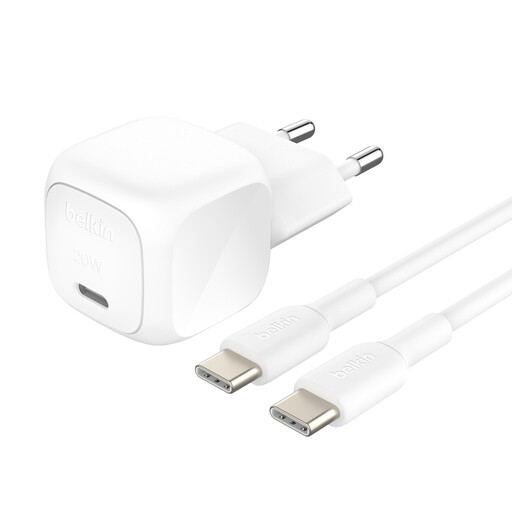
What sets it apart: This charger gets straight to the point: a simple and effective solution for everyday fast charging. Its 20W output, combined with Power Delivery technology, is perfectly calibrated for modern smartphones. It comes with a one-meter USB-C to USB-C cable, making it a ready-to-use bundle.
Highlights:
Who is it for? Ideal for those looking for a reliable primary or secondary charger for their smartphone. It's the smart choice to replace the missing charger in a new phone's box, or to finally upgrade from an old adapter.
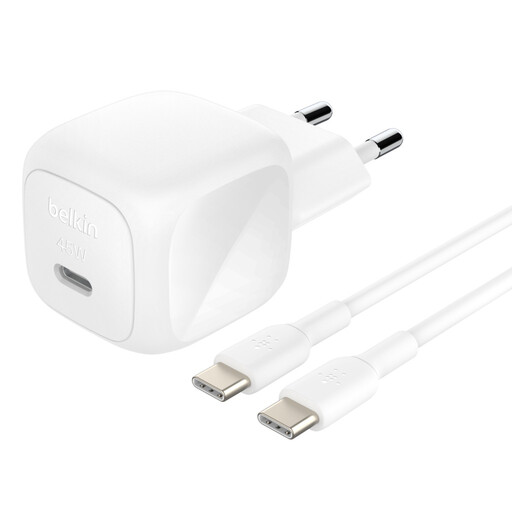
What sets it apart: With its 45W output, this charger takes versatility to the next level. It can quickly charge not only smartphones but also tablets and some ultra-portable laptops. It features USB-C PD 3.1 certification and the PPS (Programmable Power Supply) protocol, a duo that guarantees optimal fast charging, especially for the latest Samsung models.
Highlights:
Who is it for? For the user who juggles multiple devices (smartphone, tablet, ultra-portable) and wants a single, efficient charger to power everything. It's also a future-proof investment, ready for more power-hungry devices to come.
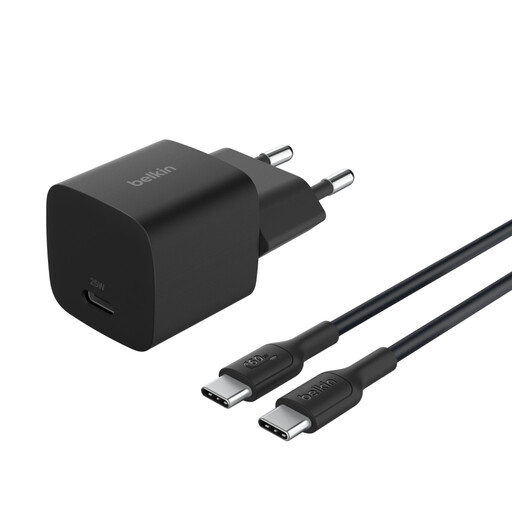
What sets it apart: This model combines the best of both worlds: 45W of power and the flexibility of a dual USB-C charger, all in an ultra-compact form factor thanks to GaN technology. It can deliver 45W to a single device or intelligently split the power (e.g., 25W + 20W) to charge two devices simultaneously.
Highlights:
Who is it for? The perfect companion for mobile professionals, couples, or anyone who wants to charge two devices at once without being weighed down by multiple adapters. Its compactness makes it a must-have for travelling light.
Even though USB-C is the new standard, many older accessories and devices still use USB-A ports. To bridge the gap between these two generations, a simple adapter is often the easiest and most cost-effective solution.
? Discover our selection of USB-C to USB-A adapters
To take advantage of fast charging on an iPhone 16, a charger of at least 20W is recommended. This is more than enough. Using a more powerful model (e.g., 45W) will not damage the phone, as it will only "draw" the power it needs. However, the speed gain beyond 20-25W will be marginal.
Yes, and it's far from a gimmick. GaN technology allows for the design of chargers that are much smaller, lighter, and generate less heat than their silicon counterparts. In practical terms, you get an accessory that is easier to carry and more energy-efficient.
Absolutely. That's the whole point of the USB-C Power Delivery (PD) standard. The charger and your device "talk" to each other to determine the ideal charging power. The charger will never deliver more power than your smartphone can safely accept. Therefore, using an overpowered charger is not at all dangerous for your battery.