
Livraison le jour même ou le lendemain

Qualité garantie

Débloquez vos offres de bienvenue: Livraison GRATUITE | Jusqu'à -80 % | 30 jours d'essai gratuits à JoyPlus
Téléchargez l'application
By the Joybuy expert teamPublished August 26, 2026
We've all felt it: the dread of a dead battery at the worst possible moment. Fortunately, the fast-charging power bank has become our best ally in avoiding disaster. The problem? The market is a jungle of models with often-vague marketing promises, making the decision a tough one. The gap between the capacity advertised on the box and real-world performance can be immense. Our mission: to help you decode the spec sheets and choose a power bank that will never let you down.
Before diving into the technical details, let's review the classic mistakes that turn a great deal into a disappointment.
To make the right choice, focus on this winning trio that defines the quality and utility of a portable battery.
Capacity (in mAh) is your energy tank: it dictates how many times you can bring your devices back to life.
Power (in Watts) is the engine: it dictates the charging speed. This is THE decisive criterion for a fast-charging power bank worthy of the name.
The number and type of ports will make your power bank either a Swiss Army knife or a headache. Today, a USB-C power bank is a must-have. It's used both to recharge the power bank itself (often very quickly) and to power your devices at full speed. Additional USB-A ports ensure compatibility with your older cables and devices.
For maximum convenience, a power bank with a built-in cable will save you from that fatal moment of forgetfulness. For dedicated Apple users, a MagSafe power bank or a Qi2-certified one offers the pinnacle of simplicity with its magnetic wireless charging.
It's no secret: weight is directly linked to capacity. A 20,000 mAh power bank typically weighs between 350 and 500 grams. A 10,000 mAh portable charger will be closer to 200-250 grams. Think about your use case: if you always carry a backpack, a heavier model won't be an issue. For light travel, a compact power bank is the way to go.
Here are a few gems that check all the boxes for different types of users.
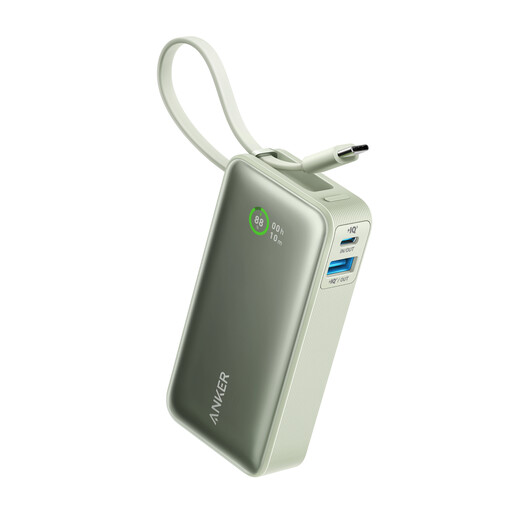
Why we picked it: Perfect for the daily commute, this portable battery offers the ideal balance of compactness and performance. Its built-in cable makes it ultra-practical and always ready to go, hassle-free.
It puts an end to the "false convenience" headache thanks to its integrated USB-C cable. No more forgotten cables at the bottom of your bag or impossible tangles!
Its bidirectional 30W charging via the built-in cable can juice up a smartphone in no time (0 to 50% in 30 min for an iPhone 14, according to Anker) and recharge the power bank itself at full speed.
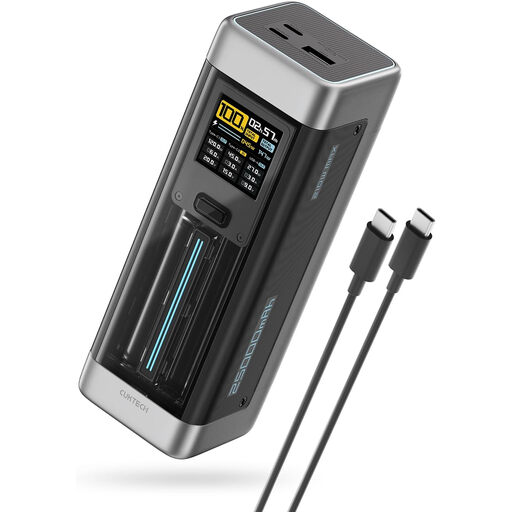
Why we picked it: Built for those who can't be without their laptop on the go. Its massive power and capacity let you work for hours, far from any outlet, powering a MacBook Pro or a compatible PC without breaking a sweat.
It shatters the ambiguous "fast charging" trap by delivering a massive 140W of power via the PD3.1 protocol—an unambiguous standard designed for the most demanding machines.
Its 25,000 mAh capacity and three ports allow you to charge a laptop, a smartphone, and earbuds simultaneously. The TFT screen displaying real-time charging stats is the little extra that will delight tech enthusiasts.
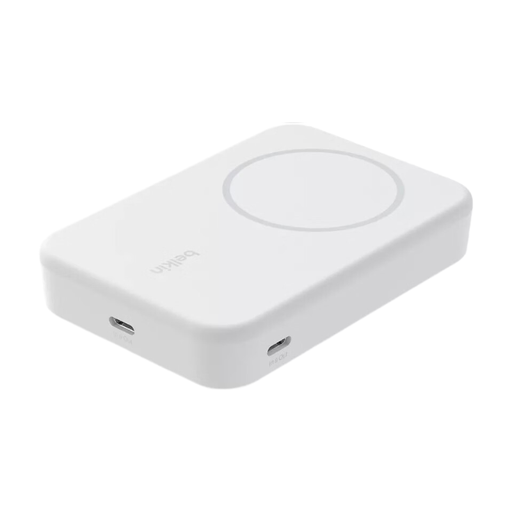
Why we picked it: The power bank designed for seamless integration with the iPhone. The magnetic alignment and fast wireless charging make the experience incredibly simple. The built-in kickstand is a real bonus for video calls or enjoying iOS's StandBy mode.
It avoids the pitfall of sluggish wireless charging. Thanks to its Qi2 certification, it delivers 15W of power—the same as Apple's official MagSafe technology—for wireless charging that's finally fast.
Its versatility: it can wirelessly charge an iPhone while powering another device (like AirPods) via its 20W USB-C port. The integrated kickstand is the icing on the cake.
We've curated a complete range of products for you that meet our performance criteria and European safety standards.
For daily use, to get through the day without stress, a capacity of 5,000 to 10,000 mAh is more than enough. It's the best balance of weight and size. For travel, weekends, or if you're juggling multiple devices (smartphone, tablet, earbuds), a capacity of 20,000 mAh or more is necessary.
No, as long as you choose a quality product. Modern power banks from reputable brands include multiple safety features (overcharge, overheat, short-circuit protection) to protect your precious device. The smart move: always opt for recognized brands that display the CE mark, a guarantee of compliance with European safety standards.
Yes, but strictly in your carry-on luggage. Airline regulations strictly prohibit lithium batteries in checked baggage. The authorized capacity limit is generally set at 100 watt-hours (Wh) per battery. Almost all power banks on the market, including 20,000 mAh (~74 Wh) and 25,000 mAh (~92.5 Wh) models, are well below this threshold and are therefore perfectly allowed on board.