
Livraison le jour même ou le lendemain

Qualité garantie

Débloquez vos offres de bienvenue: Livraison GRATUITE | Jusqu'à -80 % | 30 jours d'essai gratuits à JoyPlus
Téléchargez l'application
Battery dead when you're in a hurry? It's a nightmare we've all experienced. The market is flooded with options, but finding the right fast charger often feels like an uphill battle. Between marketing promises and opaque technical jargon, it's easy to make the wrong choice. Best case scenario, your device charges at a snail's pace; worst case, you could damage it.
As a product expert at Joybuy, my mission is to help you see things clearly. Let's cut through the technical jargon and get straight to the point: here are the pitfalls to avoid and the essential points to check before you pull out your credit card.
Charger marketing is a minefield. Here are the two most common traps that cause consumers to waste time and money.
To avoid these unpleasant surprises, focus on three features that make all the difference in performance and safety.
Wattage, measured in watts (W), determines how quickly energy is transferred to your device.
But the non-negotiable feature is compatibility with the Power Delivery (PD) charger standard. This universal standard, which uses the USB-C charger port, allows the charger and device to "talk" to each other to fine-tune the power output. It's your guarantee of a charge that is both fast and perfectly safe.
The era of the single-port charger is over. A multi-port charger is now a must-have for powering your smartphone, tablet, smartwatch, and computer.
A low-quality charger can overheat, short-circuit, and permanently damage the batteries of your valuable devices. Always insist on safety certifications like CE and RoHS, which ensure compliance with European standards. A good charger will always include protection against over-voltage, overheating, and short circuits.
To put theory into practice, here are a few models perfectly suited to specific needs.
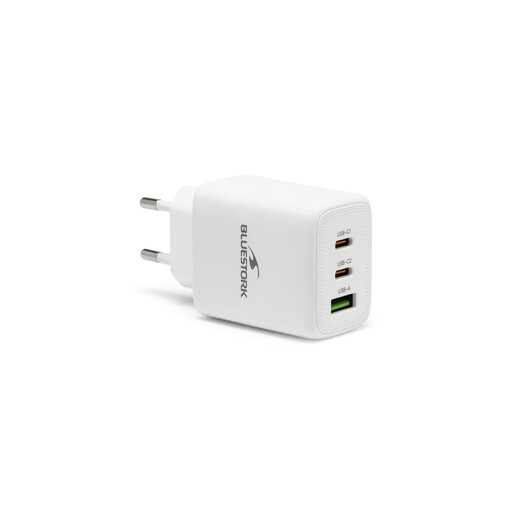
Why it's the perfect match: Ideal for digital nomads juggling a laptop and a smartphone. Its 65W output is powerful enough to charge a laptop while still having enough juice for a phone, all in an ultra-compact design.
This model bypasses the shared-power trap by delivering up to 65W from a single USB-C port, enough to charge a laptop at full speed. It supports PD 3.0 and QC 3.0 protocols for maximum compatibility.
It comes with a fast-charging cable, so it's ready to use out of the box. The inclusion of a USB-A port alongside the USB-C port offers welcome versatility for older accessories.
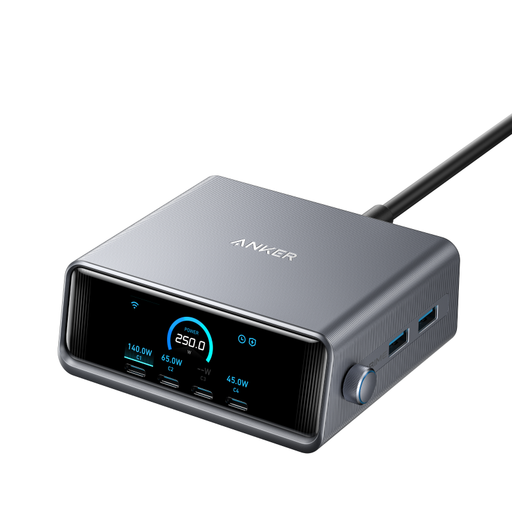
Why it's the perfect match: Designed for those who juggle a complete ecosystem (two laptops, a tablet, a smartphone...). This charging station brings order to even the most cluttered desks.
With 250W of total power and smart distribution, it makes no compromises. The LCD screen displays the power allocated to each port in real-time, offering total transparency and eliminating any doubt about charging speeds.
The ability to charge up to 6 devices simultaneously, including two laptops at high speed (up to 140W on a single port!). GaN technology ensures flawless thermal management despite this sheer amount of power.
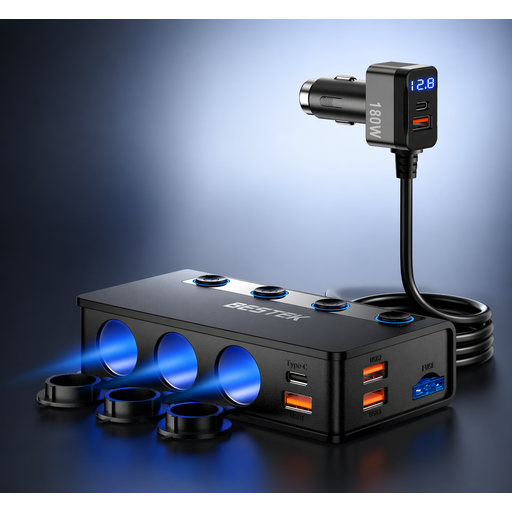
Why it's the perfect match: Essential for families or professionals on the road who need to power an army of devices in the car: phones, GPS, tablets for passengers, and even a portable cooler.
Much more than a simple cigarette lighter splitter, this car charger integrates dedicated fast-charging ports (65W PD and QC3.0). This ensures that even the most power-hungry devices get a full charge quickly, without overloading the car's electrical system.
A colossal 180W of power, 6 fast USB ports, and 3 cigarette lighter sockets. The independent switches for each socket provide total control and enhance safety.
Explore our full selection of products that meet our demanding criteria and French safety standards.
Absolutely not. A certified charger with Power Delivery (PD) technology will communicate with your phone to deliver only the maximum power it can safely accept. Using a more powerful charger poses no risk; on the contrary, it's an advantage that gives you the versatility to charge more demanding devices, like a laptop.
The USB-C port is the modern standard: it's smaller, reversible (you can plug it in either way), and, most importantly, much more powerful. It's what enables ultra-fast charging via the Power Delivery standard, which is essential for modern devices. USB-A is the older connector, which is larger and far more limited in both power and speed.
For anyone looking for compactness and efficiency, the answer is a resounding yes. A GaN charger delivers the same power as a traditional model in a package that's up to 50% smaller and lighter. It also runs much cooler, which is a real bonus for the longevity of the charger and your devices. It's a very smart investment for travellers or anyone looking to lighten their bag.