
Livraison le jour même ou le lendemain

Qualité garantie

Débloquez vos offres de bienvenue: Livraison GRATUITE | Jusqu'à -80 % | 30 jours d'essai gratuits à JoyPlus
Téléchargez l'application
So, you've splurged on a new smartphone. The problem? It's fast-charge compatible, but the charger itself is missing in action. You're now facing a jungle of options and technical terms: wattage, USB-PD, GaN, QC 4.0... It's easy to get lost and, more often than not, make the wrong choice.
An unsuitable charger not only risks recharging your devices at a disappointing speed but can also, in some cases, prematurely wear out their batteries. To help you see things more clearly and make a smart investment, we've broken down the pitfalls to avoid and the essential criteria to check before choosing your next fast charger.
Marketing can often be misleading. Here are three common mistakes that cost time and money.
To avoid making another mistake, master these three fundamental parameters.
Power, expressed in watts (W), determines the charging speed. Each device has its own needs:
The protocol is just as crucial. The USB Power Delivery (PD) standard is now the most universal. It's used by iPhones, Google Pixels, recent Samsung models, and nearly all laptops that charge via a USB-C charger. The Quick Charge (QC) protocol remains common on many Android devices. The rule of thumb: always check the protocol supported by your device.
If you see the term GaN charger, it's an excellent sign. This technology replaces traditional silicon with gallium nitride, a much more efficient semiconductor. The tangible benefits for you are clear:
This technology is particularly valuable for a multi-port charger or a high-power model.
Here, it all depends on your habits.
Rather than a simple product list, we've matched charging solutions to user profiles to help you find the one that truly fits your daily life.
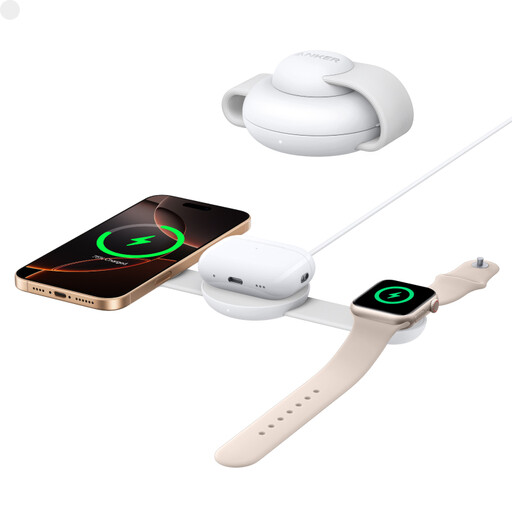
Why this choice? Ideal for travellers and remote workers in the Apple ecosystem. Its ultra-compact, foldable design slips into any bag and replaces three separate chargers and cables (iPhone, Apple Watch, AirPods).
No more headaches over cables and compatibility. This all-in-one station is optimised for Apple devices, with Qi2-certified 15W fast charging and MagSafe charger compatibility.
Its ultra-portable foldable design and simultaneous charging for 3 devices. Bonus: the 40W power adapter and cable are included.
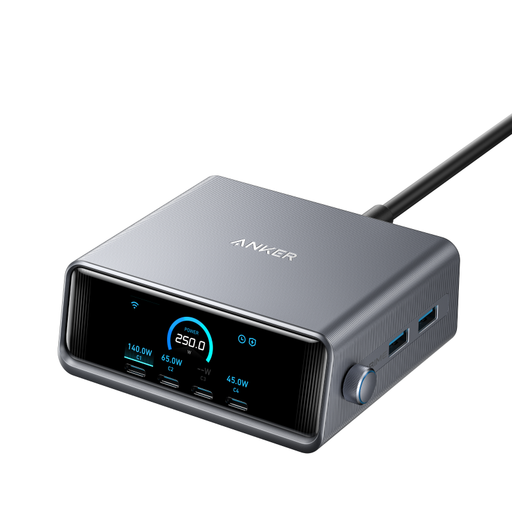
Why this choice? For those who constantly juggle a laptop, smartphone, tablet, and other gadgets. This desktop station centralises everything with a colossal 250W of power.
It obliterates the problem of collapsing shared power. With 250W total and smart distribution, it can charge multiple power-hungry devices simultaneously without compromising on speed.
A total output of 250W, 6 ports (4 USB-C, 2 USB-A), and an LCD screen to view power distribution in real-time. Total control.
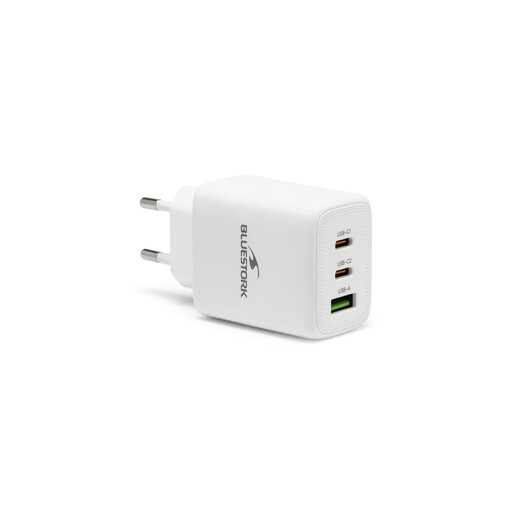
Why this choice? The perfectly balanced solution for charging a laptop (like a MacBook Air or Dell XPS 13) and a smartphone. Its 65W power is the ideal compromise for versatile use.
It avoids the trap of the "fast" but underpowered charger. With 65W and the PD 3.0 protocol, it ensures ample power for most recent ultrabooks, while retaining a USB-A port for older devices.
An excellent power-to-price ratio, a dual USB-C (PD) and USB-A (QC) port for maximum compatibility, and the fast-charging cable included in the box.
Discover our complete selection of products that meet our performance criteria and European safety standards.
It all depends on your most power-hungry device. For a smartphone alone, 25W to 30W is sufficient. For a laptop, aim for at least 65W. If you want to charge multiple devices at once, including a computer, a 100W station or more is a comfortable choice. The golden rule: always read your device's technical specifications to know the maximum power it can accept.
Yes, without a doubt. For the same power output, a GaN charger will always be more compact, lighter, and generate less heat than a traditional silicon model. This superior efficiency makes it the best choice, especially for powerful chargers or travel models where every gram counts.
Technically, yes, but you won't necessarily get the maximum speed. For truly fast charging, the charger and the device must "speak the same language"—that is, share a common protocol (USB-PD or QC). A modern USB-PD charger will work with almost any device, but the speed will be limited if the protocol isn't recognised or if the power is too low. Checking for compatibility remains the key.